

In an era where art is increasingly mediated through screens, Perceptrum proposes something radically simple, and quietly revolutionary: touch the painting.
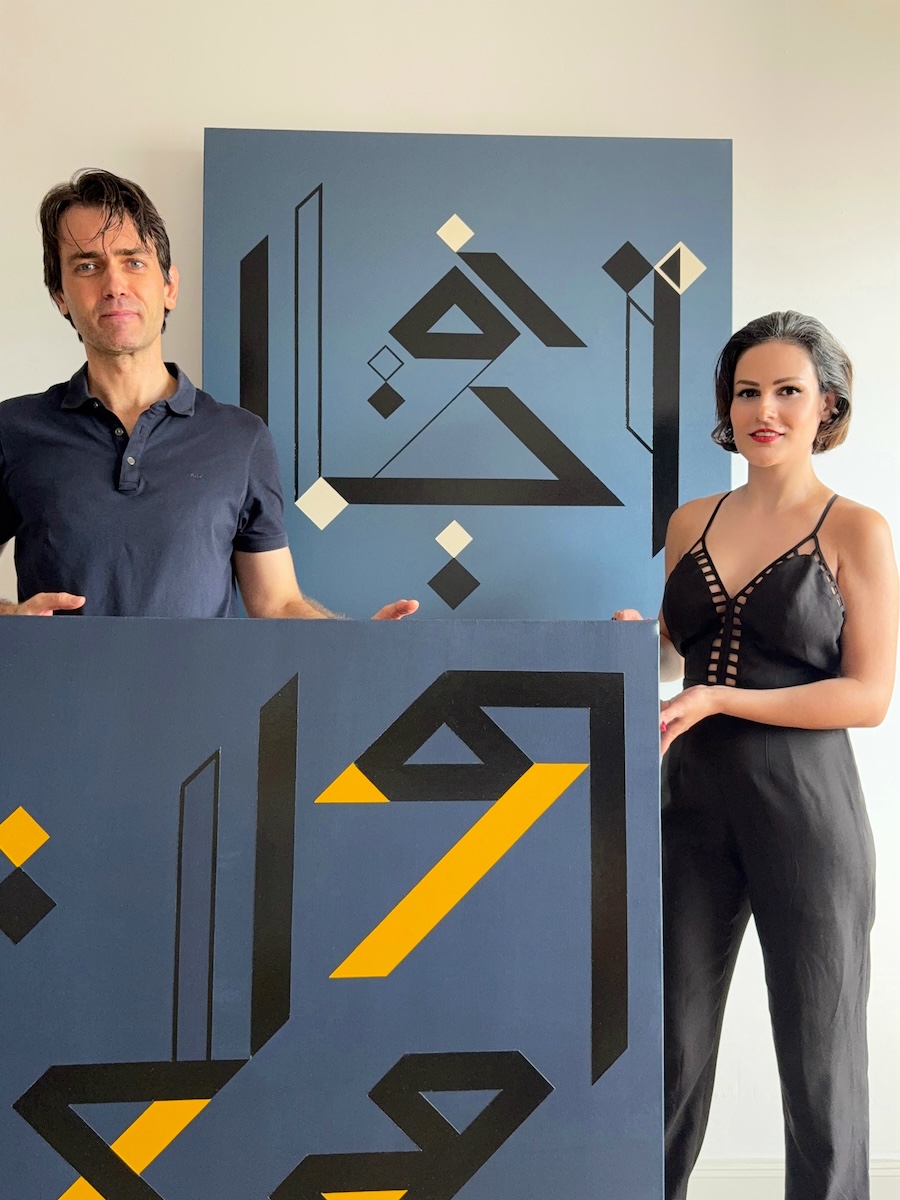
Not as an act of transgression, but as an act of communication. Founded by visual artist Dora Motèque and sound researcher Luciano Ciamarone, Perceptrum operates at the intersection of visual art, sound, and philosophy, yet resists being fully contained by any of these disciplines. Their central work, the Sounding Canvas, is not merely an innovation in interactive art; it is a redefinition of what painting is, and more importantly, what it can become.
When you encounter one of these paintings, you are immediately drawn into a sensory dialogue, where the boundary between observer and artwork dissolves, and every touch releases a subtle, evolving soundscape that feels at once intimate, unpredictable, and deeply alive.
At its core, the project asks a deceptively simple question:
What if a painting could respond?
Origins: A Childhood Intuition Becomes a System
The conceptual seed of the Sounding Canvas does not begin in a lab or studio, but in a childhood perception.
Dora Motèque recalls sensing that objects, broken toys, abandoned furniture, carried a kind of latent presence. Not metaphorically, but relationally. They could be “cared for,” even comforted, through attention. This intuition, once poetic, has now become structural: a philosophical foundation for a body of work that treats artworks not as inert objects, but as entities capable of dialogue.
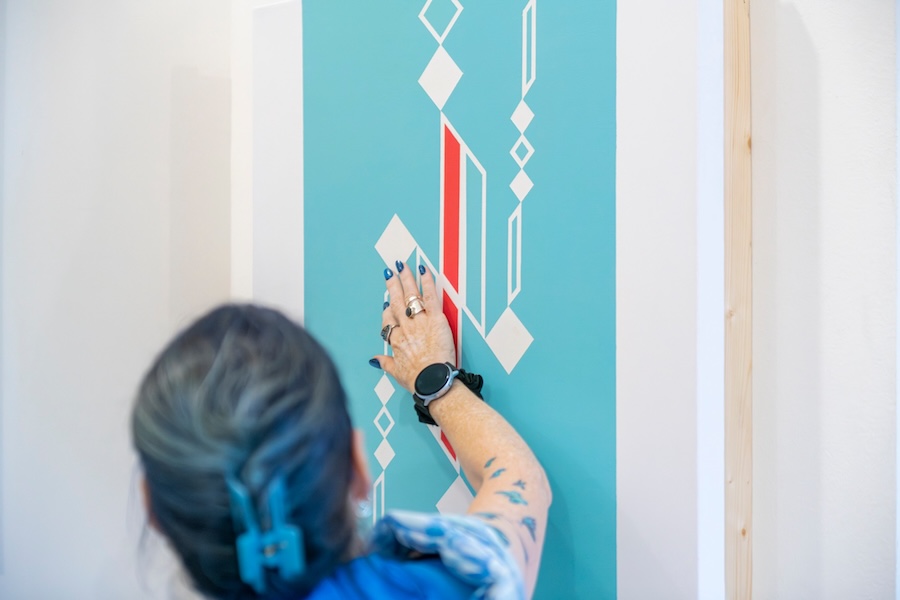
In traditional gallery culture, the relationship between viewer and artwork is governed by distance. The rule is clear: do not touch. Perceptrum reverses this entirely. Touch is not only allowed, but it is also required.
From this inversion emerges the Sounding Canvas: a painted surface that responds to physical contact with sound, transforming observation into interaction, and interaction into meaning.
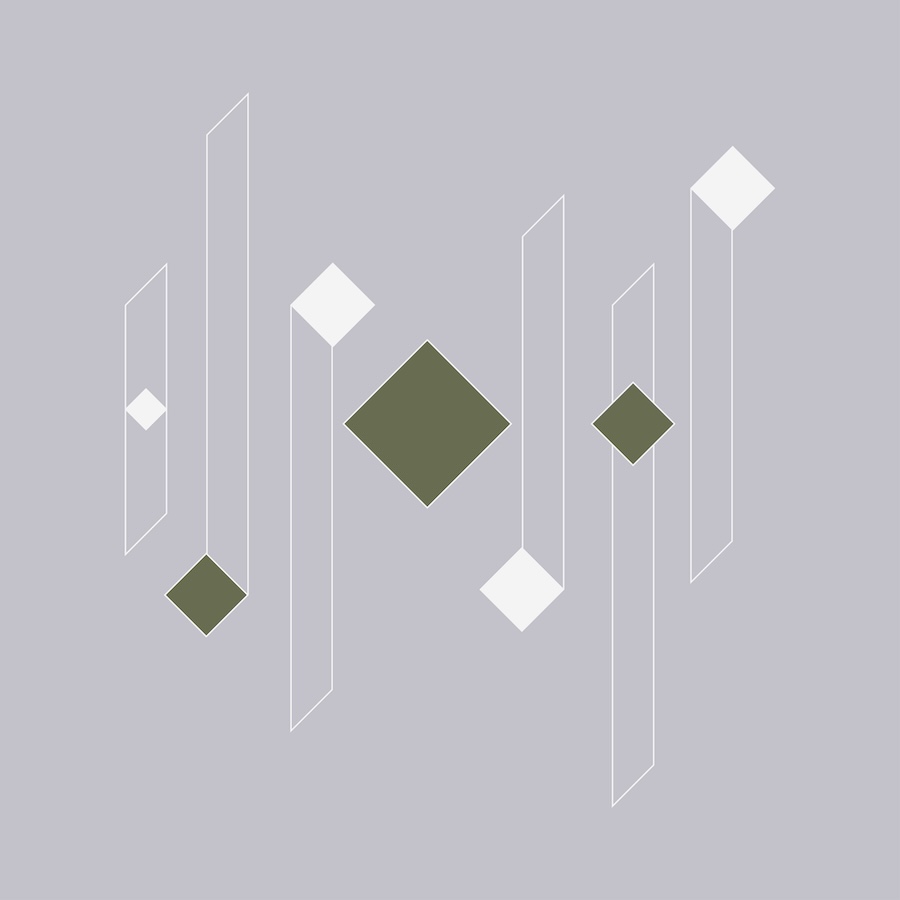
Visually, the works draw from Motèque’s semiographic research, an intricate language where forms inspired by Persian calligraphy intersect with musical notation. These surfaces are not decorative; they are interfaces, designed to be read through the body rather than the eye alone.
A Convergence of Disciplines
The collaboration between Motèque and Ciamarone is a convergence of parallel inquiries.
Motèque’s background in industrial engineering and scenography centres on spatial perception and the emotional relationship between humans and objects. Ciamarone, trained in physics and music technology, explores how sound can be generated, shaped, and spatialized through gesture.
Where one investigates presence, the other investigates response.
The Sounding Canvas emerges precisely at this intersection: a system where visual language and sonic behaviour are inseparable. Technology, however, is deliberately concealed. It does not present itself as spectacle, but as infrastructure, an invisible nervous system that allows the painting to react in real time.
Importantly, Perceptrum insists that this is not about “adding sound” to painting. Rather, it is about transforming painting into a responsive medium.
Augmented Painting: A New Ontology
Perceptrum describes their work through the term Augmented Painting, not as a technical upgrade, but as a philosophical repositioning.
Historically, painting has occupied two primary roles:
A static object to be contemplated
An immersive environment in which the viewer is absorbed
Augmented Painting proposes a third condition:
A relational surface that mediates between image, body, and sound.
In this framework, the painting is no longer passive. It listens. It remembers. It responds.
Each interaction leaves a trace, which the artists describe as a kind of “sonic memory.” The canvas evolves, shaped by the gestures of its viewers. A gentle touch produces one response; a forceful interaction produces another. Over time, the painting develops something akin to a mood, an emergent behavioural identity formed through cumulative encounters.
This introduces a subtle but profound shift: the artwork is no longer complete in itself.
It exists only in relation.
Agency, Memory, and the Living Artwork
To speak of a painting that “remembers” or “responds” risks anthropomorphism, yet Perceptrum embraces this language carefully. The Sounding Canvas operates through complex systems and AI-driven models, but its behaviour is not deterministic. Nor is it random.
Instead, it occupies a space of emergence.
Each canvas develops its own sonic personality, shaped both by its visual design and by its history of interaction. Two identical gestures on two different canvases will produce different outcomes. Even more, the same gesture on the same canvas may yield different responses depending on its “memory” of previous encounters.
The result is an artwork that behaves less like an object and more like a presence. A presence that requires care.
Touch as Knowledge
Perhaps the most radical aspect of Perceptrum’s work lies in its epistemology:
touch becomes a form of knowledge.
In traditional painting, perception is optical. Meaning is derived through sight, interpretation, and context. In immersive art, the body is often enveloped, but still largely passive.
The Sounding Canvas introduces a different model.
Here, understanding is enacted.
Interpretation is physical.
Meaning is negotiated through contact.
This shift transforms the viewer into a participant and participation into responsibility. Every gesture alters the work, not only for oneself, but for future viewers. The painting becomes a shared, evolving archive of touch.
In this sense, Perceptrum’s work aligns with relational aesthetics, but extends it beyond human-to human interaction into a triangular dynamic:
Human ↔ Object ↔ Human
A Networked Sensibility
The relational dimension of the Sounding Canvas expands further through its networked capabilities.
Multiple canvases can be connected across geographic distance, forming a distributed auditory system. A touch in one location can trigger a sonic response in another, creating what the artists describe as a “remote caress.”
This dissolves the boundaries of space.
The artwork becomes simultaneously local and global.
In such configurations, interaction is no longer isolated. It becomes collective, an unfolding composition shaped by multiple bodies across multiple locations. The painting becomes a bridge, not only between senses, but between people.
Between Instrument and Artwork
Is the Sounding Canvas a musical instrument? A painting? An installation?
Perceptrum resists categorisation.
Unlike an instrument, it does not require mastery. There is no correct way to interact. Unlike a traditional artwork, it cannot exist without participation.
Instead, it occupies a third category: a relational object that mediates intimacy.
The sounds it produces are not performances, but responses, expressions of a dialogue between human presence and material system.
A Cultural and Historical Positioning
Perceptrum situates its work within a lineage that spans from John Cage’s indeterminacy to Joseph Beuys’ concept of social sculpture, while also engaging with cybernetic and telematic art.
Yet, their contribution is distinct.
Where earlier interactive systems often emphasised mechanism, Perceptrum introduces empathy as a structural component. Technology becomes a sensitive interface rather than a dominant force.
This positions Augmented Painting within what might be described as a broader “haptic turn” in contemporary art, a return to the body as a site of knowledge in a post-digital world.
Toward a Future of Relational Art
Looking forward, Perceptrum envisions networks of Sounding Canvases distributed across cities, interactive ecosystems where gestures ripple across distance, shaping shared sonic environments.
Beyond galleries, the work suggests applications in hospitals, schools, and public spaces, contexts where touch, care, and non-verbal communication can foster connection.
In these scenarios, the artwork becomes more than an aesthetic object.
It becomes a social interface.
A tool for empathy.
The Ethics of Perception
Ultimately, the Sounding Canvas reveals something fundamental about human communication. That is it:
Reciprocal
Embodied
Cumulative
To engage with the work is to recognise that perception is not passive. It is an active, ethical act. Every gesture carries a consequence. Every interaction leaves a trace.
In a culture dominated by speed and distance, Perceptrum proposes a slower, more attentive mode of being:
To touch.
To listen.
To respond.
And in doing so, to rediscover the possibility that art is not something we look at, but something we enter into a relationship with.
