

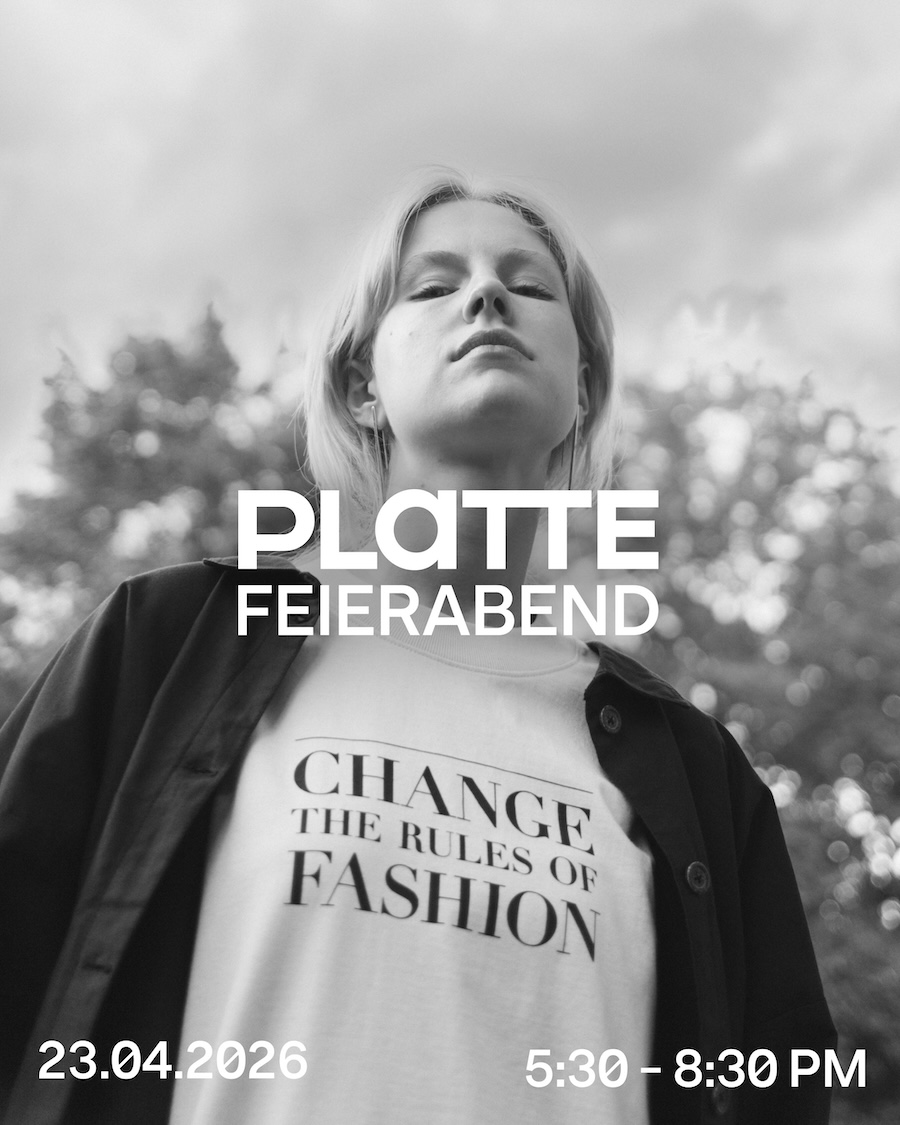
As part of Fashion Revolution Week, this month’s Feierabend at PLATTE highlights Designer Natascha von Hirschhausen, whose work has long been driven by a commitment to resource-efficient design and fair production. The evening will feature a performance and sounds by Phyllis Josefine, aka dvdv.
Model @rike.pelz, Photographer @holger.nitschke
From 5:30 PM, Denisse Beltran is going to serve soft tacos. Supported by BRLO.
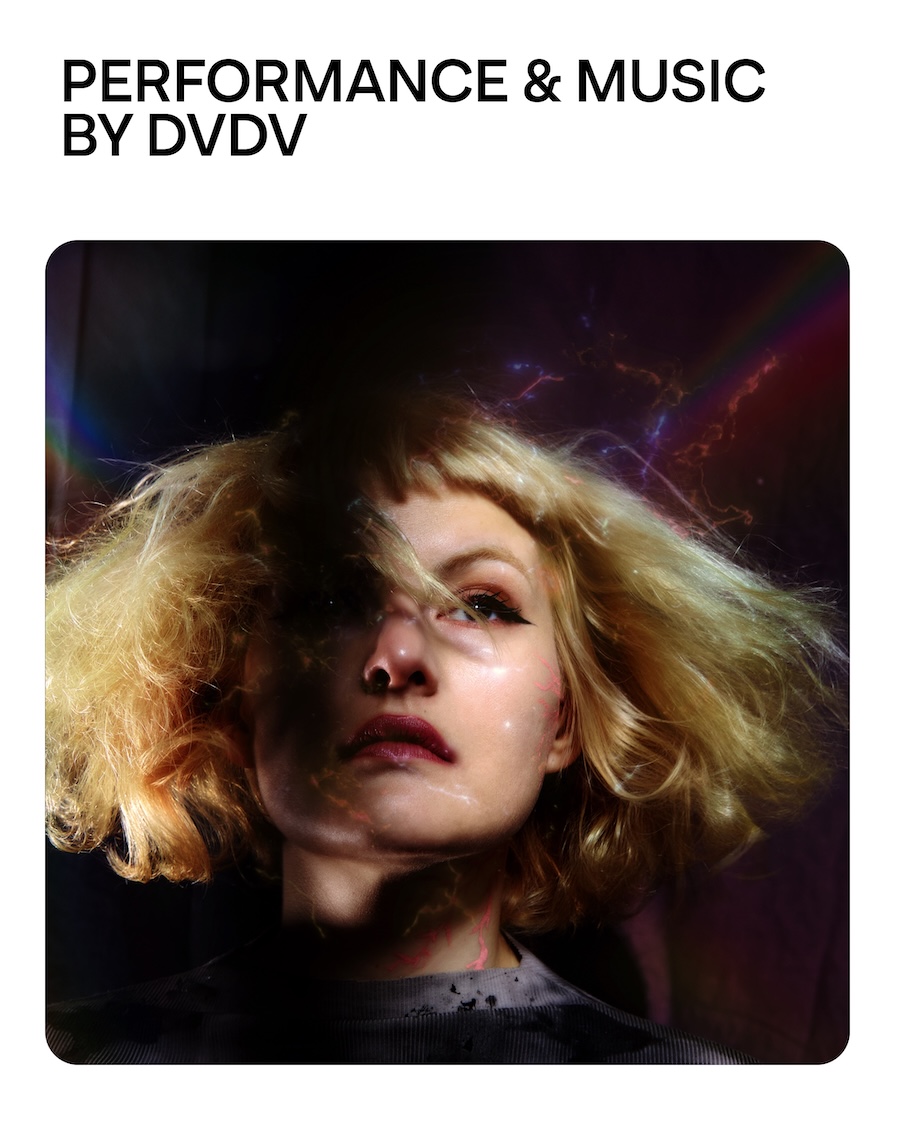
Artist @dvvvdvvv, Photographer @yukokotetsu
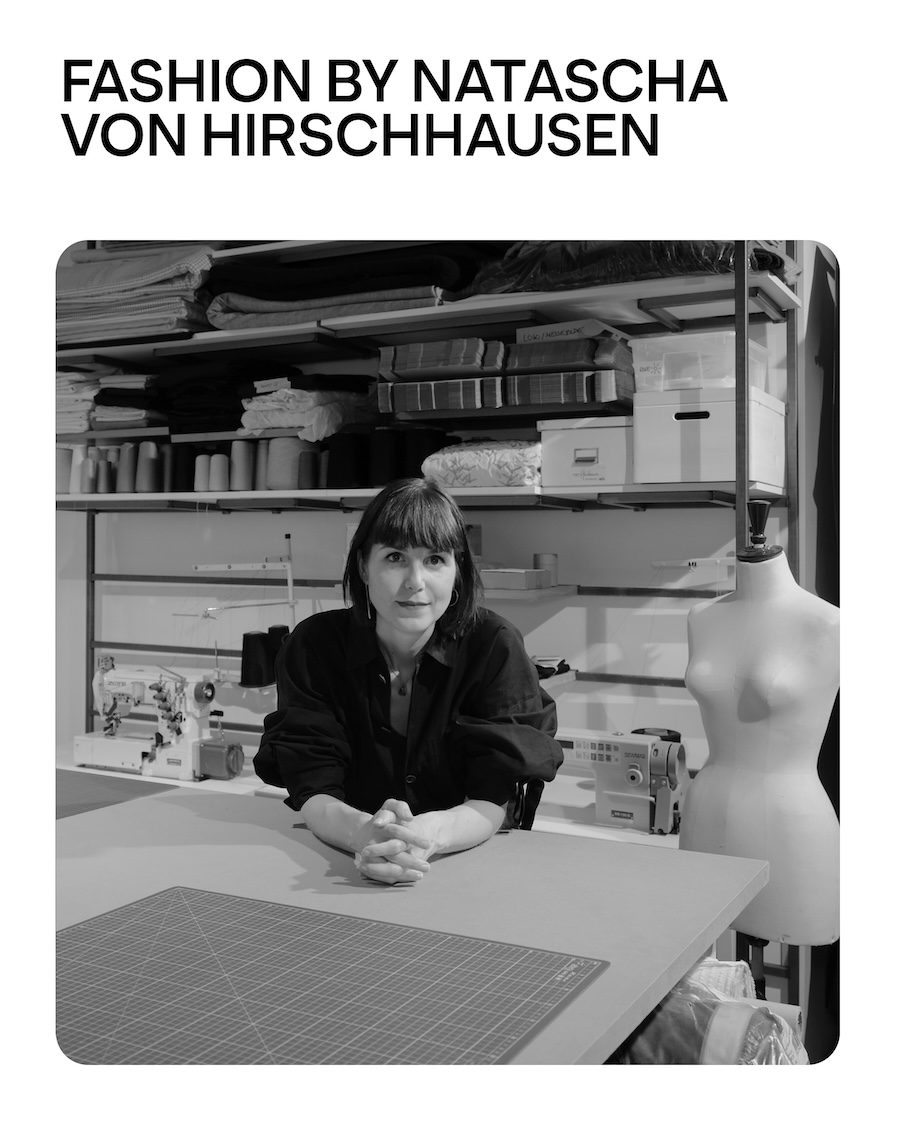
It was fate when Natascha von Hirschhausen first bought her sewing machine over 15 years ago. Since then, she has completed her studies in fashion design and started her own label, operating out of Berlin. Central to her work is a zero-waste concept in which she reduces pattern cut-offs to less than 1% and operates on a made-to-order basis, working with local artisans to help her produce her clothing. In an interview with us, she speaks about her design philosophy and why zero-waste is not the non plus ultra of sustainability.
PLATTE: How did you first get into design?
NATASCHA VON HIRSCHHAUSEN: Many people have this story about always wanting to be a designer, but that wasn’t the case for me. I was 19 and studying physics when I bought a sewing machine, and I never got up again. I realised that this was what I really wanted to do, and then I moved to Berlin.
PLATTE: Do you think that bit of physics you studied helps you in your work?
NATASCHA: I only studied physics for a year. It wasn’t very intense, but what I do have is an interest in analytical thinking. I’m not afraid of numbers and math. That helps because I have a very technical approach with my zero-waste cuts. It has a lot to do with three-dimensional thinking, but also with math, numbers and cutting. I think it goes hand in hand, more than you might expect.
PLATTE: And where did you study fashion design?
NATASCHA: I did my MA at Weißensee in 2015 and then finished the Master Craftsman School in 2016. After that, I started my own label right away. I had created the collection, and several tutors advised me to do my own label.
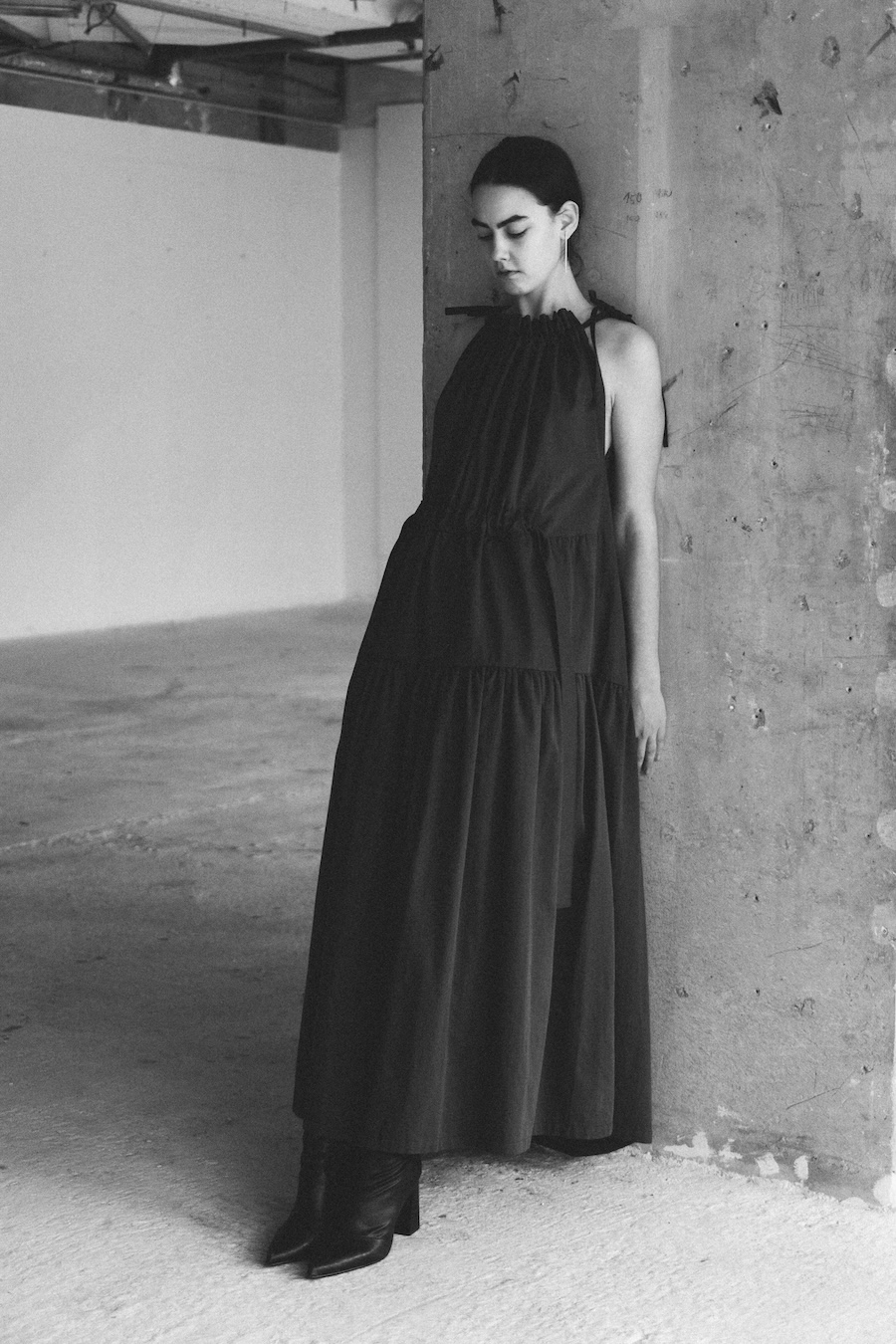
Model @johanna.brgr, photo @holger.nitschke
PLATTE: Was it ever an option to work for a different brand?
NATASCHA I think it all has pros and cons, but it was a conscious decision to give myself time to grow. I studied fashion design, and suddenly had to run a business. I found that very challenging, and it takes a while to get into it. I lacked certain contacts, certain experiences. I had to build it up step by step.
PLATTE: Why is a zero-waste approach so important to you in your work?
NATASCHA: Before I started my label, I had been working on sustainability for a long time. But the topic of waste really came to me in 2014, when I was in Bangladesh. I still try to find the right words for it, because I look at it from a very Western point of view, but it really felt like the whole country was drowning in our textile waste. A lot of the problems in the textile industry have to do with waste, and it’s a sign that we don’t value the resources we use enough. It’s a sign that we don’t value the work that goes into creating and processing these materials. For example, 20% of the cut-off material is simply thrown away. Sometimes they are recycled, but rarely. Those are resources for 30 to 40 billion pieces of clothing a year. To me, this is a fundamental design mistake, and I wanted to solve it.
PLATTE: You were awarded the German Federal Ecodesign Award for your Zero-Waste and Sustainability concept. Would you say that is the most important aspect in your work?
NATASCHA: It’s hard to say one thing is the most important, but if I had to name one thing, it would actually be the design. The key to sustainability is design. No matter how clothing is produced, if it’s not worn, it’s not a sustainable piece of clothing.
That’s why I only make pieces with a lot of different aspects in mind. I want them to be versatile, but also size-fluent. Bodies change over time, and that shouldn’t mean you can’t wear your favourite pair of pants anymore. Many of my pieces can also be worn differently, so you discover them over and over again. I always want the clothes to be there for the body and not the body for the clothes.
Visually, I also get inspired by architecture and product design, but it’s not like… many designers work with one specific reference in mind for a certain collection. It doesn’t work like that for me because I just have one collection that develops with every piece I make.
PLATTE: What is the kind of feedback do you hear from your customers about the clothes?
NATASCHA: My customers really enjoy my trousers. One person came into my store and bought the same pair she already had. I asked her if she had lost them or needed us to repair them, but she just said she didn’t have anything else to wear when those trousers were in the wash, so she wanted a second pair.
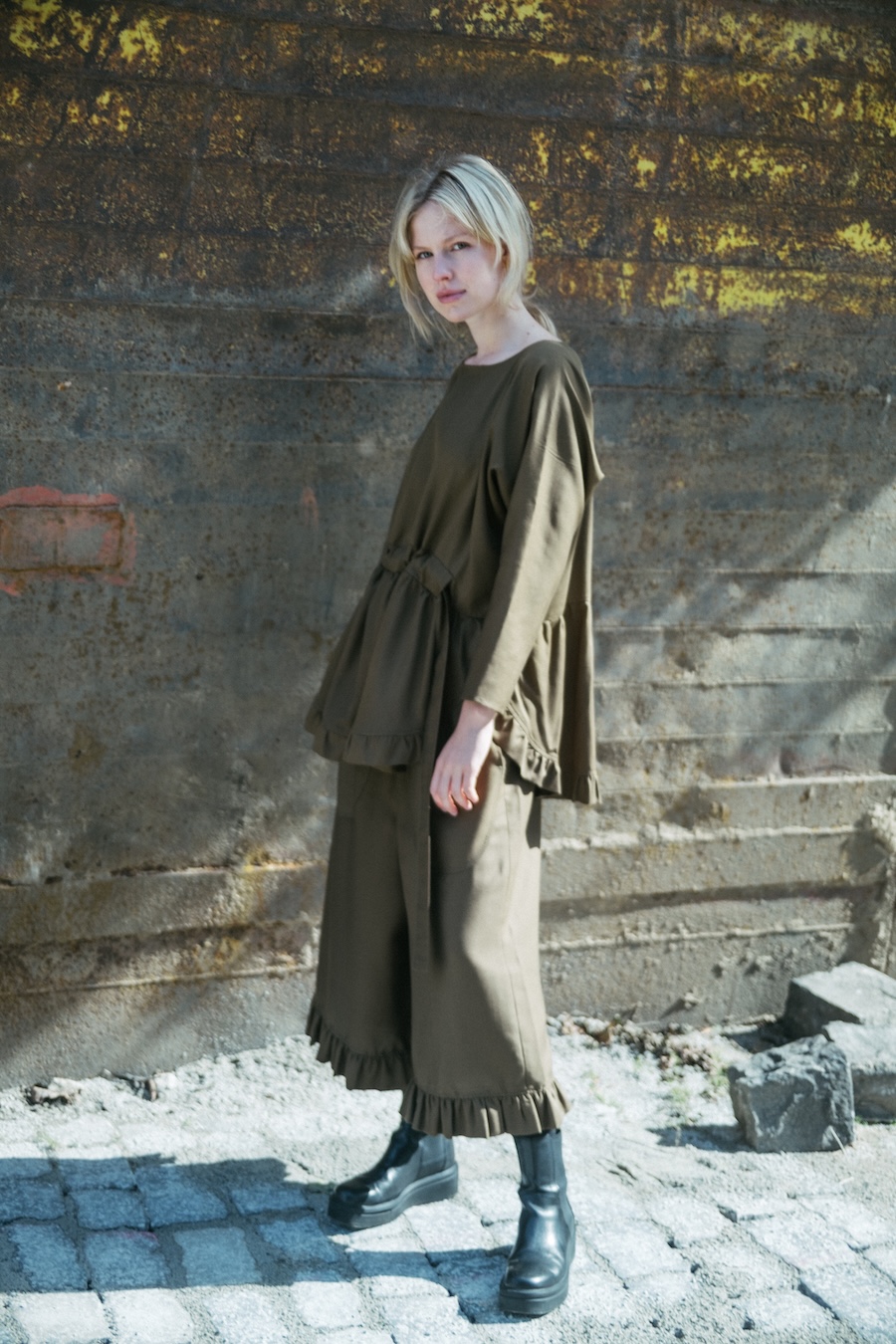
Model @rike.pelz, Photographer @holger.nitschke
PLATTE: So the trousers are a crowdpleaser?
NATASCHA: It really shows what I’m trying to do, though! One pair of favourite trousers that you just never want to let go of because you are well-dressed, but they’re also incredibly comfortable, like jogging pants. They work for all kinds of events that happen over the course of the day, though.
What I also remember is one of my regular customers coming in and saying, “Do you actually know why I came in?” and I asked, “No, why did you come in?” and he told me it was because my pieces reminded him of Yohji Yamamoto. It was really crazy because I don’t think that influence is visible in clothes at all, but I think the fundamental feeling of the brand shares a similarity. And he felt that, too, and I thought that was an amazing compliment.
PLATTE: Is Yohji also one of your design role models, then?
NATASCHA: In the way he thinks and speaks about fashion, definitely.
PLATTE: You produce regionally, which is, of course, exemplary, but tell me a little about the challenges that come with it?
NATASCHA: We have a small core collection that is pre-produced in small quantities, and for that, I outsource. Everything else is made-to-order. Made-to-order models are incredibly important; a lot of the waste production in the textile industry is related to overproduction. But it’s also a price driver because you don’t have this cost-proportionalization, and it takes a lot longer. Making ten pants at once is just much more efficient than individual production. It becomes difficult to keep the craft and production alive in Germany, but I think it’s really important to make that effort.
PLATTE: That’s also how you build those long-lasting relationships with possible collaborators.
NATASCHA: Yes. It was a challenge to find someone who would deal with our patterns, since they’re different from industry standards. They also needed to be enthusiastic about it, because it does require some time to understand. Luckily, we found someone, and they do it very well. Yes, and that’s how super nice relationships last a long time.
www.platte.berlin / @platte.berlin
Interview by Lynn Yin Dittel @https1ynn
RSVP:
www.platte.berlin/rsvp/feierabend-with-natascha-von-hirschhausen
