

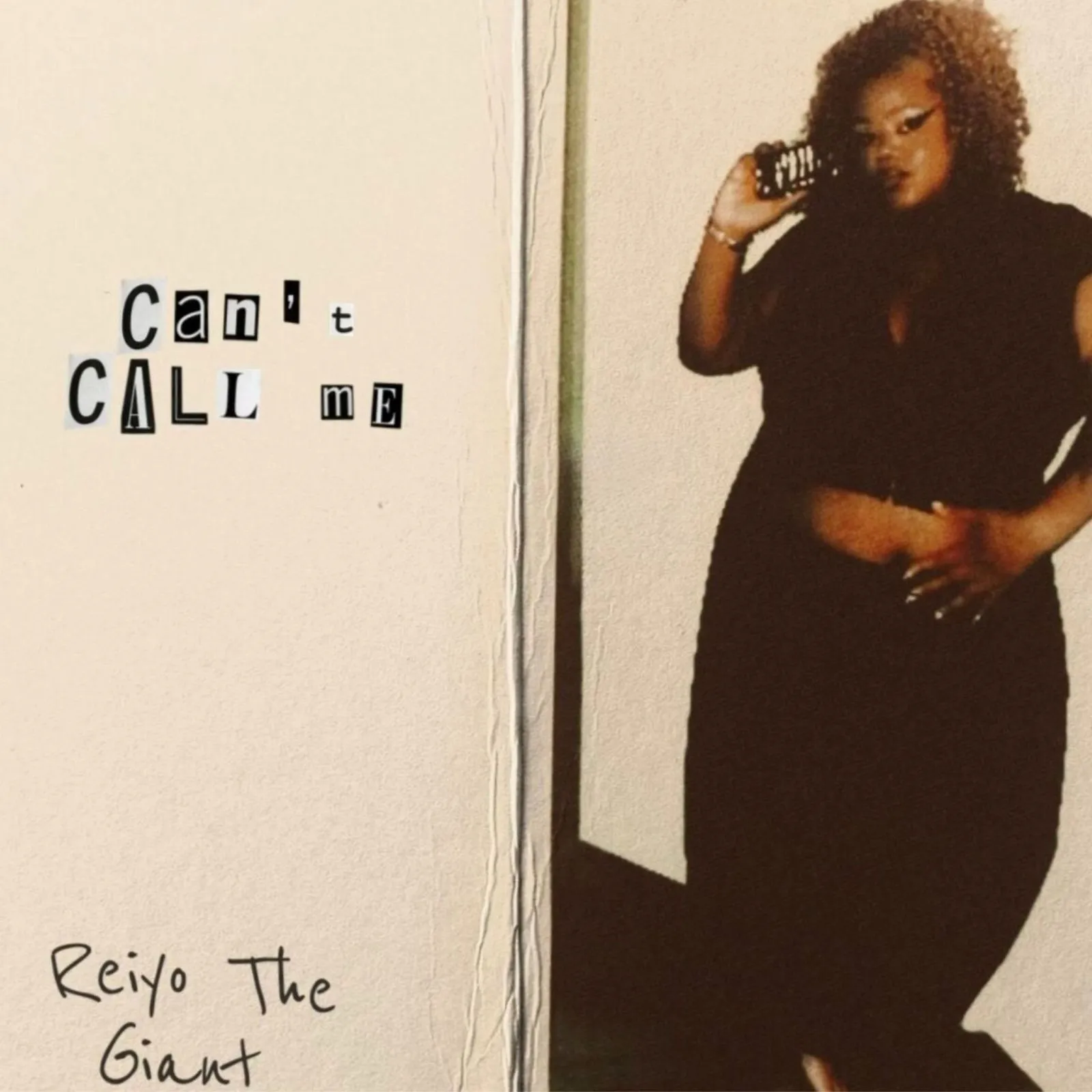
Reiyo The Giant talks about grief in a way that makes it feel less like an ending than a force that keeps changing shape. Born in the Bronx and now based in Atlanta, the artist uses atmosphere, metaphor, and an instinct for world-building to make room for experiences that resist easy explanations. Her latest single, “Can’t Call Me,” produced by Anwar Sawyer via Safari Riot, finds her at a particularly clear point in that process.
After loss, desire, and the impulse to hold on, there is the decision to leave first, protect her boundaries, and choose herself without pretending she feels any less deeply. Built from alternative R&B, soul, and atmospheric electronica, the track carries the hazy, immersive quality that defines her work while moving with a new sense of certainty.
“Can’t Call Me” is part of her forthcoming debut album, a record shaped by a period of profound personal change and loss. Across the album, Reiyo looks beyond romantic heartbreak to understand how those experiences have shaped the way she relates to herself, other people, and the world around her.
Talking to Reiyo, we found an artist who treats emotion not as something to overcome but as something to understand, make space for, and eventually transform. Her answers carry the same quality as her music: imaginative without losing their emotional weight and deeply personal without asking for a simple resolution.
“Can’t Call Me” feels like a song about reclaiming your own emotional authority after grief. When you were writing it, what did choosing yourself actually look like in your life?
Choosing myself looked like leaving first. It looked like no contact with people I once loved or even just imagined a future with. It looked like admitting that attraction and projected lustfulness are not enough to abandon myself, my boundaries, or my desire for true connection. It was like an “aha!” moment when I realised I could actually choose not to tolerate less than what I deserve or even want.
Your music often makes very personal experiences feel almost otherworldly. Do you naturally process your own experiences through metaphor and imagination, or does that language emerge once you begin writing?
I do tend to naturally process my own experiences through metaphor and imagination. I’m a deeply spiritual and existential person (I’m a Sagittarius stellium), so most of my experiences are filtered through pattern recognition, dream recollection, and symbolic recurrences. Writing, like singing, is a medium for me. I believe there’s beauty in viewing yourself as a mirror of the world around you, and I like to imagine that I am also a world of my own, capable of immense transformation. Also, because of how deeply I can feel and relate to my experiences, there’s almost an inner need to become larger than whatever I’m feeling so it doesn’t eventually overpower me.
I’m really interested in the way you use atmosphere in your music. Your songs can feel like places as much as they feel like narratives. When you’re writing, do you imagine a physical or visual world around a song before you know exactly what you want it to say?
I always imagine a visual world around a song before I begin writing or figuring out what I need to say. I wrote a piece a little while ago on the alchemy of writing a song and its ability to transport. I view each song as a landscape where I’m standing in the middle. Each instrument is a moving part that circles me before finally setting into place. Each sound is full of emotion, dedicated and committed to becoming part of this new world. Each groove (and the spaces in between them) becomes my way of navigating and deciding the tone, pace, message, and whether or not my voice needs to comply or disrupt.
You draw from literature, film, television, and music, and your references range from Zora Neale Hurston and Richard Bruce Nugent to Guillermo del Toro and Michaela Coel. What have those influences taught you about storytelling that you’ve carried into your music?
They’ve taught me that storytelling requires honesty and commitment to your own voice, perspective, intentions, and shortcomings. Also, that it requires a non-avoidant connection to the world around them. You must be willing to look at everyone and everything as whole and complex and worth investigating. You must be willing to question what everyone accepts as normal. They also all seem to understand the more dark and damp areas of life and aren’t afraid to explore them relentlessly. All while staying true to their natural way of processing and recollection and to what their thoughts may sound like when they reach them.
There’s a strong sense of character in the way you present Reiyo The Giant. How much of your artistic identity existed before the music, and how much did the music teach you about who that character could be?
Before I came up with the name Reiyo The Giant, I was always talking about how I wish I could be 10 feet tall with some moon boots, just kind of running around the city. I’m obsessed with the feeling of vastness. Also, I’m obsessed with all things fantasy. When I decided I wanted to create music, I juggled with names that felt right and settled on (just) REIYO. As I was making more and more music, I noticed that I often leaned into an otherworldly energy through the use of atmosphere and that my voice was a tool for delivering truth. Becoming Reiyo The Giant allowed me to create this kind of mythology around myself where I can be vast and belong to somewhere even grander that can hold me and the stories I wish to tell. I needed to create something visual that could bring people with me through these song landscapes.
You first introduced your music with the self-produced 2021 EP “Romeo,” and you’re now preparing to release your first full-length album. Looking back at “Romeo,” what feels most different about the way you see yourself and your music today?
I feel a lot more emotionally mature now. ‘Romeo’ felt very much like my early 20s—upset at the world and love. That EP came from a place of validating my ego and letting my emotions be bigger than me. Now, I feel a bit more of a collaborative energy when it comes to me and my feelings. We work with each other as opposed to me feeling the need to simply invoke the spirit of the emotion. There’s a lot more emotional range to the music I’m creating now. It feels like I’m allowing myself to be more than upset. Also, I’m giving myself the grace to recover and come down from whatever emotions were triggered from the ‘Romeo’ era. It’s all grief, but now it’s got somewhere to go.
Across the songs you’ve shared from your upcoming debut album, there’s a recurring movement between loss, love, fear, and transformation. Did making the record change the way you understand your own relationship to those experiences?
Absolutely. I’d say the record was made to help me better understand my relationship to those experiences. When I started the album, I knew it’d be about grief. I knew because that was my guiding force. I had lost my great-grandmother, my aunt, and my uncle in the span of 3 years. I was terrified of most things after that. I moved, transferred schools, and dropped out after creating a life centred around my intellectualism and being an academic. I had my first breakup two years after that. Life felt extremely confusing, and I was going through some really extreme changes. When I made ‘Romeo,’ I was upset. Anger, disgust, and heartache were at the centre. When I started this new record, I de-centred romance and realised loss was plaguing more than just my love life. It was changing everything. It was shifting how I interacted with people and the world around me. It was pulling me further into myself when all I wanted was to reemerge into normalcy. Making this record forced me to sit inside the damage and seek understanding and acceptance instead of repair.
Listen to “Can’t Call Me” and connect with Reiyo on Instagram, TikTok, and YouTube.
Words and interview by Escarlina
