

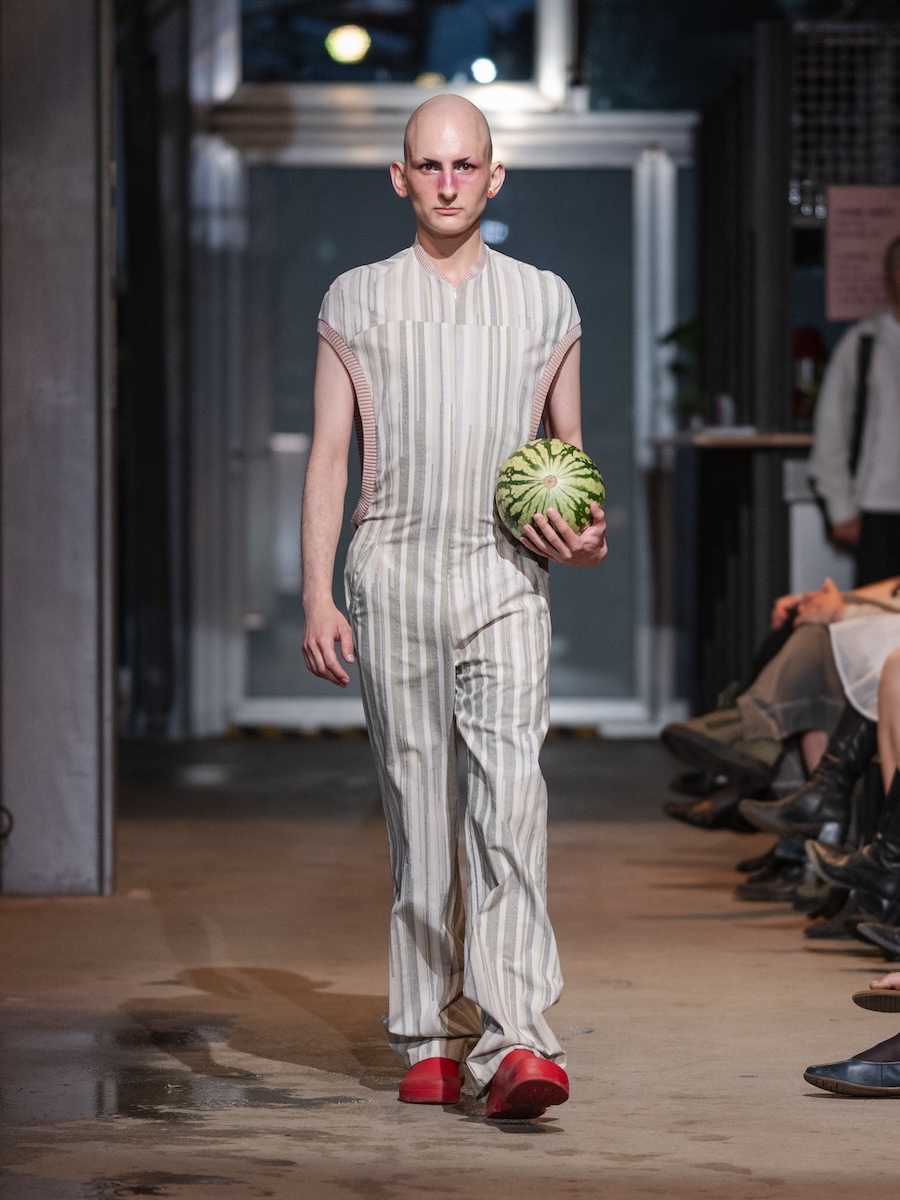
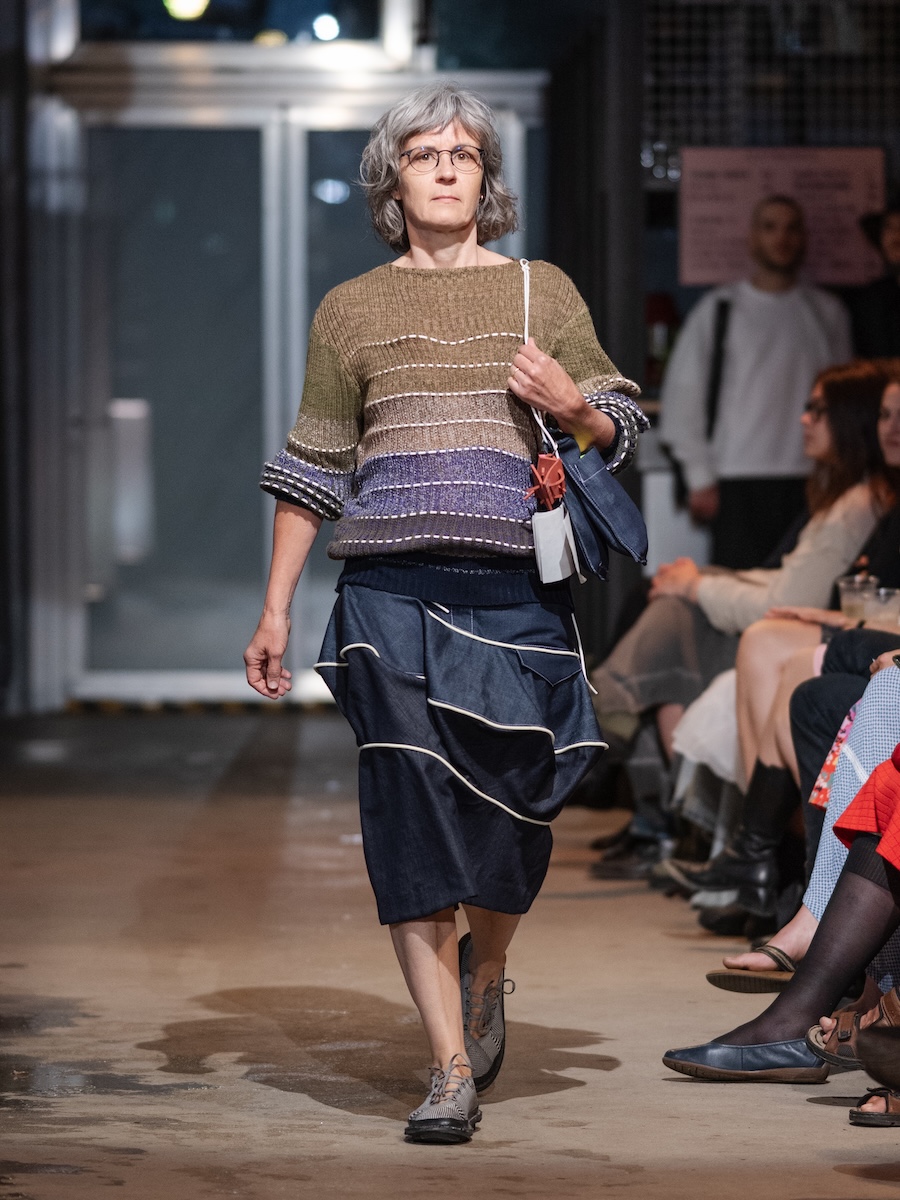
Fashion isn’t built in isolation; it thrives on connection, collaboration, and shared energy. For native Berliner Renee Klaßen, the graduate collection ‘bildet bündchen’ is a testament to the power of creative community. Surrounded by an extensive network of collaborators, mentors, and friends, including her own mother walking on the runway, Renee turned her design process into a collective celebration of craft and mutual support.
At the heart of Renee’s work lies an endless fascination with knitwear. Grounded in soft, warm wool and contrasted against light, technical layers like nylon and cotton, her pieces merge spontaneous experimentation with intricate craftsmanship. For Renee, fashion is far beyond the outdated industry standards of ultra-thin, homogenous figures; it’s an inclusive medium designed to make real, diverse bodies feel empowered and completely at ease.
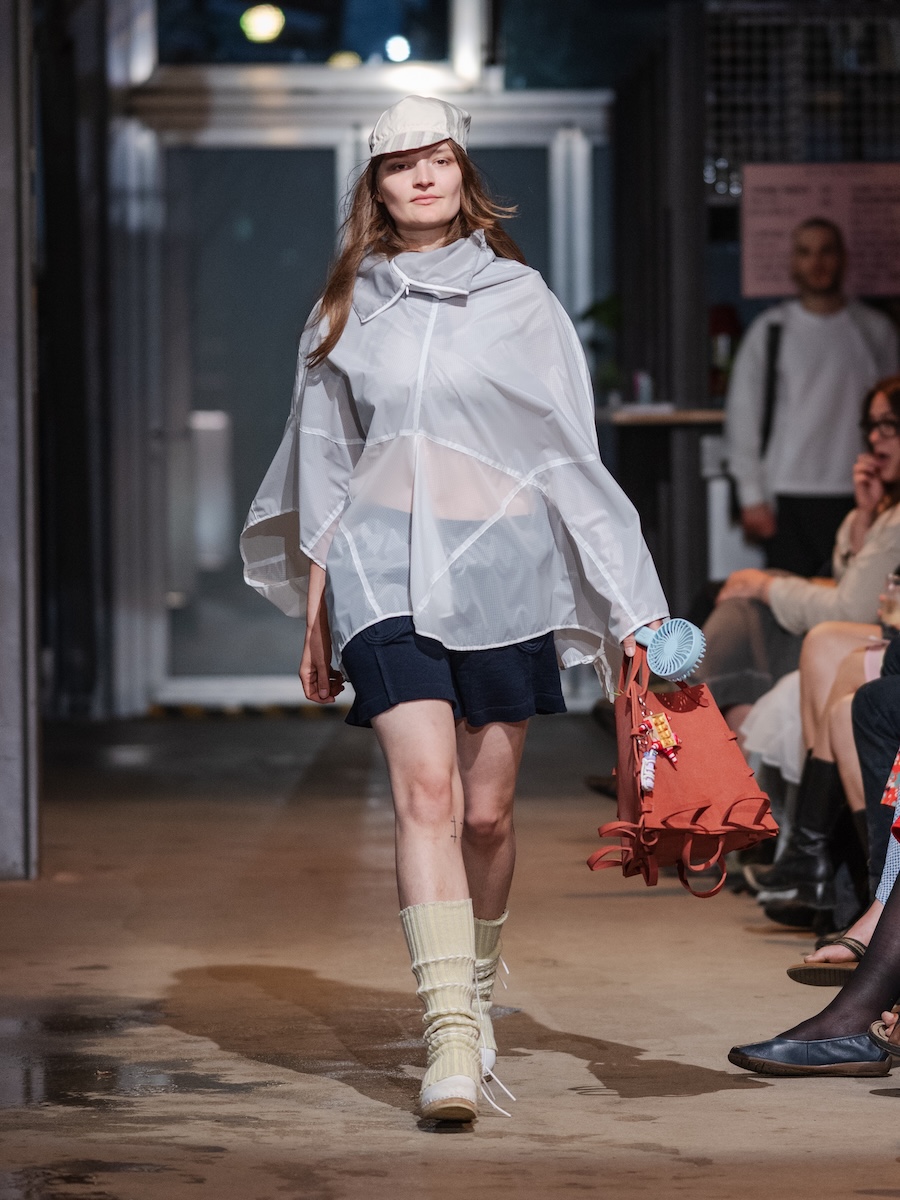
Rooted in Berlin’s familiar creative backdrop yet refined by transformative experiences abroad and intense identity-seeking courses at Weissensee under William Fan, Renee treats garments as durable, versatile products rather than transient trends. When her tactile, layered collection hit the open, community-centred architecture of ZK/U, the studio puzzle snapped into place with overwhelming pride.
Tiramisu & Tactile Community: Step Into the Universe of Renee Klaßen
Read on as we talk to Renee about stepping outside elitist runway tropes, finding freedom in the endless possibilities of knitting, and why her structural collection translates into the layered, delicious logic of tiramisu ice cream.
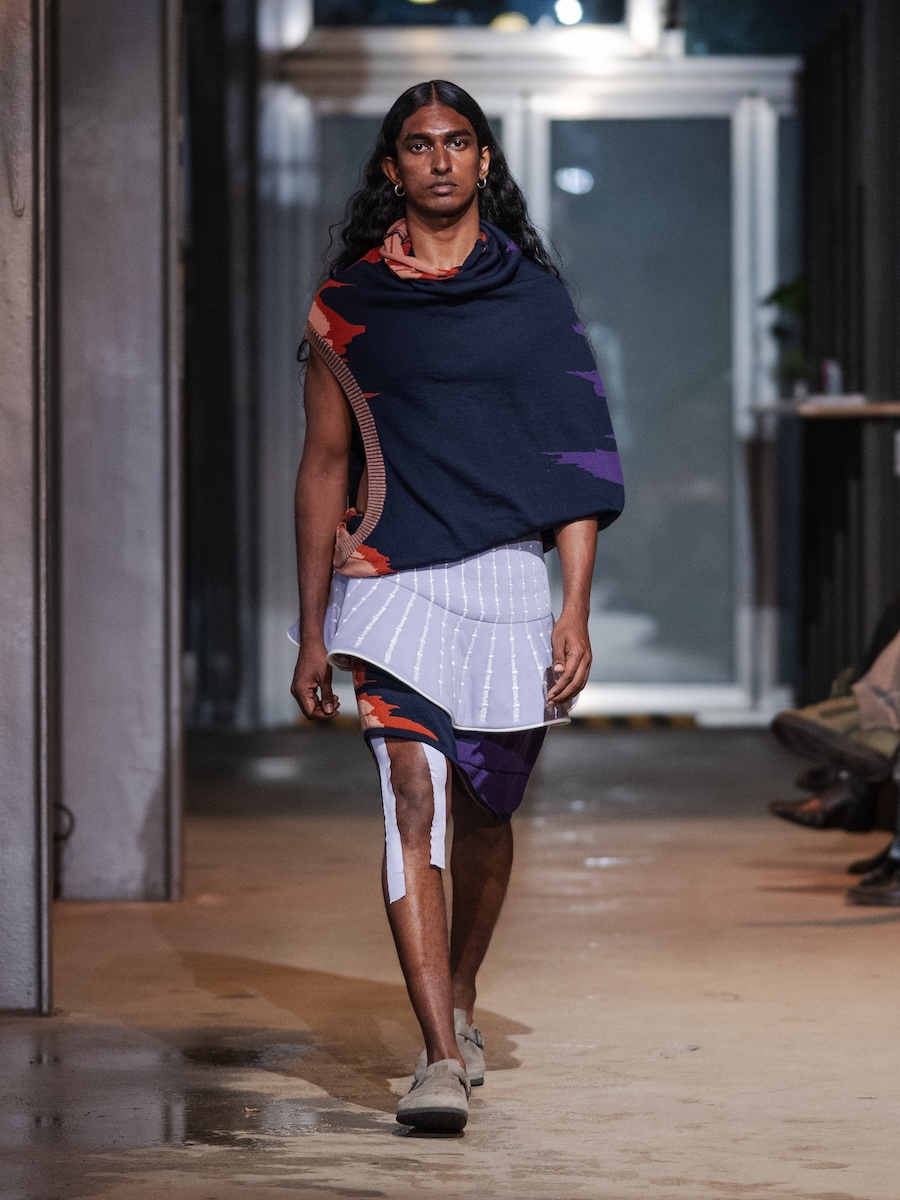
What was your approach to choosing your materials, and how did working with those specific textiles or textures impact your design process?
In my collection, I have mainly worked with wool, cotton and nylon. In the beginning of my working process, I decided to start working with knitting. We had a few cones of wool stored at the art college, which I began experimenting with. Wool has some wonderful properties. It is very soft, warm and a natural fibre. I wanted to create some contrast with the wool and knitted fabric, so lighter materials such as nylon or cotton were the obvious choice.
How do your personal background, heritage, or the environments you’ve lived in manifest in the details of your designs?
It’s very important to me to work in a pleasant environment. I enjoy working alongside friends and supporters with whom I get on well. It’s only when I have this kind of working environment that I can work creatively. Naturally, my surroundings also influence my designs, and I’m very happy to acknowledge and take this influence seriously. I love it when projects don’t have to be created entirely on my own and in isolation.
Looking back at your time as a fashion student at Weissensee, what was the most valuable lesson—or perhaps the most unexpected challenge—that shaped your identity as a designer?
The Weißensee Academy of Art has shaped me greatly and presented me with countless challenges. Every semester and every project is very different, and it is precisely these varied challenges that have really shaped me as a designer. When we took a course with William Fan, which was all about finding our own design identity, I felt completely overwhelmed at first. Looking back, however, I think that this course gave me particular confidence and has subsequently had a huge influence on my design process and way of working. It also helped me a great deal to spend time studying abroad at other universities. Weißensee understands that this is very important and is therefore incredibly supportive in every way.
Berlin has a very distinct subcultural and creative energy. In what ways, if any, did the city’s landscape or community influence your graduate work?
As I grew up in Berlin myself, it’s very difficult for me to see exactly how the city has influenced me. Berlin is my home, and for me, the creativity here feels familiar and comfortable. Generally speaking, it’s of course brilliant to have so much on offer culturally in Berlin and to be inspired and influenced by it all. Nevertheless, it was also important for me to get away from Berlin now and then; afterwards, I always feel a strong desire to come back here.
Many collections today engage with contemporary cultural, political, or ecological themes. How do you view your role and responsibility as a designer entering the industry right now?
I think it is incredibly important as a designer to be aware of one’s own privileges and to be able to put one’s own work into context. As fashion is such an everyday medium, it can be used to communicate a great deal. A person’s political stance can be conveyed through an outfit. As a designer, it’s interesting to create garments for this purpose. On the subject of sustainability: creating fashion in collections no longer makes sense; it is far more important to develop sustainable products designed for durability and versatility.
Your collection showcases a balance between conceptual thinking and technical craftsmanship. How did you navigate the space between free experimentation and practical execution?
I experiment and put things into practice at the same time. Whilst I’m already working on one outfit, I’m still experimenting with the next one. This gives me plenty of scope to embrace experimentation and serendipitous mistakes as I develop my collection. From a design perspective, it also allows outfits to reference one another.
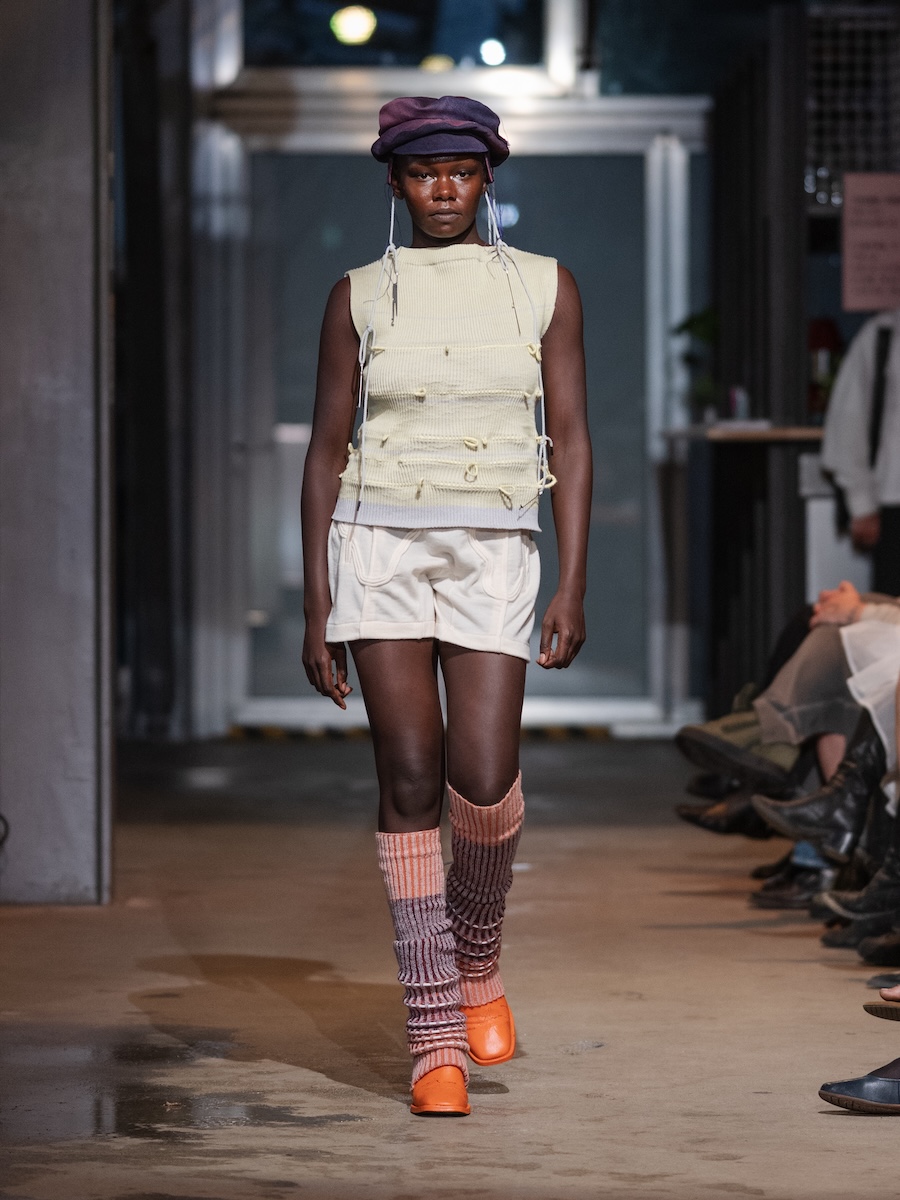
Seeing your work transition from the studio into the specific architecture and energy of yesterday’s show at ZK/U, how did that moment feel, and did it change how you view your own pieces?
I was overwhelmed. Our studios are full – full of materials, influences, colours and all sorts of other objects. It’s truly stunning to see what emerges from these spaces and how the clothes look when presented in large venues such as those at the ZKU. I was also proud to see how the whole collection puzzle had finally come together. This gives me great motivation to carry on and take on new challenges.
The ZKU is a very interesting community space and was a perfect fit for us from the Weissensee Academy of Art. The openness of the building brought a really lovely atmosphere to the whole event.
What kind of dialogue or emotional reaction do you hope to trigger in the person viewing or wearing your garments?
I want people to feel comfortable in my clothes. It’s important to me to build a small community with my models on the catwalk and to convey that feeling to the outside world. This also means ensuring that the models feel at ease and that a diverse range of people are seen on the catwalk. We must finally stop making fashion exclusively for exceptionally tall and very thin people.
Now that the graduate show is behind you, what aspects of your creative practice or design philosophy are you most excited to explore next?
I’d like to carry on knitting. I feel as though knitting is a little bubble where there’s still an endless amount to discover. I also like the people who knit. Knitting gives me a sense of spontaneity, technique and flexibility, which I really enjoy. At the same time, I’d like to continue working in an interdisciplinary way – not just focusing on one thing, but exploring the connections between different techniques. I’d also like to delve deeper into the relationship between design, technique and performance.
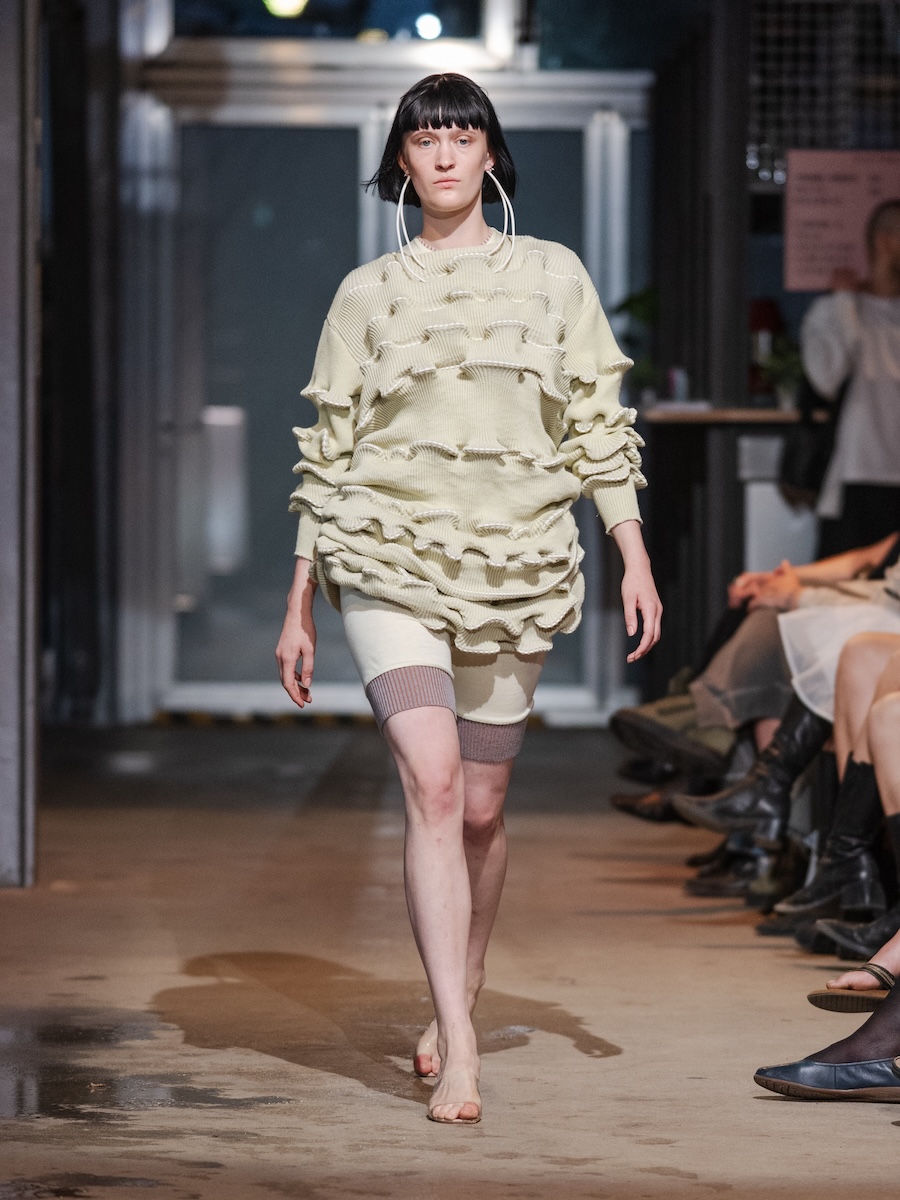
If your collection or creative identity could be translated into an ice cream flavour, what would it be and why?
My collection would be a tiramisu ice cream! Not because I drink so much coffee, but because I love tiramisu so much and I also find the way a tiramisu is put together really interesting. It consists of layers of ladyfingers and mascarpone, arranged in strips. I think the vertical and horizontal lines go very well with my ‘bildet bündchen’ collection.
@renee__ruth
Photographer: Anita Schulte-Bunert @nit.sb
Supervisor: Prof. Clara Leskovar, Prof. Doreen Schulz
knit supervisor: Luisa Lauber
Rope collaboration in knit top with Jelisa Weber @jeliezy
Consultancy: Prof. Patrik Rietz, Madeleine Madej, Robert Brenn-Struckhof
Sewing help: Anna Ballweg, Monica Kuleßa, Maja Meppelink
Screenprinting help: Louise Drubigny
Embroidery help: Kathrin Jahnes
Theorie: Antonella Giannone
Pattern making help: Lucia Mors de Castro
Runway models: Jelisa Weber @jeliezy, Ziha @zihaa.01, Sophia Engel @sophia_engel, Susanne Klaßen @susanne_klassen, Emma, Ardix S. @ardickz, Antonia Heinz @toni.hnz
Thanks to all friends and family for helping out and supporting me.
CREATIVE & MOVEMENT DIRECTORS
Sarah Ama Duah @sarah_ama_duah
Madlen Schmid
PRODUCTION DIRECTORS
Doreen Schulz
Madeleine Madej
CASTING DIRECTOR
Madlen Schmid
STYLIST
Tabassom Charaf @tabicharaf
MAKE-UP ARTISTS
Head of Make-Up Artists: Feride Uslu @feride_uslu11 für airbeauty.com @ferideairbeauty
Dominika Obacz @dominica_obacz
Mert Kenger @mertkenger
Sarah Elisa Fischer
Sarah Ort
HAIR ARTISTS
Nicole Puzalowski
Béanne Da Costa @hairtouchedby
Jennifer Ohia @mmynd.irl @5.minah
Special thanks to our partners
Bezirksamt Mitte
ZK/U Zentrum für Kunst und Urbanistik @zku.berlin
Objets Trouvés Möbelmanufaktur @objets.trouves.berlin
uns* Model Agency @wirsinduns
VIVA Model Agency @vivamodelsberlin
The event is supported by the Economic Development Office of Berlin’s Mitte District Council in cooperation with PLATTE.Berlin, which is responsible for guest management and PR @platte.berlin
