

Memory is a fragile, dissolving entity, and for designer Varvara Vysotskaia, clothing is the medium through which its fragmented threads can be saved. Her graduate collection, ‘Imagined Archive’, is an extraordinarily poignant, deeply personal exploration of family heritage, exile, and the quiet weight of memory when living far from home.
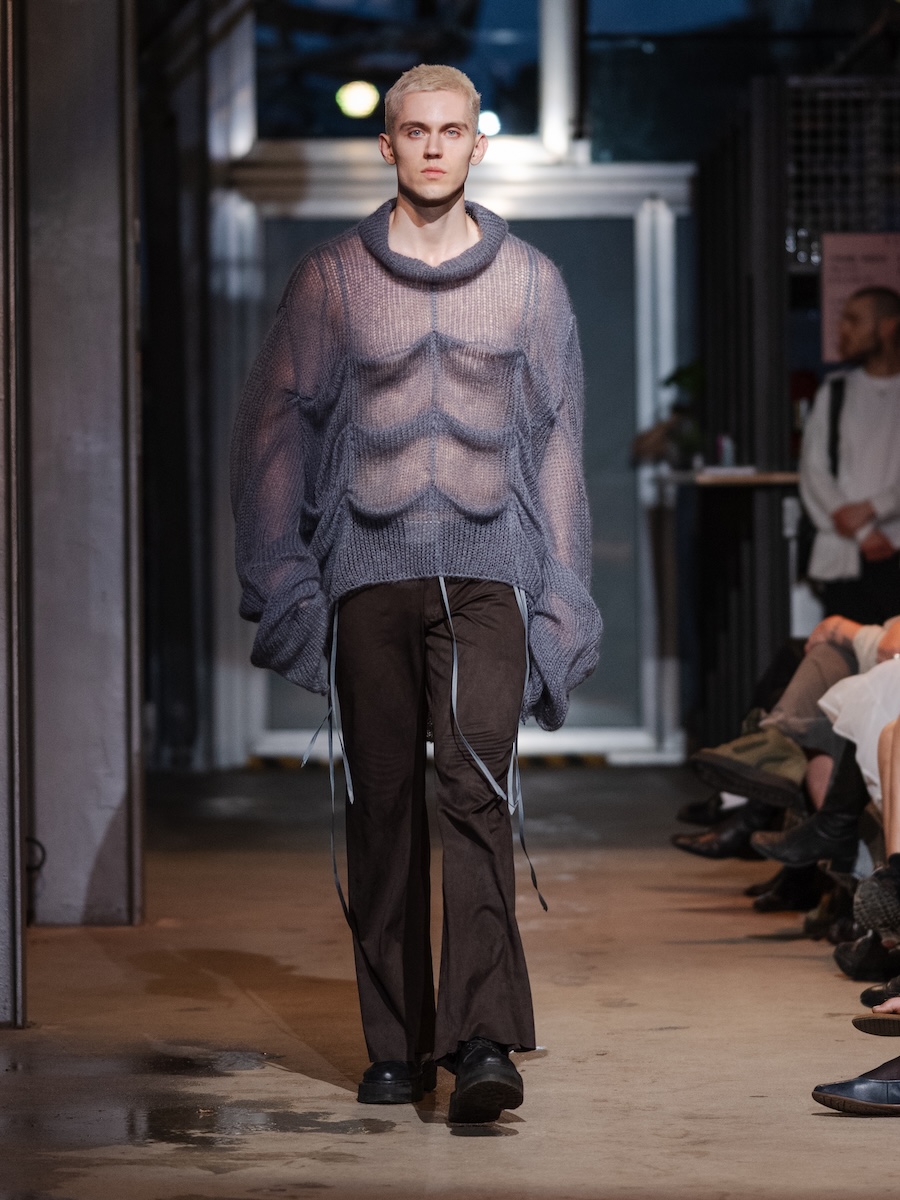
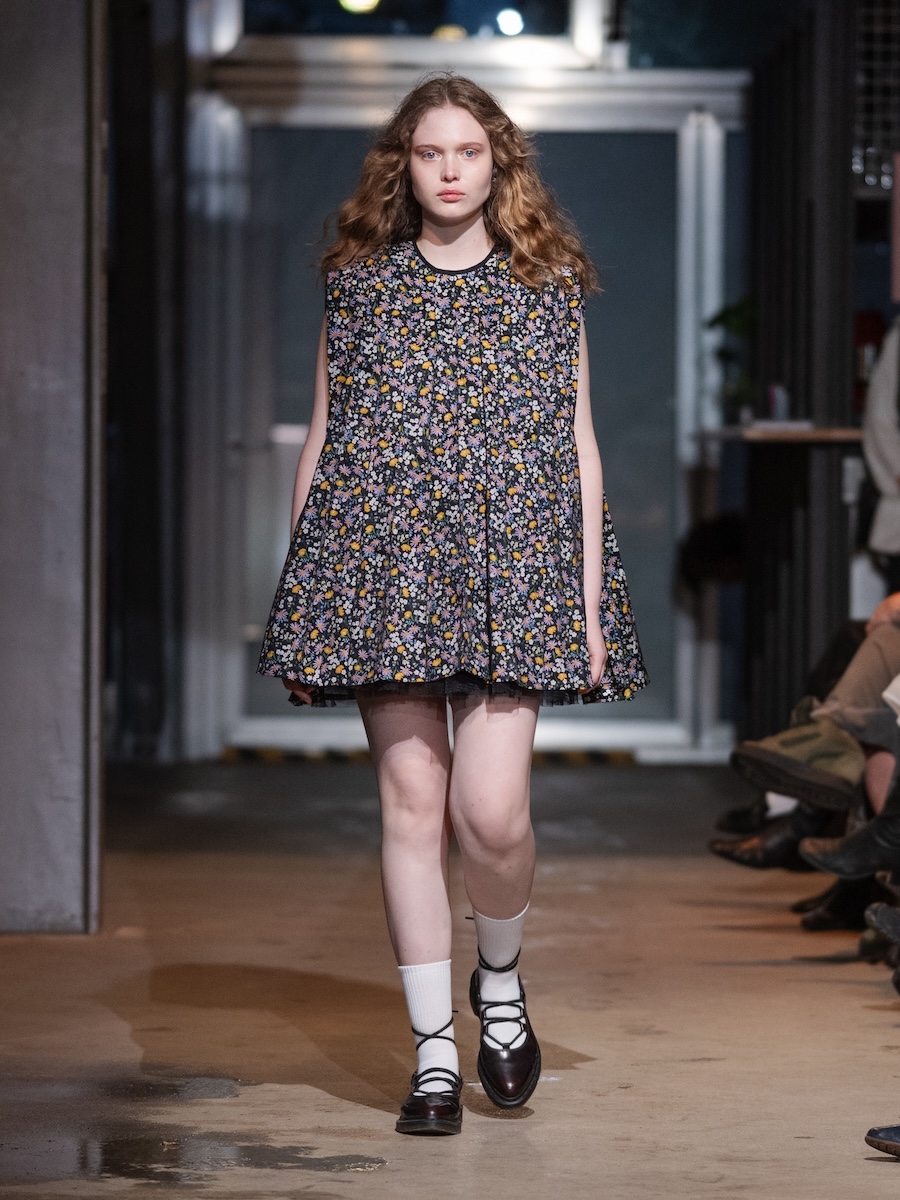
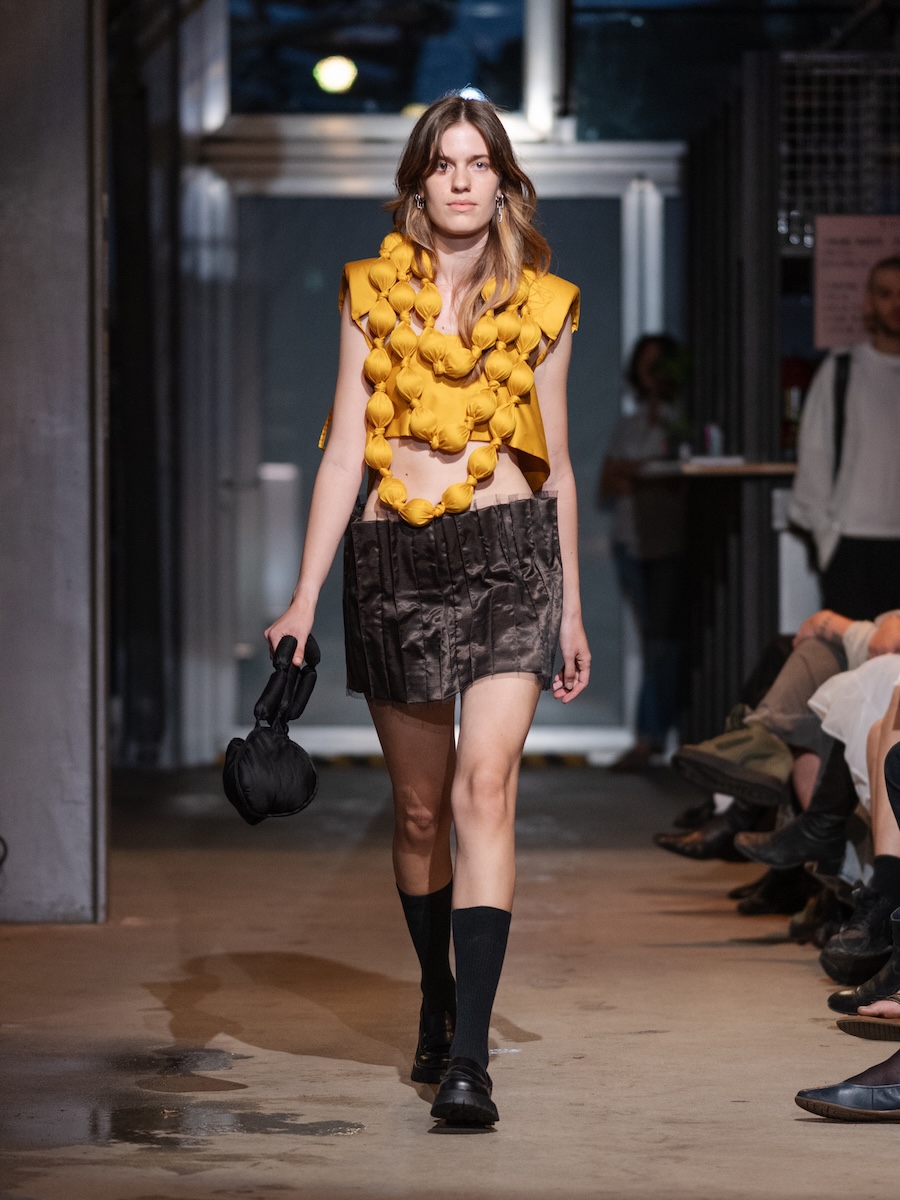
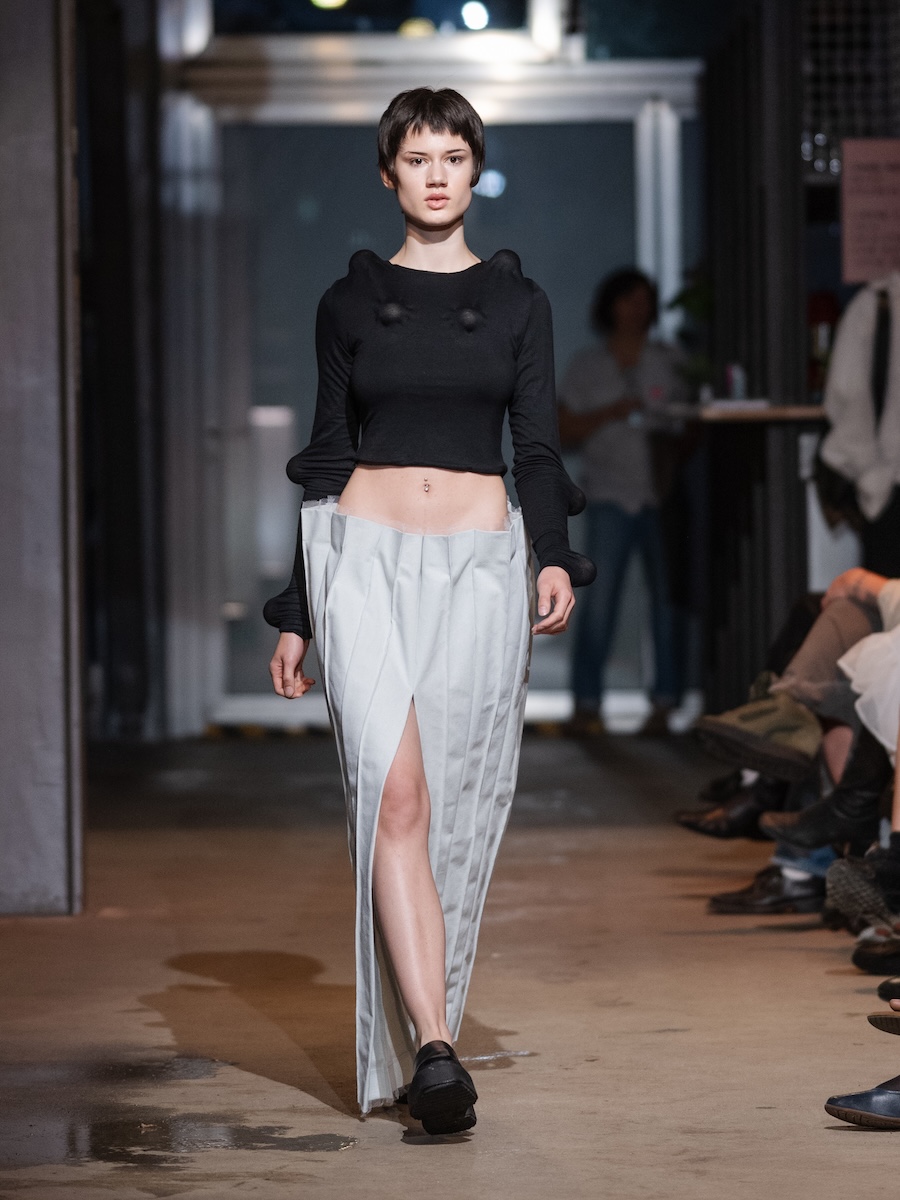
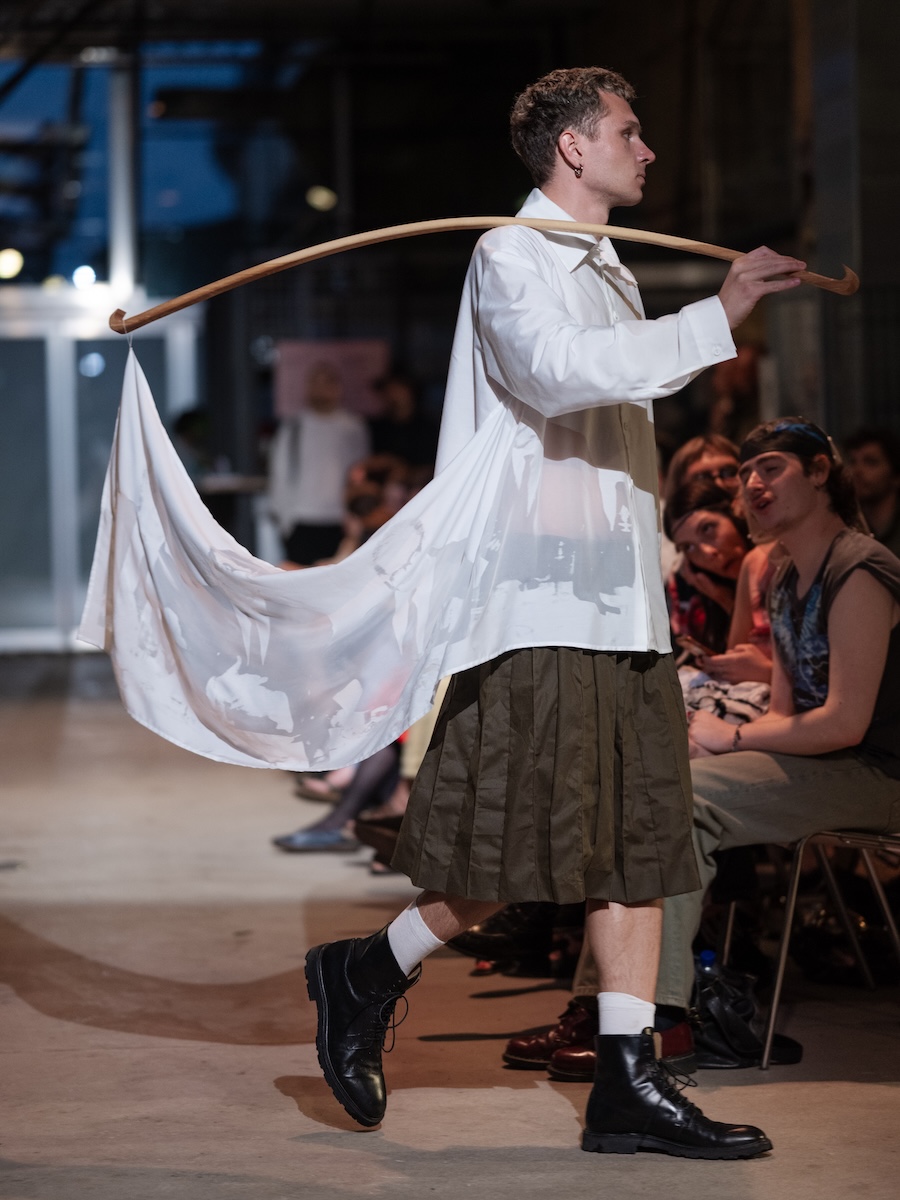
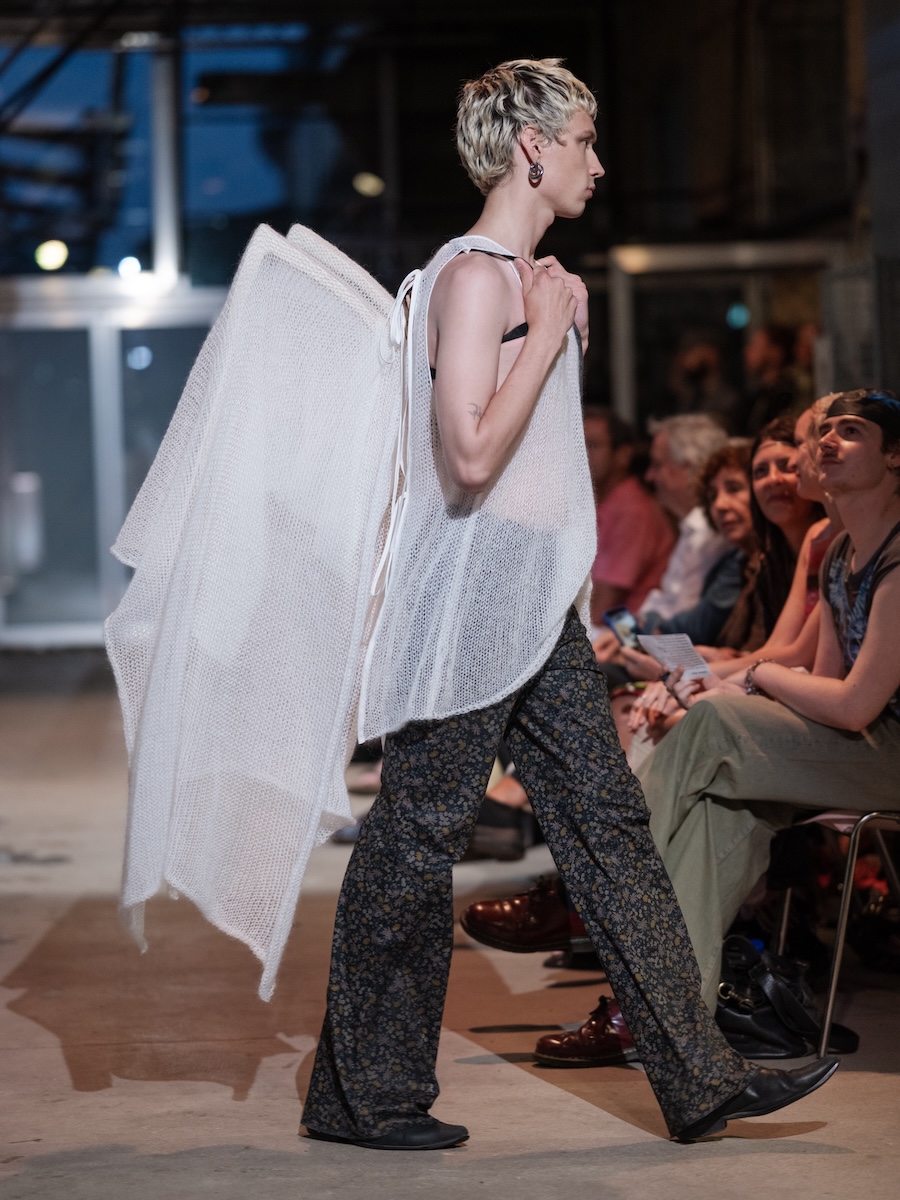
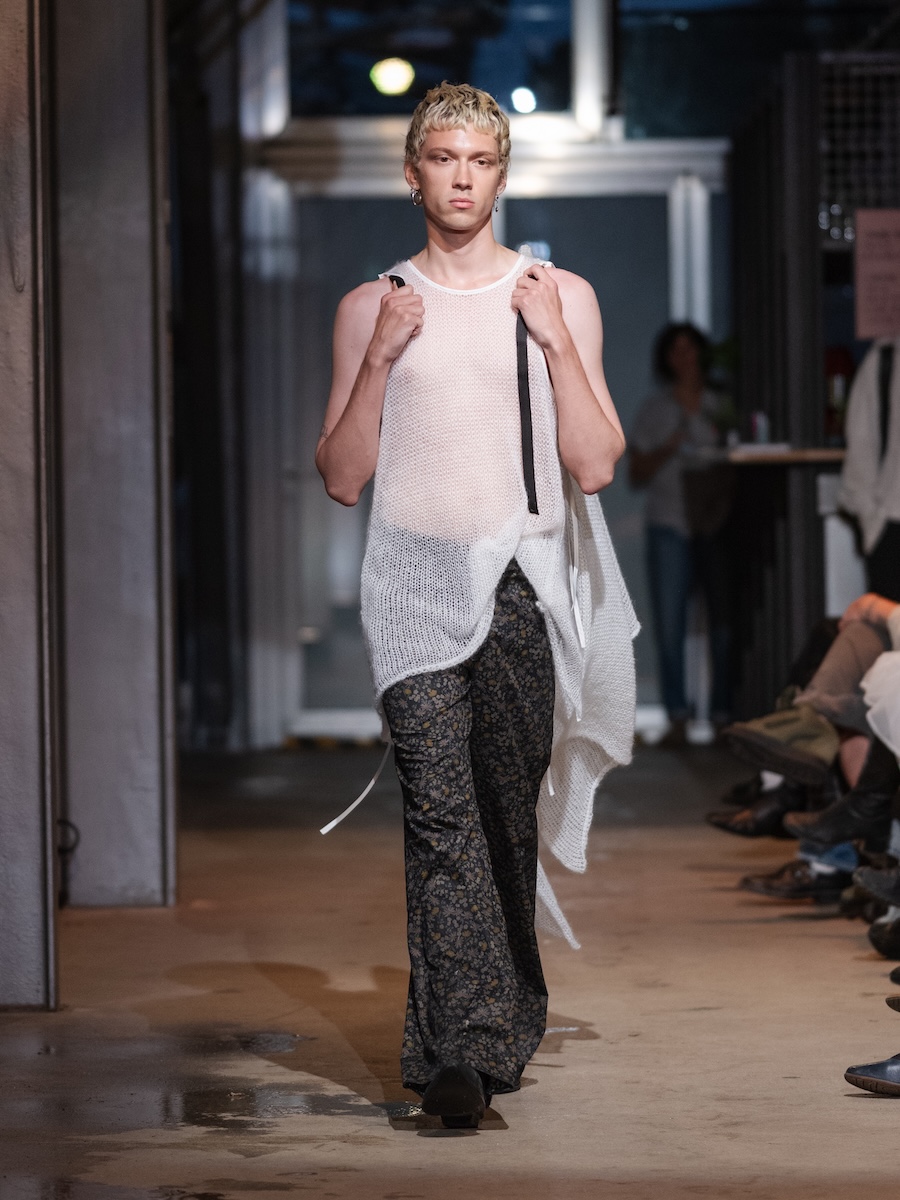
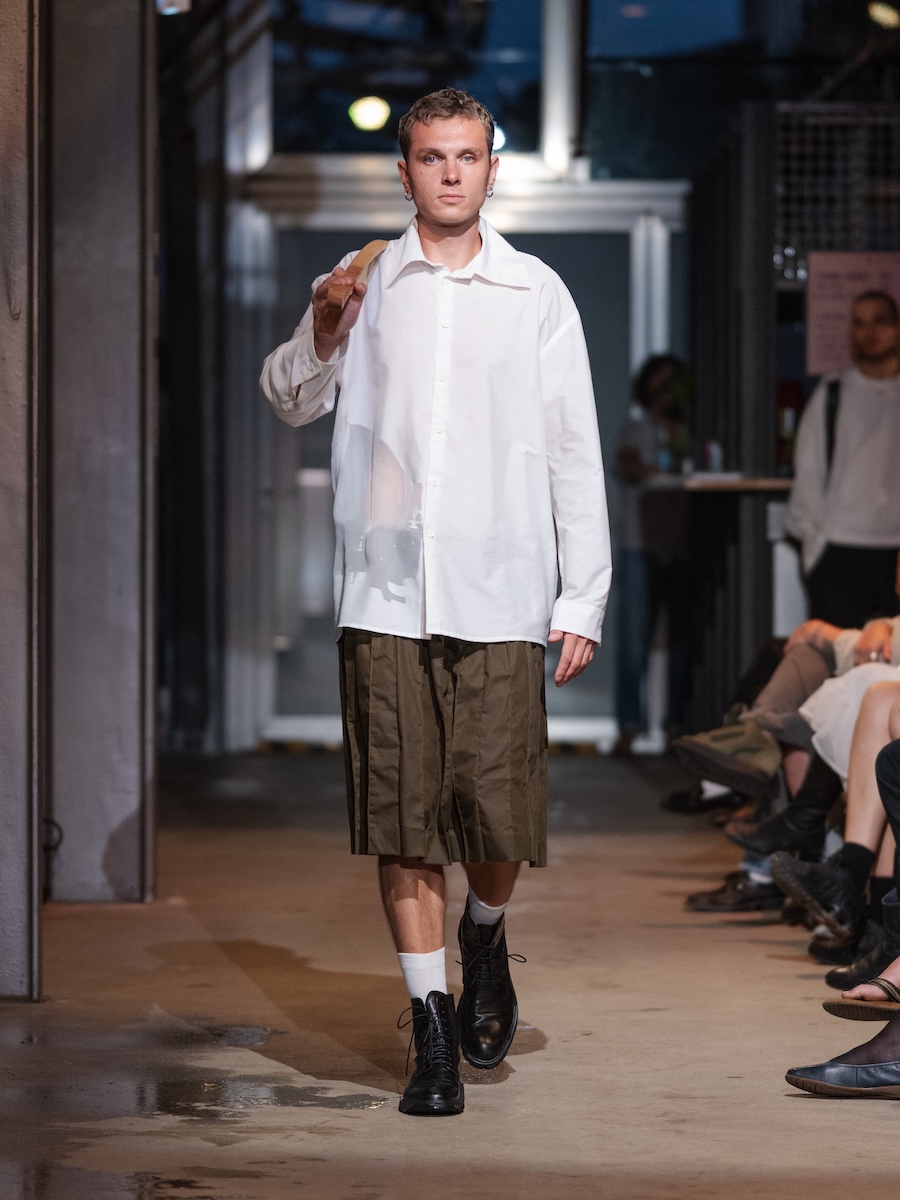
Every textile in Varvara’s collection acts as a vessel for a ghost. Semi-transparent, loose mohair knits appear to disintegrate directly on the body—a visual metaphor for time eroding what we hold dear. Floral prints echoing her mother’s childhood dresses are shrouded in dark mesh, mimicking web-like anxiety and censorship that obscure the past. In her final look, a 1960s photograph of her grandfather’s geologist colleagues is burned into the fabric using the devoré technique, resurrecting an ephemeral moment of Soviet joy. From fabric-wrapped bead necklaces inspired by historical resourcefulness under systemic scarcity to raw political urgency, Varvara’s work warns against self-censorship and silence before they morph into comfort and control.
Yet, despite its heavy emotional core, Varvara’s design philosophy yields deeply wearable, empowering pieces. When her models stepped onto the outdoor stairs and concrete of ZK/U, the garments shed their studio isolation and stepped into reality, carrying a clear, universal call to action: hug your family, ask the hard questions, and never let silence win.
Melting May Ice Cream & Ghostly Archives: Step Into the Universe of Varvara Vysotskaia
Read on as we talk to Varvara about trusting one’s creative voice, fashion as an ongoing human dialogue, and why her collection tastes like melting ice cream on a hot May afternoon at the start of an endless summer.
What was your approach to choosing your materials, and how did working with those specific textiles or textures impact your design process?
The concept of my collection is about reconstructing fragments of family memory, so every material had to carry that idea.
I chose loose, semi-transparent mohair knits because I wanted them to feel as if they were dissolving on the body, slowly falling apart under the influence of time.
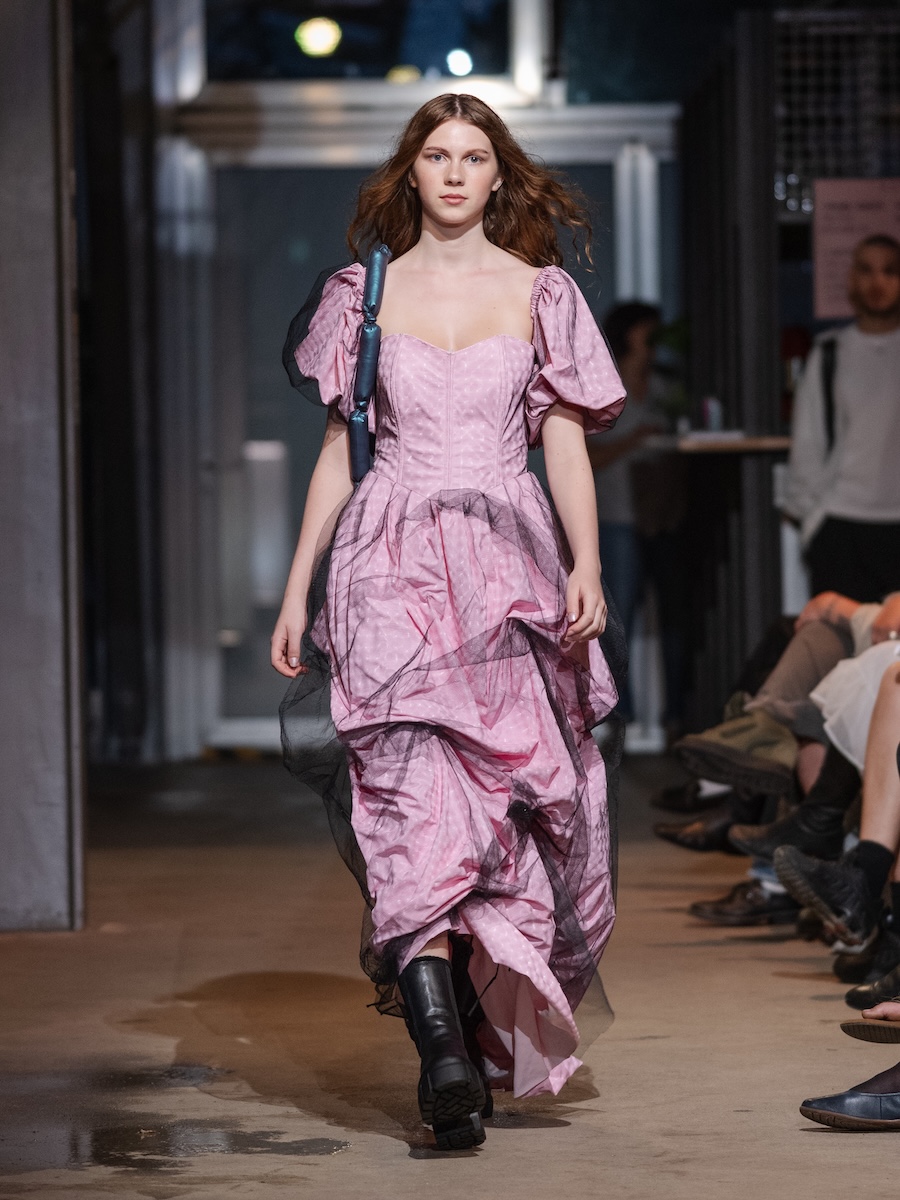
The floral fabric resembles the dress my mother wore as a child. I covered it with black mesh, just like the pink dress. The mesh introduces a feeling of anxiety—it interrupts the familiar pattern, tangles around it like a spider’s web, making the memory harder to reach.
For the final look, I burned a family photograph into the fabric using the devoré technique. It shows my grandfather’s colleagues—geologists in the 1960s—celebrating together. To me, they are like ghosts of my family’s voices, a fragile thread that still connects me to them.
How do your personal background, heritage, or the environments you’ve lived in manifest in the details of your designs?
Because my collection reflects on memory and the rupture of the family archive while living far from home, it was important for me to balance the warmth of memory and the desire to reach for it with the realities of censorship, silence around family tragedies, fear, restraint and scarcity.
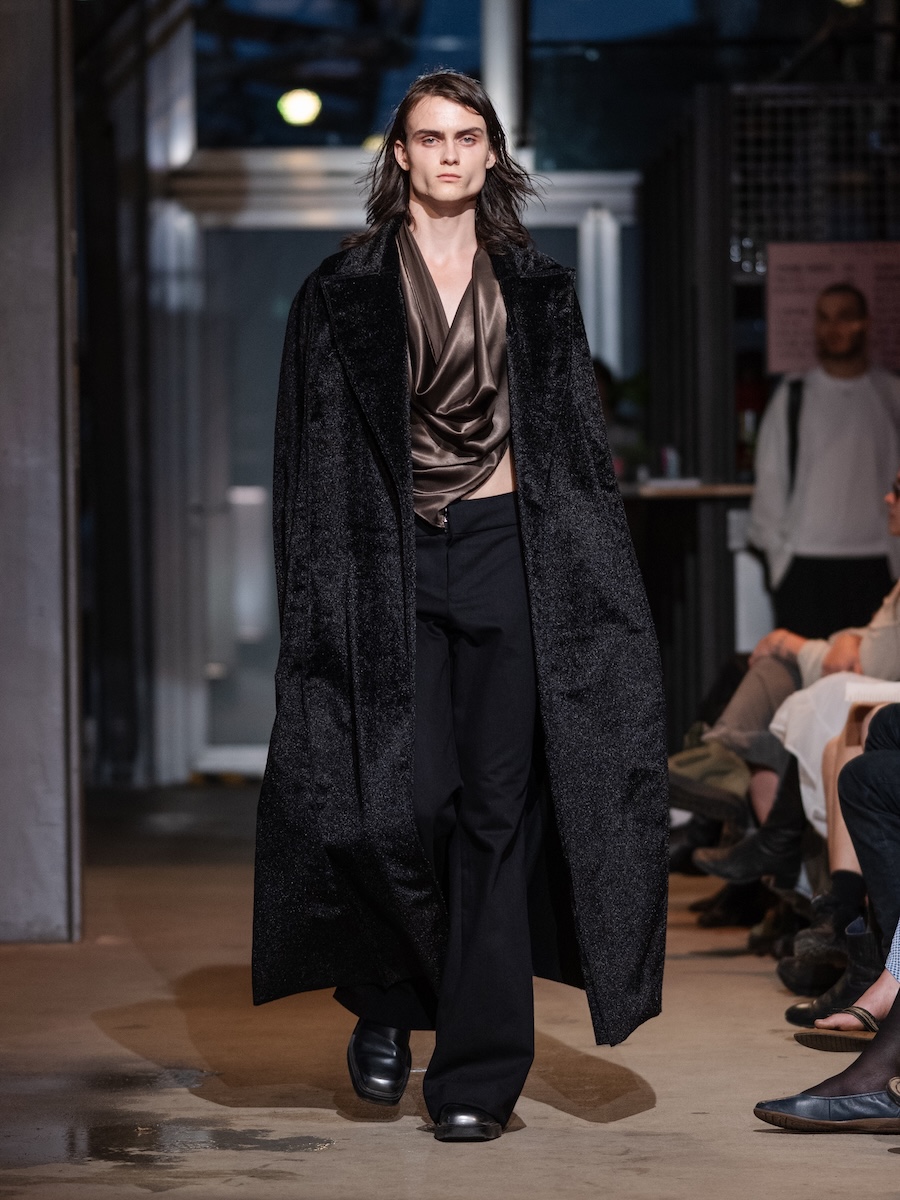
The yellow beads that appear as part of one of the tops are inspired by a Soviet practice. During the years of stagnation, women often made jewellery from whatever they had. They wrapped beads with leftover scraps of fabric from sewing projects and turned them into necklaces. I used the same principle for the handles of my bags.
Looking back at your time as a fashion student at Weissensee, what was the most valuable lesson—or perhaps the most unexpected challenge—that shaped your identity as a designer?
The most important lesson I learned at Weißensee was to trust my own voice.
The school gives you enormous creative freedom and access to incredible workshops. I found myself wanting to try everything. Over time, I became much more interested in using those possibilities to tell one story well, instead of telling many at once. Looking back, that shift shaped me more than any particular technique I learned.
Berlin has a very distinct subcultural and creative energy. In what ways, if any, did the city’s landscape or community influence your graduate work?
I love Berlin for its freedom, inclusivity and diversity. It’s a city where people from all over the world collaborate, support one another, find a common language and share their stories. Living here constantly reminds me that we have much more in common than what separates us. To me, that’s the strongest argument for peace.
Many collections today engage with contemporary cultural, political, or ecological themes. How do you view your role and responsibility as a designer entering the industry right now?
Being a designer comes with responsibility because you’re choosing how to use your voice.
I want to tell deeply personal stories, but tell them in a way that allows someone from a completely different culture, somewhere on the other side of the world, to look at them and think, “I know what that feels like.”
Your collection showcases a balance between conceptual thinking and technical craftsmanship. How did you navigate the space between free experimentation and practical execution?
The best compliment I can receive as a designer—and I heard it from several of my models during the show—was: “I feel so good in this. I feel like myself.”
I’m interested in creating ready-to-wear with a shift. I like inventing a character and then translating that character into clothing in a way that makes the person wearing it feel confident, comfortable and completely themselves. That’s where experimentation and practicality meet for me.
Seeing your work transition from the studio into the specific architecture and energy of yesterday’s show at ZK/U, how did that moment feel, and did it change how you view your own pieces?
It was emotional. I felt that the space brought so much life into the collection. The openness, the industrial atmosphere, the staircases leading outside—it suddenly felt as though the clothes had left the studio and entered the real world. Watching that happen was one of my favourite moments of the whole project.
What kind of dialogue or emotional reaction do you hope to trigger in the person viewing or wearing your garments?
As someone living far from home and making a collection about a family photo album, my message is simple.
If you can still hug your mother, your father or your grandparents, do it.
Ask them the questions about their past that you’ve always wanted to ask.
Don’t allow censorship—or self-censorship—to silence those conversations, even if they’re uncomfortable.
Sometimes comfort becomes a cage from which dictatorship slowly begins to grow. Stay attentive.
Now that the graduate show is behind you, what aspects of your creative practice or design philosophy are you most excited to explore next?
I want to make clothes that real people wear and build a dialogue with them.
In the end, the relationship between a designer and the person wearing the clothes feels very much like a conversation—an exchange of thoughts, values and experiences. I find that incredibly beautiful.
If your collection or creative identity could be translated into an ice cream flavour, what would it be and why?
It would be the ice cream you eat after school at the end of May, standing at a bus stop in the heat. Your thoughts drift because of the sun, the ice cream melts down your hands, your exams are finally over, and ahead of you stretches a long summer— unpredictable and full of possibility.
@gaer.co
Anita Schulte-Bunert – Runway Photography @nit.sb
Models:
Look1: Karl Klemens @karlklemens
Look2: Darya Trushkina @ya_trusha
Look3:Jeanie @jeanie.ks
Look4: Oleksii Bespavlov @oleksii.bespavlov
Look5: Kirill Burduzha @k_burduzha
Look 6: Ida @idsoco7
Look 7: Mona @an_na_mo_na
Look 8: Andrei Glukharev @glukharev_andrei
CREATIVE & MOVEMENT DIRECTORS
Sarah Ama Duah @sarah_ama_duah
Madlen Schmid
PRODUCTION DIRECTORS
Doreen Schulz
Madeleine Madej
CASTING DIRECTOR
Madlen Schmid
STYLIST
Tabassom Charaf @tabicharaf
MAKE-UP ARTISTS
Head of Make-Up Artists: Feride Uslu @feride_uslu11 für airbeauty.com @ferideairbeauty
Dominika Obacz @dominica_obacz
Mert Kenger @mertkenger
Sarah Elisa Fischer
Sarah Ort
HAIR ARTISTS
Nicole Puzalowski
Béanne Da Costa @hairtouchedby
Jennifer Ohia @mmynd.irl @5.minah
Special thanks to our partners
Bezirksamt Mitte
ZK/U Zentrum für Kunst und Urbanistik @zku.berlin
Objets Trouvés Möbelmanufaktur @objets.trouves.berlin
uns* Model Agency @wirsinduns
VIVA Model Agency @vivamodelsberlin
The event is supported by the Economic Development Office of Berlin’s Mitte District Council in cooperation with PLATTE.Berlin, which is responsible for guest management and PR @platte.berlin
