

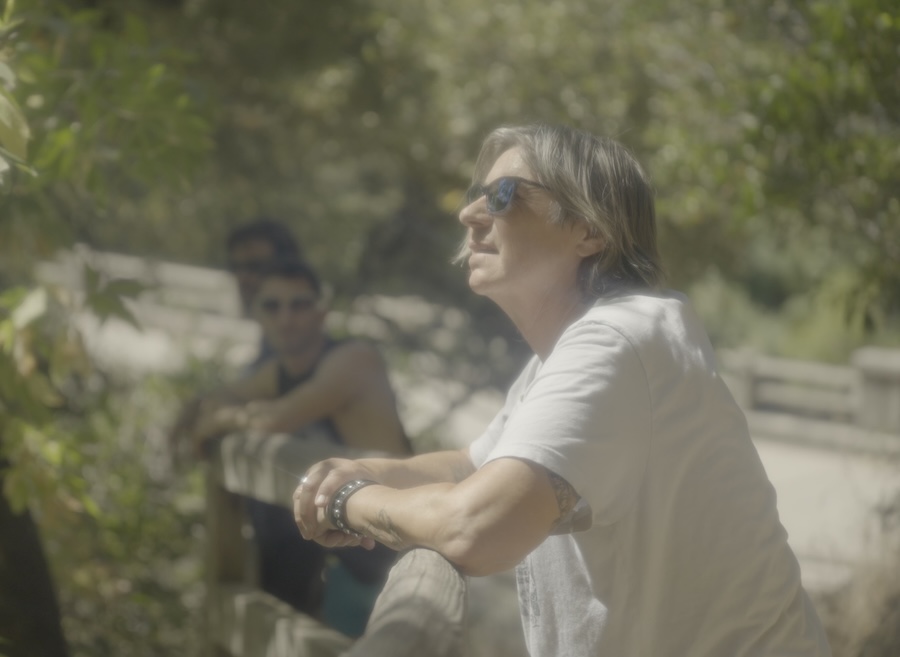
Lynn Breedlove has never stopped writing. Not after decades fronting seminal dyke punk band Tribe 8, not after founding Homobiles, not after winning a Lambda Literary Award, and not after 2020, when his stepbrother murdered his father and stepmother in their Grass Valley home. The writing just kept going, a daily practice that eventually became “Why I Like Dead Guys,” the debut album from Trust Me, his new band with guitarist Travis Andrews and percussionist Andy Meyerson of The Living Earth Show.
The three recorded the album over seven days in the house where the murders took place. Breedlove describes it as feeling right, like being close to the people he lost. He would fall asleep on the porch listening to Andrews and Meyerson composing inside. When it came time to deliver certain lines, he had to pause, breathe, and let the weight of the words land. That slowing down, he says, helped him feel his dad there.
The album that emerged is a series of vignettes about the men in Breedlove’s life, living and dead, beloved and infuriating. It spans the AIDS crisis, chosen family, knife collections, and a complicated inheritance of grief that Breedlove transforms, as he always has, into something that makes people laugh and cry at the same time. We sat down with Breedlove to talk about all of it.
The name Trust Me is striking and a little provocative. Where did that phrase come from, and what does it capture about the themes running through the album?
I have a tattoo I drew and got stick-and-poked by Stanya Kahn when we were on the ’97 Sisterspit tour. It says, “Trust me, I’m a doctor,” and the little stick figure looks crazy and has a knife. It was an ironic early 20th-century joke I applied to my onstage Tribe8 persona, my first band, in which a lot of knife-wielding and threats of revenge were aimed at men who were clearly NOT trustworthy. Many of us, including men, did not trust men, as they hadn’t earned our trust. And then my own stepbrother killed my dad and his mom, the ultimate betrayal. But that title has come to mean so many other things. As evidenced in most of my work and the stories on this album, collaborating with Travis Andrews and Andy Meyerson on this vulnerable project is healing my disappointment in humans of all genders, as it did in our other band, COMMANDO. With discernment, one can find some who are not enraging. Also, we’re asking the listener to trust where we’re about to take you and that, although daunting, the journey might be worth it.
Trust Me brings together storytelling, experimental music, and performance. How did the collaboration between you, Travis Andrews, and Andy Meyerson take shape, and when did it become clear this should be a band rather than another kind of project?
It was their idea. They liked the COMMANDO piece I wrote, called Prince, and the video we made with Daniel Foerste, a take on how Prince spoke to each of us personally, especially queer and trans people. Andy and Travis suggested we do more of that flavour, different from other COMMANDO songs. Honey Mahogany’s tunes tend to lean into a certain vulnerability, as do the lyrics of Drew Arriola-Sands, Krylon Frye, Juba Kalamka, and me, whose words express some tenderness, but in what I like to call “the key of RAHR,” whereas this is quiet storytelling put to acoustic guitar and some chill percussion.
The title “Why I Like Dead Guys” is provocative and emotionally complex. What does that phrase capture about the themes running through the album?
It’s also the title of the first song/story I wrote about my relationship with men. I like to say I’m a man-hating man, joking about how confusing it is to be a dude that’s mad at other dudes. WILDG was supposed to be a COMMANDO song, but ended up as the last piece on the album. The way we write, I blurt stuff out, and the guys say, “That’s cool, let’s put that here.” They thought it summed up all the other stories about men. I love ’em, I hate ’em; some are great, some are annoying, and some are heartbreaking. Some are all the things. It’s also a reference to a conversation I had with my dad after my uncle died, and I said, “Are you still mad at him?” And he said, “No, after people die, I’m not mad at them anymore.” And most of the stories are about dead guys (or dogs) or the one guy who ought to be but isn’t, and resisting the revenge urge for that guy, struggling to forgive or at least accept. I often find myself waiting for him to die. I resist that as well, because it gives him more space in my head than he deserves. I’m a fan of never waiting; just mind your business, and have some business to mind. Fortunately for me, my work is play. So, make rage into something helpful.
“Why I Like Dead Guys” was born from one of the most devastating moments of your life. How did you decide to turn that pain into art, and when did you know you were ready?
I never stopped writing. The boys suggested we make something out of that daily practice. We went on short writing retreats, and it evolved organically. There wasn’t a lot of effort on my part. It flowed easily. And they created the melodies as a river to float the stories down, making it safe to be as tender or irreverent as I wanted to be.
You recorded the album and built the live show over seven days in the house where the murders took place. What did it mean to be in that space, and how did it shape the creative process?
It felt right. I was home there and felt held, close to my dad and stepmom. I slept on the porch like always; the lights were low, the stars were out, and it was sweet. I’d look in the window from the porch at night, see Andy and Travis composing under the warm, colored lights, and go to sleep listening to their work. When we were recording, I did have to take a breath or do a couple of takes to deliver the lines without getting choked up. That slowing down helped me feel my dad there with me, or any of the people I was talking to or about. They all seemed to gather around to hear, the way you can feel the presence of the dead at a celebration of life.
This album confronts grief very directly. Did creating it change your relationship to the events that inspired it? And what does releasing the album into the world mean to you now?
I have always confronted my feelings directly. I’ve been accused of being intense. I don’t see that as a bad thing. And saying it out loud is more intense than writing it. When I read it, the words hit me, like, “Oh, I didn’t know I felt all THIS.” Although to anyone else it is obviously a lot. I tend to breeze through feelings that stop other people in their tracks. So, it was good for me to pause and feel the full weight of it. Performing it live, I can hear the sniffling in the room, and that’s even more impactful, to know everyone is grieving something. Afterwards, my pals come up, some still crying, often people I’ve never seen cry, tough guys, admitting they were laughing at the same time. And that’s the goal, to evolve from the chainsaw-wielding, put down weapons and face crises with humour, and to lead anyone else to the tools to do the same. It’s a relief to see we’re not alone in our struggles.
“Cornfed Boy Finds Bag” revisits the San Francisco underground during the AIDS crisis. What made that particular memory and person important to include in the album’s narrative?
All the other losses were brought back in this process by the main one. It’s a domino effect. And a lot of the characters aren’t even the closest people I lost. Along the way, the stories I chose to tell were almost random, like, oh, this person is an archetype, oh, that one became part of me, and the idea that no suffering is less or more important than any other for the individual. Some people were easier to talk about because we weren’t as close, but they were all important as members of my community, symbols of all the rest. But Cornfed Boy specifically showed me how fast we could die. I was living a high-risk life right before I met him, and after he left, I went back to that life more intensely than ever for about a year, as if to say, “Fuck you, Death, I’m invincible,” or “I can’t stand to feel all this,” and then I quit. Partly because of him. But he’s just one of many of my other friends and community members who died of or lived with complications from AIDS. He just happened to be very close in my daily life when it happened, so that knocked me for a loop. His shock became mine in real time.
You’ve been telling queer stories for over thirty years. What has changed in how the world receives those stories, and what remains just as hard?
I don’t know how each individual receives any story. That’s the thing, you write it, put it out there, and let go of the outcome, and that’s the hard part. It’s both challenging and freeing to write with no attachment to how it’s received. I didn’t think anyone would want to hear this. But apparently, it’s needed. We’re all experiencing grief, anger, compassion, love, and irritation for our fellow humans, and yet we need to lean into all of that, which is counterintuitive, especially now.
How do you see this album fitting into the broader story of queer memory and survival?
That’s why they’re a handful of character-driven vignettes. I hope it reminds us of who impacted us in our lives and that when those people left, they became part of us. We are asked to make our own myths because our heroes are always ripped away, devalued. We need to keep talking about those who inspire us.
The idea of chosen family appears repeatedly in your storytelling. How has that concept evolved for you over the years?
It was a strong concept in my small family. My German mom was separated from her mom by the wall at a young age, and so she was always pulling aunties, uncles, sisters, and her friends’ children to her. Met them because they rented her a room in Berlin, or stayed friends for life with her ex from Chemnitz. A very not-straight lady thing to do. My dad was a basketball coach, a father figure to lots of boys. And he married into a large family after he and Mom divorced, so he inherited three sons and a bunch of grandchildren and great-grandchildren. I was an only child, so I was always trying to build community, start a band or a business, or meet all the queers on tour, make them laugh, and start a pit. Now it’s based on compassion. Shoring each other up. There has always been a violent element in society attacking their neighbour, but it’s the first time I’ve been this present for it. The gift of a personal tragedy is, if you’ve been at all self-centred before, it can be, as we like to say, another fucking opportunity for growth. A wake-up call to the hardships of anyone who’s been subjected to threats daily for centuries, or a bad childhood, or a single incident that changed everything forever.
We get to see, as my grandma said, we’re “not the only pebble on the beach,” while also having compassion for ourselves. It’s not an either/or situation.
As “Why I Like Dead Guys” arrives and the live show continues to evolve, what’s next for Trust Me? Do you see this as the beginning of a longer journey for the band?
There’s a potentially endless supply of stories as long as my brain and body continue to function. If the boys don’t get bored, I’m in. I have no plans to shut up any time soon. Authoritarianism makes for some pretty good punk rock, art, philosophy, and activism, unless they manage to suppress it entirely, and even then, it just goes further underground. As Medgar Evers said, you can kill a man, but not an idea.
Follow Trust Me on Instagram and Bandcamp.
Follow The Living Earth Show on Instagram and YouTube.
Follow Lynn Breedlove on Instagram.
Interview by Escarlina.
