


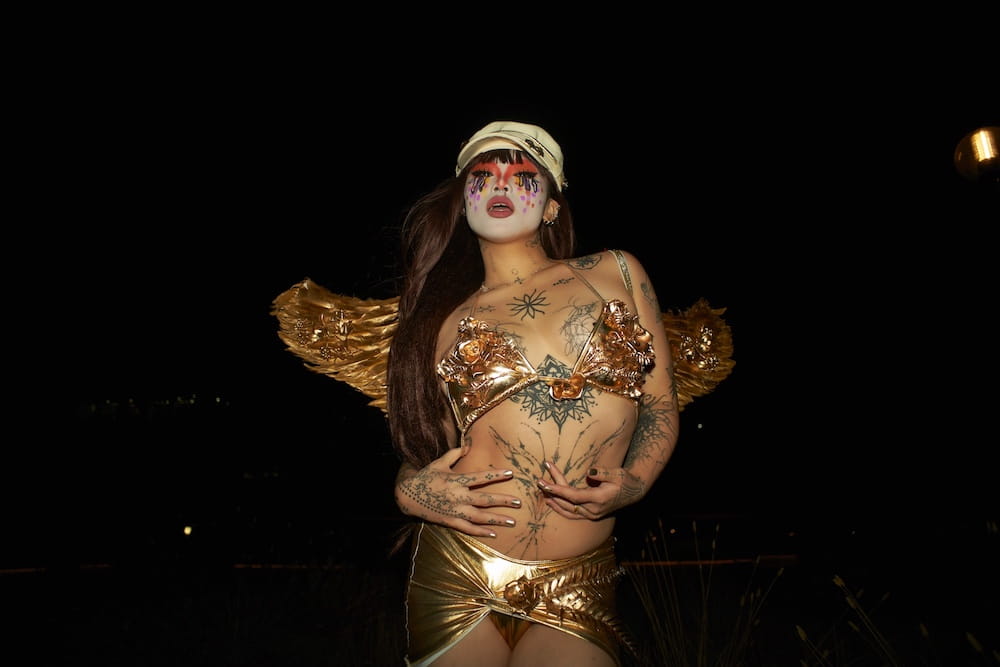
Known across London’s club circuit for high-intensity techno and hardcore, DJ and producer AC (dot robot) steps into a deeply reflective space on her new EP, London 2026. Written between autumn 2025 and summer 2026, the four-track project serves as a seasonal audio diary documenting her transition from student life to creative independence. Released on 16 October 2026, the record captures her journey since moving from China to London at eighteen, tracing the realities of immigration, heartbreak, and self-discovery as a young queer woman.
Across its four tracks, AC (dot robot) maps her personal evolution through the seasons. From the resilience of opening cut “No Regret” to the vulnerable trance atmospheres of “The Worst of Me,” the traditional Chinese pipa melodies on “Rocky,” and the nostalgic warmth of “Summertime Daydream,” the EP reveals the full emotional spectrum of her artistry. Below, she speaks with us about converting raw vulnerability into club music, honouring her cultural roots, and how London’s queer community helped her build a place of her own.
You describe London 2026 as an “audio diary” across four seasons. At what point did you realise these tracks were telling a single chronological story?
It wasn’t something I planned from the beginning. The inspiration and production of each track came from the four seasons, so as I put the tracks together, I realised they naturally followed a chronological journey through the year. That’s when I realised they weren’t just separate tracks, but were becoming one chronological story of a year in London.
Looking back at the version of yourself who moved from China to London at 18, how has your relationship with the city and your identity within it changed?
Actually, quite a lot has changed. When I first moved to London at 18, the city felt huge and incredibly free, but at the same time, there was always this sense of floating, I don’t really knowing where I belonged. Back then, I was mostly focused on adapting to the city, the language, and a completely different way of life. I also couldn’t help comparing myself to the people around me.
As time goes by, I realised that my relationship with London had shifted from “I need to fit in here” to “I can live here in my own way.” Nowadays, I have a much more complicated sense of familiarity with the city. There are things I love, things I complain about, and things I’ve definitely grown attached to. When it comes to identity, I no longer feel the need to define myself so strictly as either Chinese or Londoner. Instead, I feel like both sides have become part of who I am.
Looking back, I don’t think my 18-year-old self realised that moving to London wasn’t just about changing where I lived. In a way, it was also the beginning of slowly discovering and redefining who I was.
“No Regret” was written on a flight back to London. What was it about being between two homes that brought those feelings of resilience into focus?
I admire myself, and at the same time, I feel deeply for the person I’ve had to become. I want a better life, and I’m willing to work hard and fight for it.Sometimes, when I think about everything I’ve been through, the hardships, the setbacks, and even being bullied by others in different situations. I still cry. But I don’t cry because I’m weak. I cry because I feel for myself, and for everything I’ve had to endure. Somehow, after I let those emotions out, my goals become even clearer, and I feel more certain about what I believe in.
I don’t really see my life as being between two homes, or as a feeling of being lost. This is the path I chose for myself. Looking back at all these years, I realize it hasn’t been easy but I made it through. And every year, I can see my life getting better and I am getting closer to the goals I’ve set.
Anything that didn’t break me has only made me stronger. The difficult experiences have become part of my story, and they’ve given me perspective, depth, and strength. I’m ready for what comes next.
“The Worst of Me” confronts guilt and relationship breakdown. How was it processing such vulnerable emotions through a techno framework?
I think techno gave me a different way of processing those emotions. When you’re dealing with big emotions, it can be difficult to put everything into words. The repetition and physicality of electronic music allowed me to step outside of the emotion a little bit and experience it through the body instead.
For this track, I brought in a lot of trance elements, especially in the atmosphere and emotional build-up. I wanted to take something very intimate and vulnerable and put it into a framework that could still feel beautiful and euphoric. In that sense, the music became a way of releasing those feelings rather than simply describing them.
“Rocky” blends traditional Chinese pipa with modern electronics. How did you approach bringing that heritage sound into your contemporary production?
Pipa is a traditional Chinese instrument, and I’ve always been really drawn to its unique timbre. I remember listening to “Ambush from Ten Sides”and being completely moved by the sound of it. The pipa can be incredibly clear and bright, but it can also carry something much deeper and more melancholic.
When I was making “Rocky”, I wanted the track to feel very relaxed and natural, something that could give you a sense of relief, where you can embrace loneliness and maybe even find some comfort and beauty in it. There’s also this subtle feeling of spring arriving, like a sense of renewal and hope. So I thought adding pipa into Rocky would be a great idea. Its sound brought another emotional layer to the music without taking away from that feeling of lightness.
At the same time, I’ve always wanted to introduce more traditional Chinese instruments to people from different cultural backgrounds through my music. I call my music “cunty techno”, and I think there’s something inherently cunty about Chinese traditional instruments too. So putting them into my music feels very powerful to me. Chinese culture is cunty, traditional instruments are cunty, and the way I bring them into techno is cunty too.
I’m taking something that belongs to my cultural background and putting it into the music I’m making through AC (dot robot)’s taste.
“Summertime Daydream” touches on growing older away from home. How do you balance building a new life in London with holding onto your roots in China?
I don’t really see the situation as I have to choose between the two. China is where I come from, and London is where I’m building my life now, so both naturally become part of who I am.
I’m grateful for the foundation I had in China, which gave me the confidence and freedom to choose my own path and come to London. Moving to London has given me a lot of new experiences and perspectives, but I still carry my memories, culture and the way I grew up with me. I go back to China every year and spend time with my family, so I never really feel disconnected from home. Being away from them makes me want to work harder and build something meaningful here in London, so that one day I can give something back to my family.
For me, it’s not about leaving one place behind for another. It’s about taking where I come from with me, while building a life here and continuing to grow.
How did finding London’s queer community shape your sense of belonging, and in what ways has that network influenced your growth as an artist?
London’s queer community has been a really important part of finding my sense of belonging here. I’m queer myself, my closest friends are queer as well, so being surrounded by this community feels very natural and personal to me. It’s a space where I can be completely myself, while also being inspired by people with very different backgrounds, stories and ways of expressing themselves. It’s been a phenomenal experience.
As an artist, it has encouraged me to be more open, experimental and honest in my work. I’ve also learned a lot from the people around me, not just musically, but from their different stories and ways of seeing the world. That sense of freedom and openness has definitely become part of how I approach my own music.
People know your DJ sets for high-intensity techno and trance, but this EP is far more reflective. How do those two sides of your sound feed into each other?
I see my DJ sets and making music as two different but connected ways of expressing myself. A DJ set is very much about the audience — it’s a form of release, a shared experience, and a celebration that belongs to everyone in a some space. Making music, on the other hand, is much more intimate. It’s a process of constantly thinking, experimenting and questioning, like having a conversation with myself.
I think they feed into each other because the energy and emotions I experience with an audience find their way into my music, while the more introspective side of making music gives me a deeper understanding of what I want to express when I DJ.
Having established yourself in London after moving on from student life, how has your relationship with independence shifted while making this record?
I think my relationship with independence has changed quite a lot. When I was a student, independence felt more like being able to take care of myself — figuring things out on my own, making my own decisions, and learning how to navigate a new city.
What’s interesting is that this EP documents that transition in real time. When I started working on the first track I had just graduated and was only beginning to figure out what an independent version of myself looked like. By the time I finished the last track of the EP, I had found a job also and had really started to establish myself in London.
In a way, the first track represents me beginning to search for that independent version of myself, while the last track marks the point where I finally felt like I had become “her”.
I think that’s also changed what independence means to me. It’s become less about proving that I can do everything on my own, and more about trusting my own instincts, making choices that feel right for me, and taking responsibility for them. Looking back, I realise the EP isn’t just a collection of tracks, it’s also a record of that transition into adulthood and into a version of myself that feels much more grounded.
What do you hope listeners take away from hearing such an intimate, seasonal snapshot of your life?
I want to tell them that “ You are not alone”. I hope people can connect with the emotions behind the tracks, even if their experiences are completely different from mine. The tracks are very personal and rooted in different seasons of my life in London, but I hope they also remind listeners of their own memories, places and moments.
Follow
@acdotrobot
London 2026 is out now: https://tr.ee/qPBtM1Lff9
