


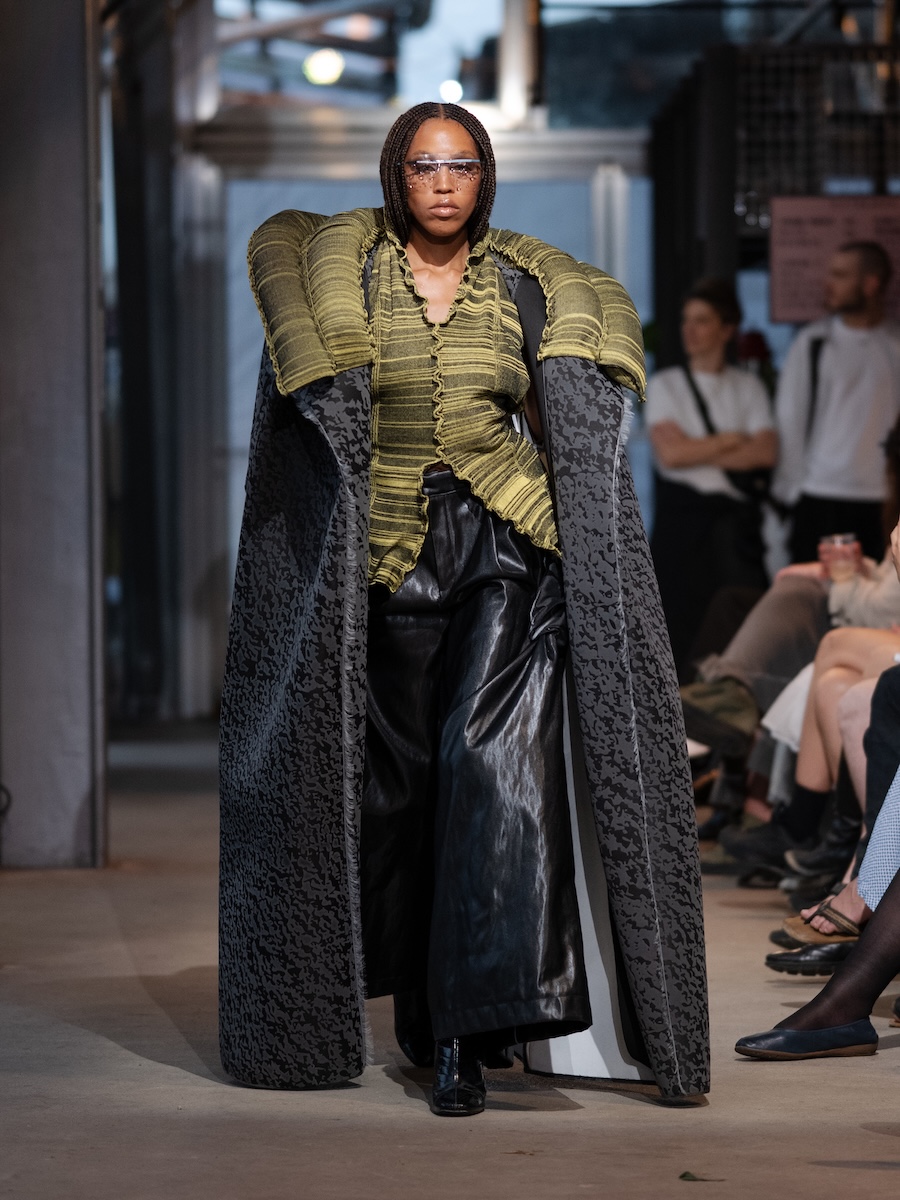
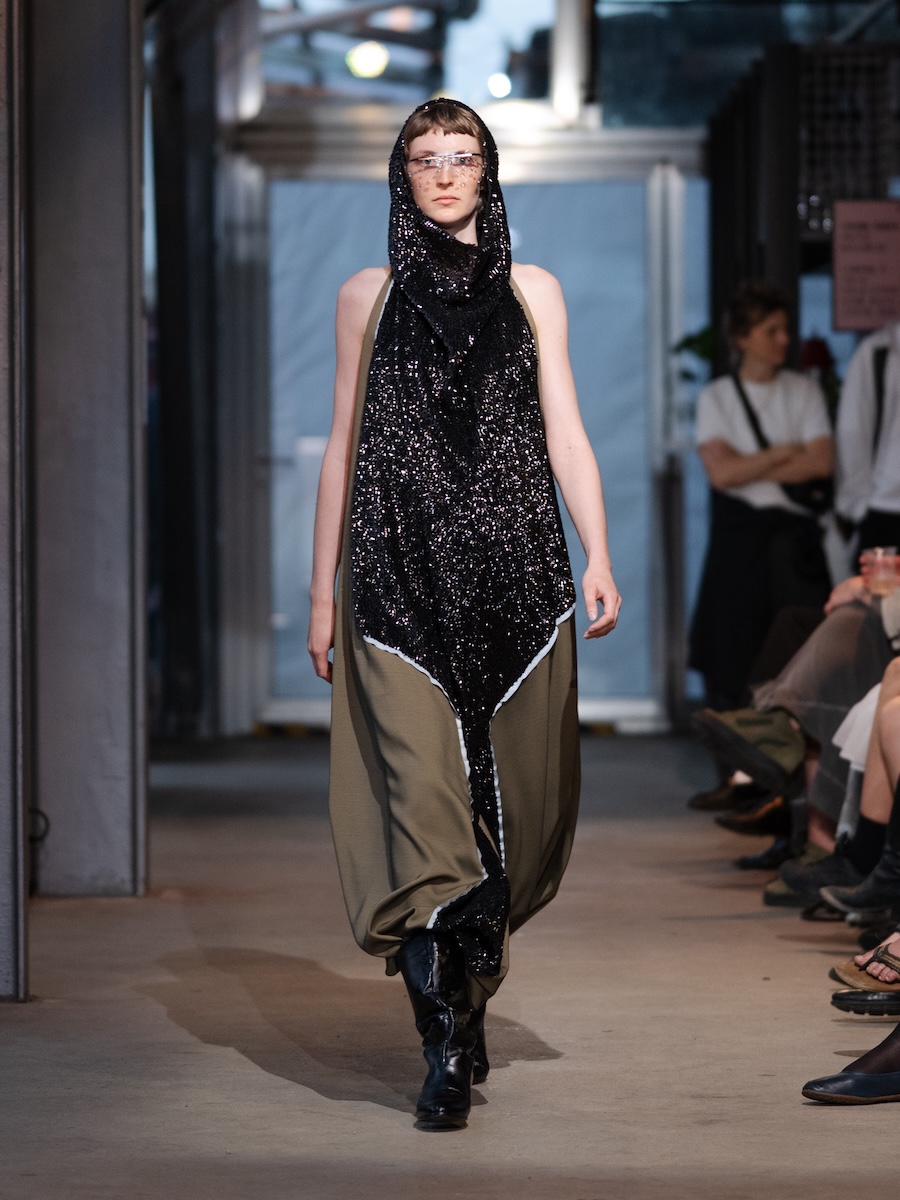
Where the industrial friction of the highway meets tactile human protection, you find the design world of Änne Ruwe. Her graduate collection, ‘Achtung, Wildwechsel!’ (Caution, Deer Crossing!) is a high-impact exploration of volume, technical armour, and the fine line between concealment and bold visibility.
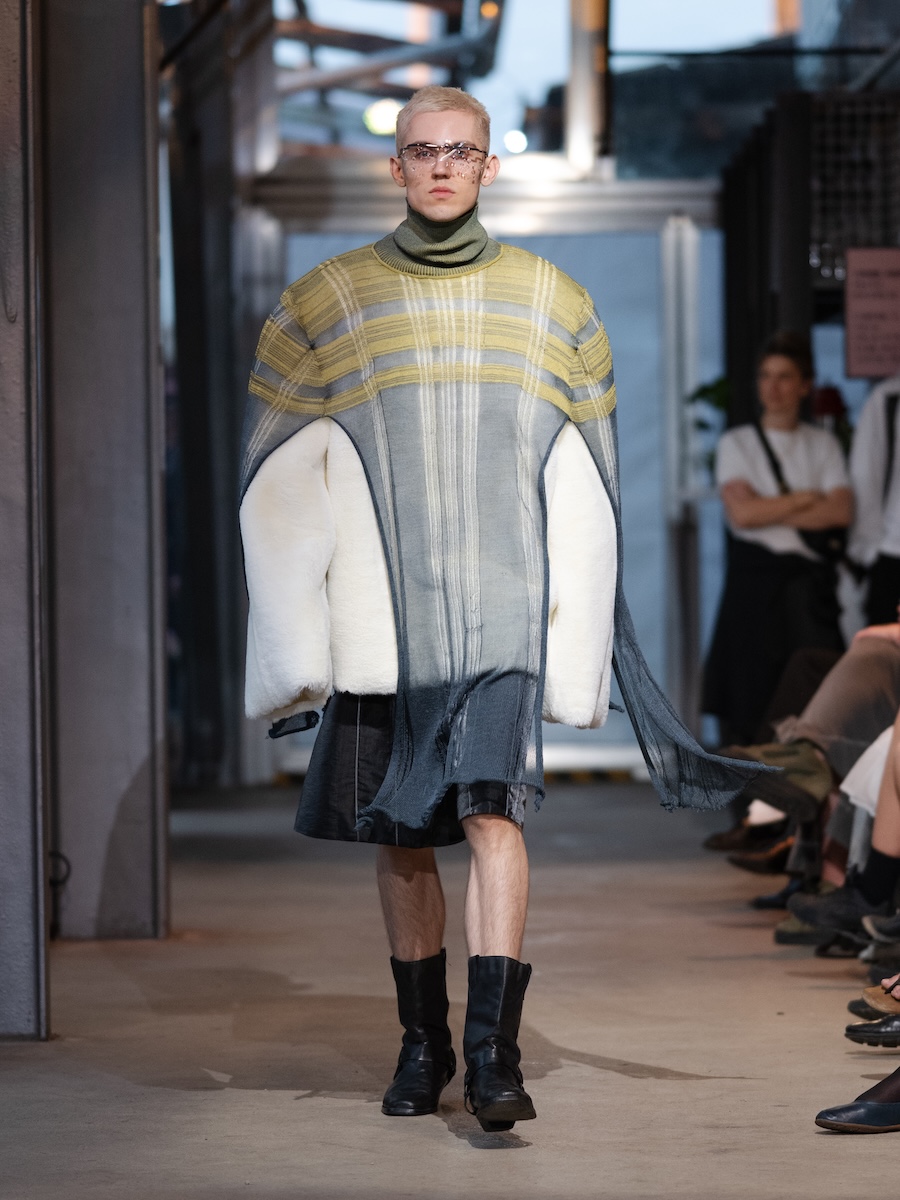
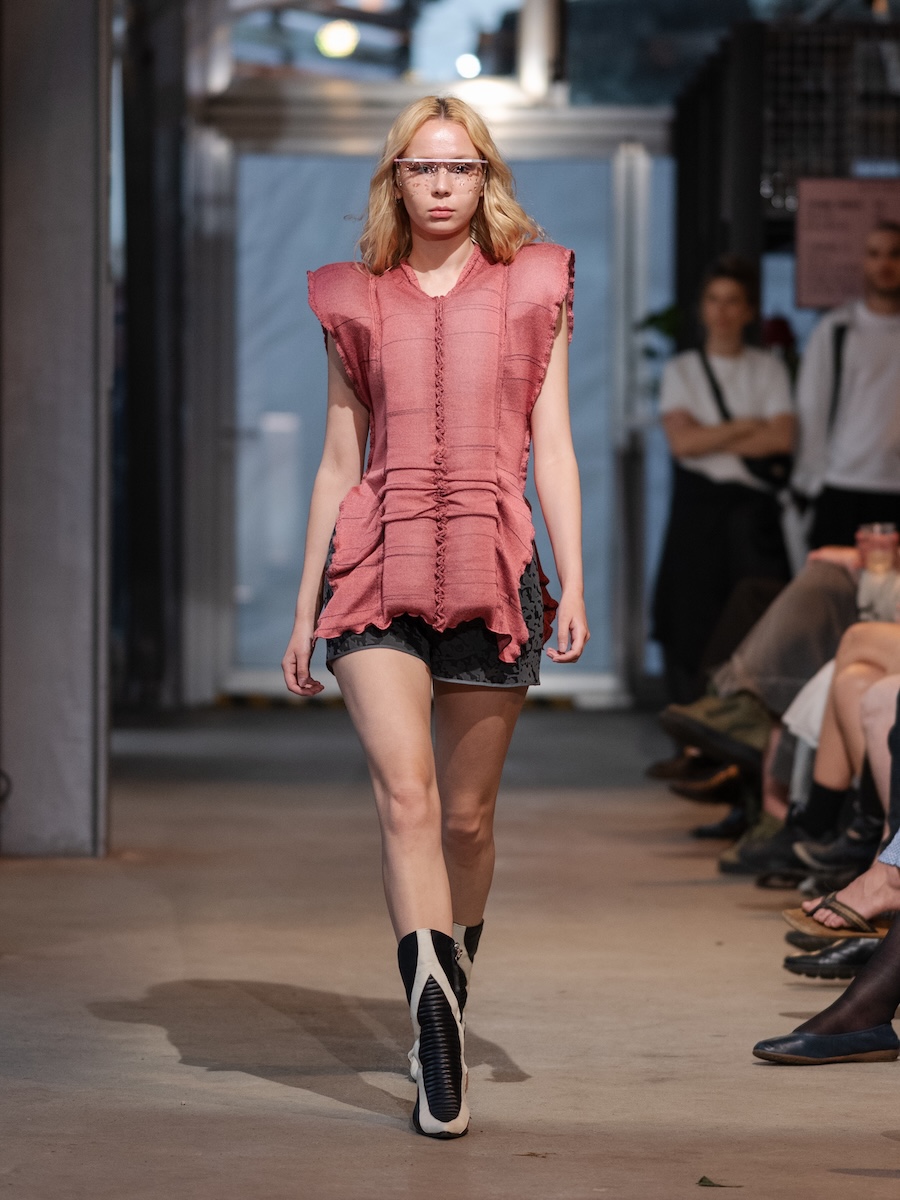
Drawing inspiration from childhood road trips between her hometown of Greifswald and North Rhine-Westphalia, along with a visual nostalgia rooted in bold, graphic cartoons, Änne translates mechanical aesthetics into sculptural silhouettes. At the core of her collection sits dense neoprene, emblazoned with photographic macro-prints of cracked highway asphalt. She expertly counters these rigid, technical forms with organic, malleable structures born out of intensive experimentation in the knitting workshops. The result is a tactile dialogue between hard asphalt surfaces and soft, cocooning armour designed to empower the wearer.
Grounded by a simple yet vital question: “Would I wear this myself?”, Änne approaches design with an eye for clean bounds, hidden details, and genuine physical comfort. When her looks commanded the runway against the concrete architecture of ZK/U, the fusion of street texture and high-concept sportswear felt right at home in the Berlin landscape.
Charcoal Black Sesame & Asphalt Armour: Step Into the Universe of Änne Ruwe
Read on as we talk to Änne about the thrill of merging smart textiles with traditional knitcraft, designing for comfort and protection, and why her collection looks and feels exactly like a scoop of charcoal black sesame ice cream.
What was your approach to choosing your materials, and how did working with those specific textiles or textures impact your design process?
Initially, I looked for materials that are particularly good at creating large, voluminous silhouettes and that have a slightly ‘technical’ look. Neoprene became a core fabric in the collection. I also printed on it. The pattern is originally a close-up of cracked asphalt.
I also spent a lot of time in the knitting workshop, experimenting with knit patterns and yarns. The results were great organic shapes that I integrated into the collection. I really like the interplay between these rather technical, static materials and softer, more malleable elements. In general, textiles, textures, and colours have a major influence on my design process. Exciting surfaces inspire me and often contribute to the shape-finding process during my very first design steps.
How do your personal background, heritage, or the environments you’ve lived in manifest in the details of your designs?
As a child, I spent a lot of time in cars travelling from my small hometown of Greifswald to visit family in NRW. These road trips sparked my fascination with cars and all things technical. I also have a weakness for clean cuts and shapes, finding great aesthetic value in bound edges and hidden details. I trace this appreciation back to my childhood love for cartoons and comics.
Looking back at your time as a fashion student at Weissensee, what was the most valuable lesson—or perhaps the most unexpected challenge—that shaped your identity as a designer?
Last semester, a visiting lecturer asked me during one of our meetings whether I would wear my own designs. It is quite an obvious question, but I remember it often when I’m stuck in my process.
Berlin has a very distinct subcultural and creative energy. In what ways, if any, did the city’s landscape or community influence your graduate work?
I think studying fashion here is really ideal. Just walking the streets provides you with endless inspiration from so many impressions. And the atmosphere encourages constant experimentation as well.
Many collections today engage with contemporary cultural, political, or ecological themes. How do you view your role and responsibility as a designer entering the industry right now?
It is very important to be aware of that responsibility. Fashion is a visual medium that carries and communicates so much.
For me, I see my role as developing garments that offer physical comfort, protection and empowerment for the wearer. For the future, I hope that the industry becomes more inclusive and accessible.
Your collection showcases a balance between conceptual thinking and technical craftsmanship. How did you navigate the space between free experimentation and practical execution?
I think having a balance between the two is exactly what creates interesting looks. For me, allowing conceptual freedom to dictate the shapes, while relying on technical execution to refine them, keeps the designs both innovative and wearable.
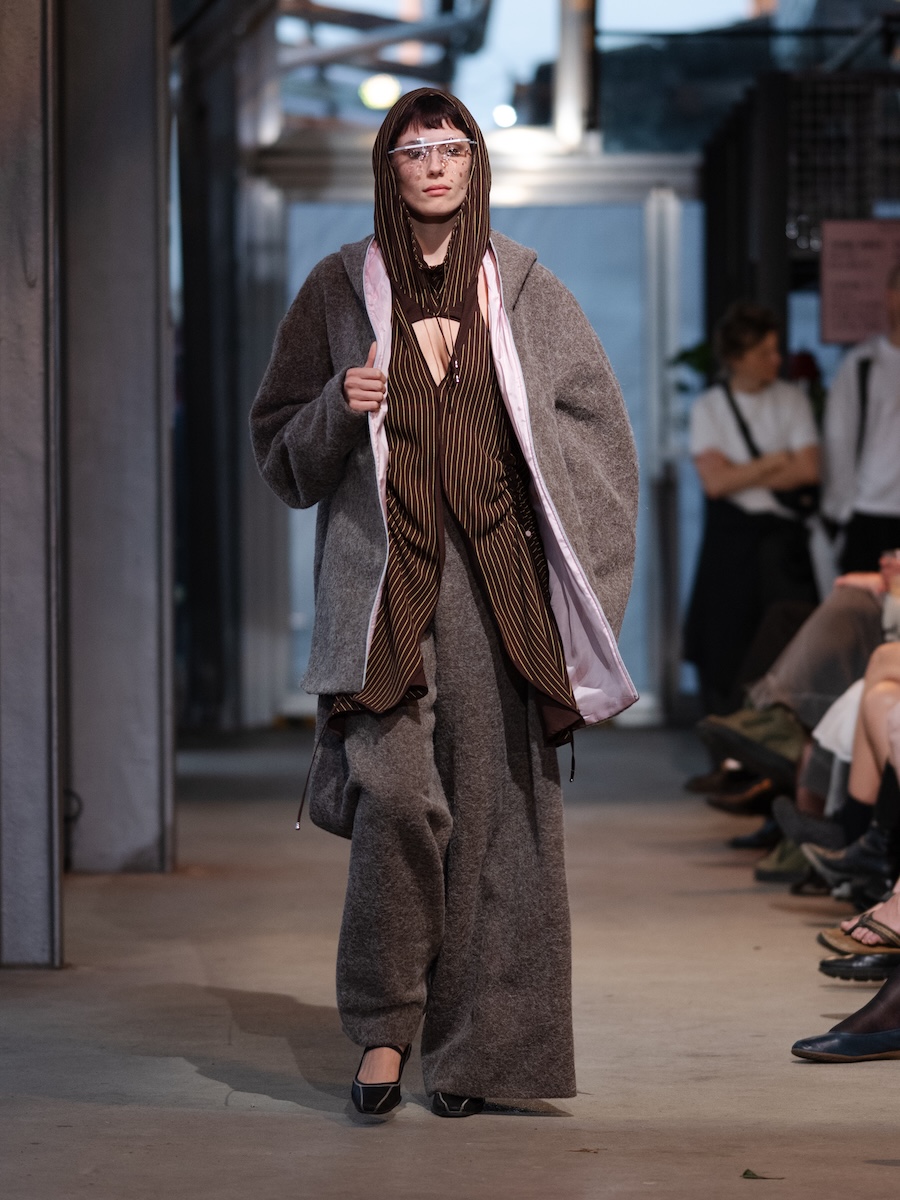
Seeing your work transition from the studio into the specific architecture and energy of yesterday’s show at ZK/U, how did that moment feel, and did it change how you view your own pieces?
It was truly a special moment. The location was amazing, and seeing the collection finally on the runway after all that hard work was so great. It is always a little bit surreal watching your ideas become reality.
What kind of dialogue or emotional reaction do you hope to trigger in the person viewing or wearing your garments?
First of all, the wearer should feel comfortable. This collection explores how clothing can offer protection and concealment while remaining visible and noticeable. I hope this translates when worn!
Now that the graduate show is behind you, what aspects of your creative practice or design philosophy are you most excited to explore next?
I would really like to dive deeper into the intersection of smart, technical textiles and traditional craftsmanship. I want to continue experimenting with surface textures, like the asphalt prints and specialised knits from this collection—and explore what is possible.
If your collection or creative identity could be translated into an ice cream flavour, what would it be and why?
I guess it would be Charcoal Black Sesame. I had it once at an ice cream shop here in Berlin, and it was surprisingly good. It fits perfectly visually and texture-wise!
@aeruwe
Models: Jazz @vagabond.jazz Karl @karlklemens Veronika @lookanhate Lilly @lilly.ro.se Flora @flora.in.progress
Anita Schulte-Bunert – Runway Photography @nit.sb
CREATIVE & MOVEMENT DIRECTORS
Sarah Ama Duah @sarah_ama_duah
Madlen Schmid
PRODUCTION DIRECTORS
Doreen Schulz
Madeleine Madej
CASTING DIRECTOR
Madlen Schmid
STYLIST
Tabassom Charaf @tabicharaf
MAKE-UP ARTISTS
Head of Make-Up Artists: Feride Uslu @feride_uslu11 für airbeauty.com @ferideairbeauty
Dominika Obacz @dominica_obacz
Mert Kenger @mertkenger
Sarah Elisa Fischer
Sarah Ort
HAIR ARTISTS
Nicole Puzalowski
Béanne Da Costa @hairtouchedby
Jennifer Ohia @mmynd.irl @5.minah
Special thanks to our partners
Bezirksamt Mitte
ZK/U Zentrum für Kunst und Urbanistik @zku.berlin
Objets Trouvés Möbelmanufaktur @objets.trouves.berlin
uns* Model Agency @wirsinduns
VIVA Model Agency @vivamodelsberlin
The event is supported by the Economic Development Office of Berlin’s Mitte District Council in cooperation with PLATTE.Berlin, which is responsible for guest management and PR @platte.berlin
