


True harmony is rarely found in identical elements; it sparks when opposites clash and resolve. For Japanese-international designer Sayo Mogi, her graduate collection, ‘SYNERGY – was wir suchen finden wir unterwegs -’ (what we are looking for, we find along the way), is an exquisite study in bringing opposing worlds into a singular, poetic flow.
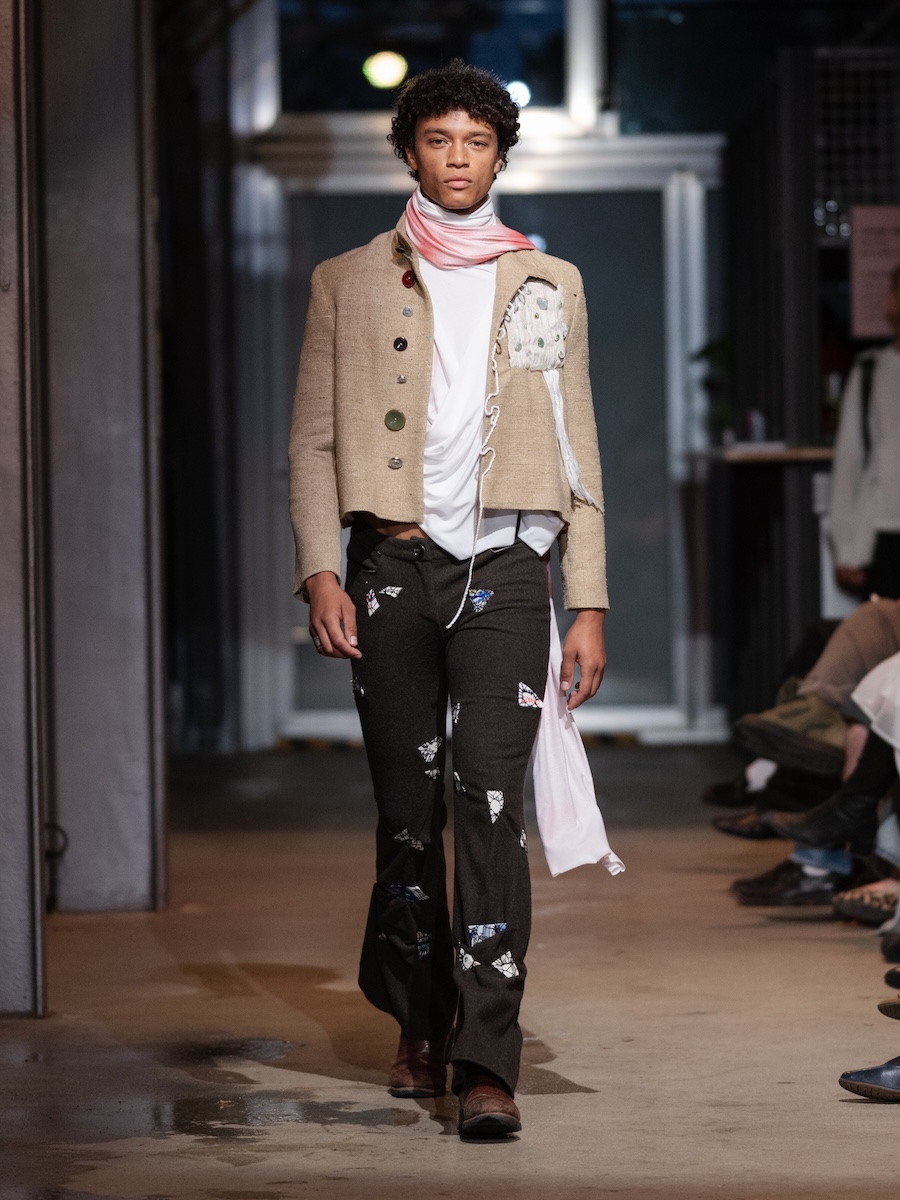
Having grown up moving between countries, cultures, and histories, and deeply influenced by both traditional Japanese craftsmanship and her father’s cinematic storytelling in Vagabunden Karawane, Sayo’s design language is inherently nomadic and conceptual. In SYNERGY, rigid, unforgiving elements meet fluid softness: hand-moulded ceramic shards balance against traditional heavy Loden trousers, while raw stones are woven directly into jacket pockets alongside artist collaborations with @sophia_engel and @zoelinea.
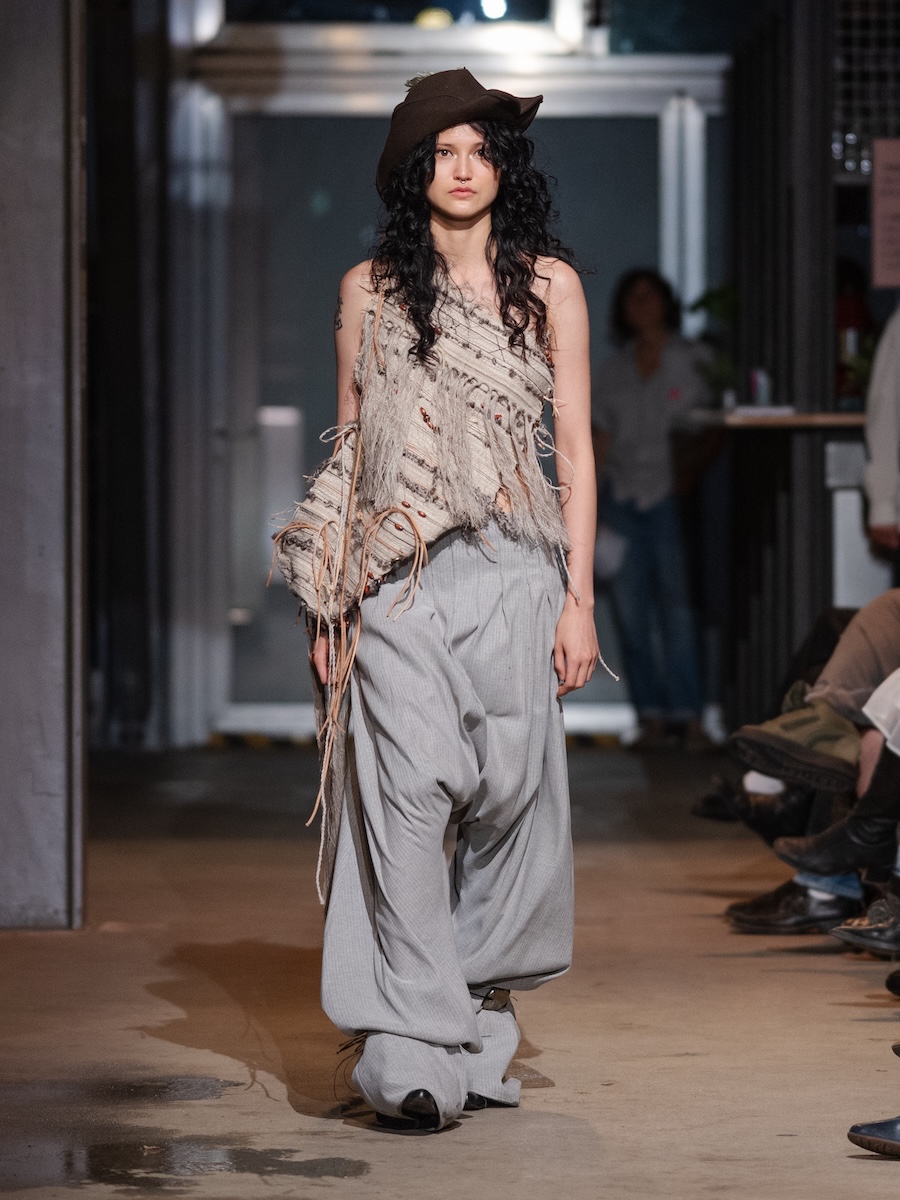
Having arrived in Berlin alone at age 19, the city became the backdrop for her transition into adulthood, granting her the creative space to forge an independent path. For Sayo, fashion is an antidote to mindless fast-fashion consumption; it’s about handcraft, mindful production, and evoking a quiet, bittersweet nostalgia. When her models stepped out at ZK/U, her sculptural, tactile garments shed their studio isolation and took on individual human life.
Raspberry-Coconut & Tactile Synergy: Step Into the Universe of Sayo Mogi
Read on as we talk to Sayo about balancing personal vulnerability with design, searching for purpose beyond commercial profit, and why her creative universe tastes like a fresh, unexpectedly layered scoop of raspberry-coconut ice cream.
What was your approach to choosing your materials, and how did working with those specific textiles or textures impact your design process?
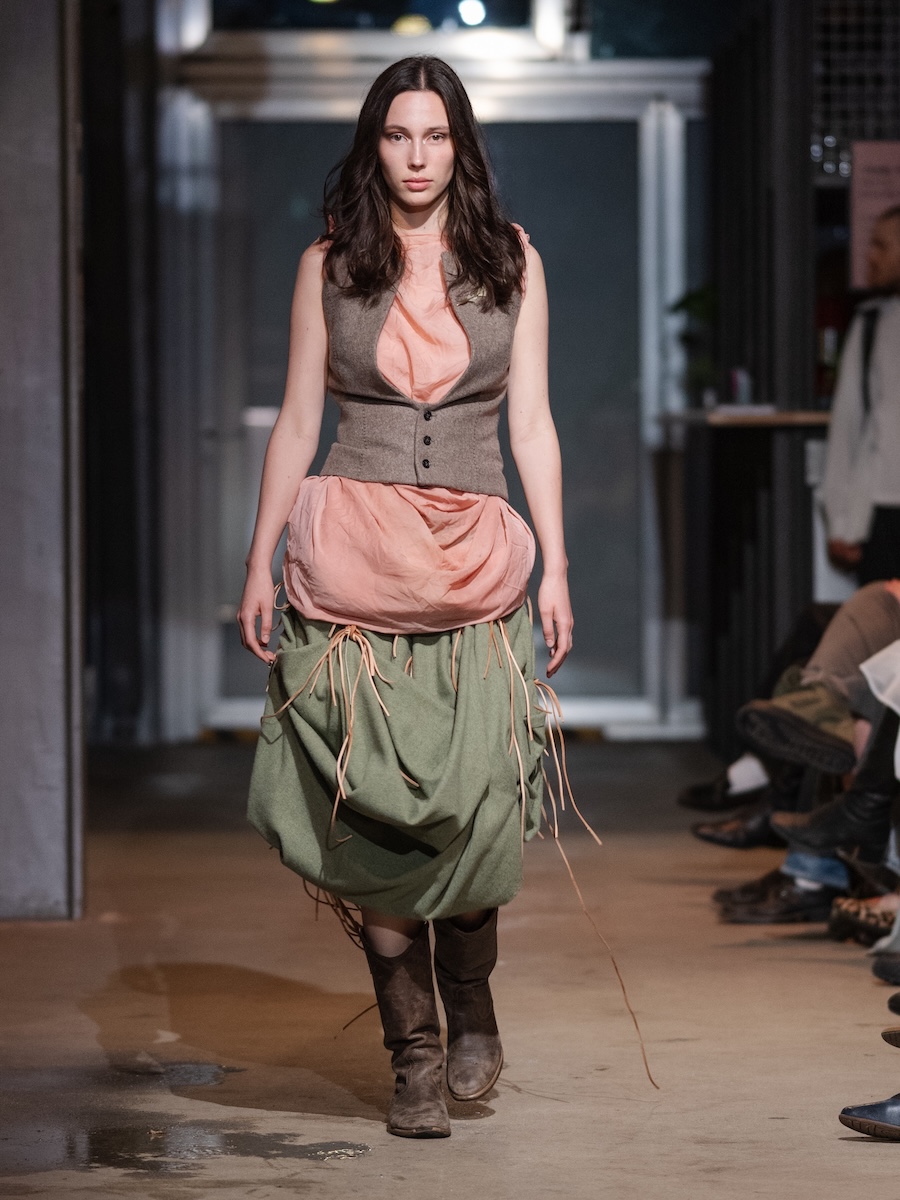
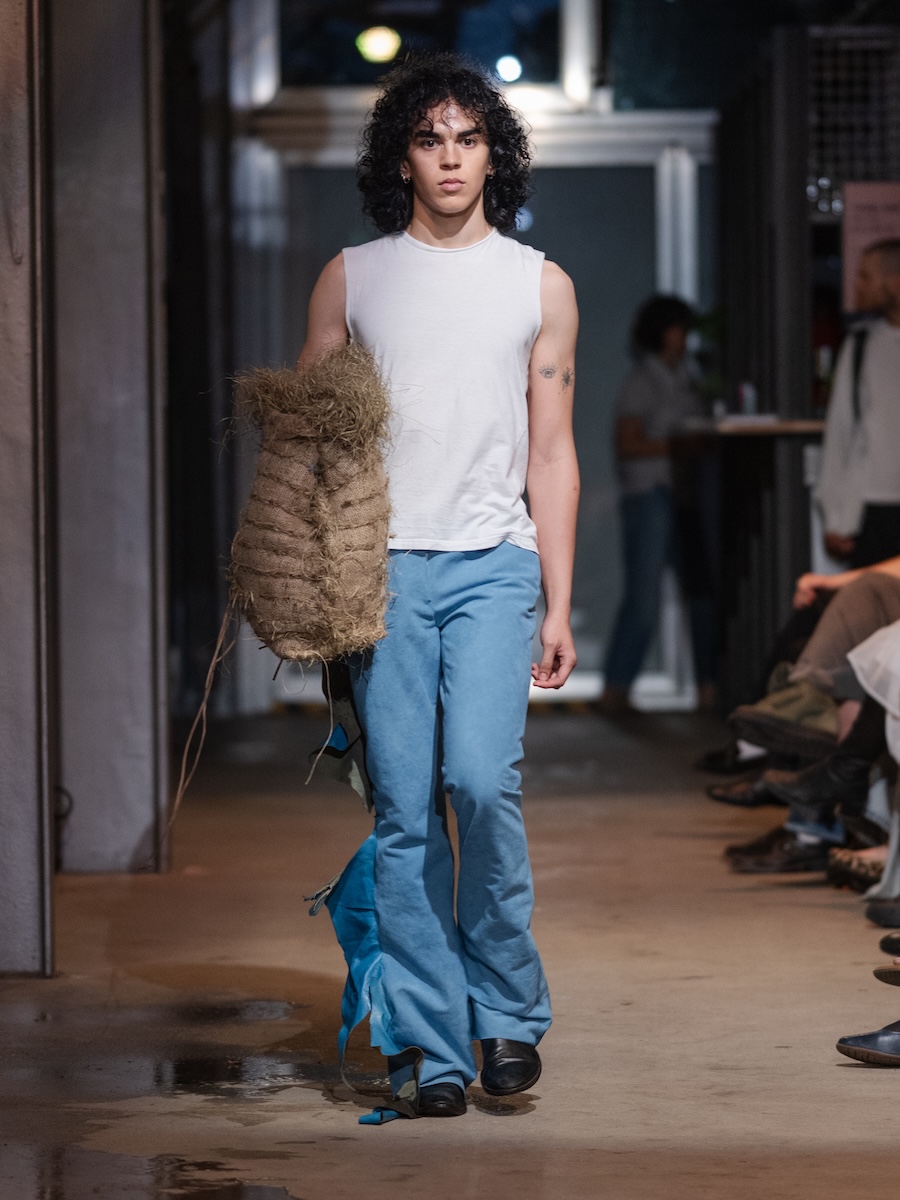
My collection is called Synergy. I focused on selecting materials that don’t traditionally match, yet when combined, they create the illusion of two opposite elements coming together. For example, the brown Loden pants are paired with ceramic shards that I held in my hand, and on the pocket of my jacket, there are stones woven into the textile. Hard and solid materials combined with soft and fluid textures create a sense of synergy—melding contrasting elements into a coherent whole.
How do your personal background, heritage, or the environments you’ve lived in manifest in the details of your designs?
I grew up moving between several countries because of my parents’ work, and having parents from different cultural backgrounds has given me a deep appreciation of diverse histories and how different cultures can intertwine. I am often inspired by Japanese craftsmanship and their understanding of materials. At the same time, my father’s work as a filmmaker, especially the concept behind the movie Vagabunden Karawane, has influenced the more narrative and conceptual aspect of my designs.
Looking back at your time as a fashion student at Weissensee, what was the most valuable lesson—or perhaps the most unexpected challenge—that shaped your identity as a designer?
One of the biggest challenges I encountered was reflecting on how my personal life influences my work. It’s neither purely positive nor negative, but finding a balance between my personal situation and creative output has made my work deeply personal and authentic.
Berlin has a very distinct subcultural and creative energy. In what ways, if any, did the city’s landscape or community influence your graduate work?
I’m not sure if my work is directly influenced by Berlin’s culture, but living here forced me to reflect on many things and gave me important space to develop independence. I moved to Berlin at 19, alone and far from family, and now at 25, I consider this city the place where I transitioned into adulthood and created my own environment as an independent person.
Many collections today engage with contemporary cultural, political, or ecological themes. How do you view your role and responsibility as a designer entering the industry right now?
I believe that as a designer today, it is crucial to approach cultural, political, and ecological issues with both awareness and sensitivity. Striking the right balance is challenging, but these themes influence me constantly and shape how I think about my work. I see my responsibility as creating pieces that not only tell a story or express an idea but also reflect an ethical understanding of the world around us.
For me, sustainability is more than just material choices — it’s about valuing craftsmanship, longevity, and mindful production. I want my work to contribute positively, encouraging people to think critically about consumption and the impact of fashion on the environment.
Collaboration plays a significant role in this process. For my BA project, working with artist friends allowed me to explore perspectives and techniques beyond my own vision, bringing richness and depth to the collection. I believe that openness to dialogue and shared creativity can lead to more thoughtful, impactful work.
Your collection showcases a balance between conceptual thinking and technical craftsmanship. How did you navigate the space between free experimentation and practical execution?
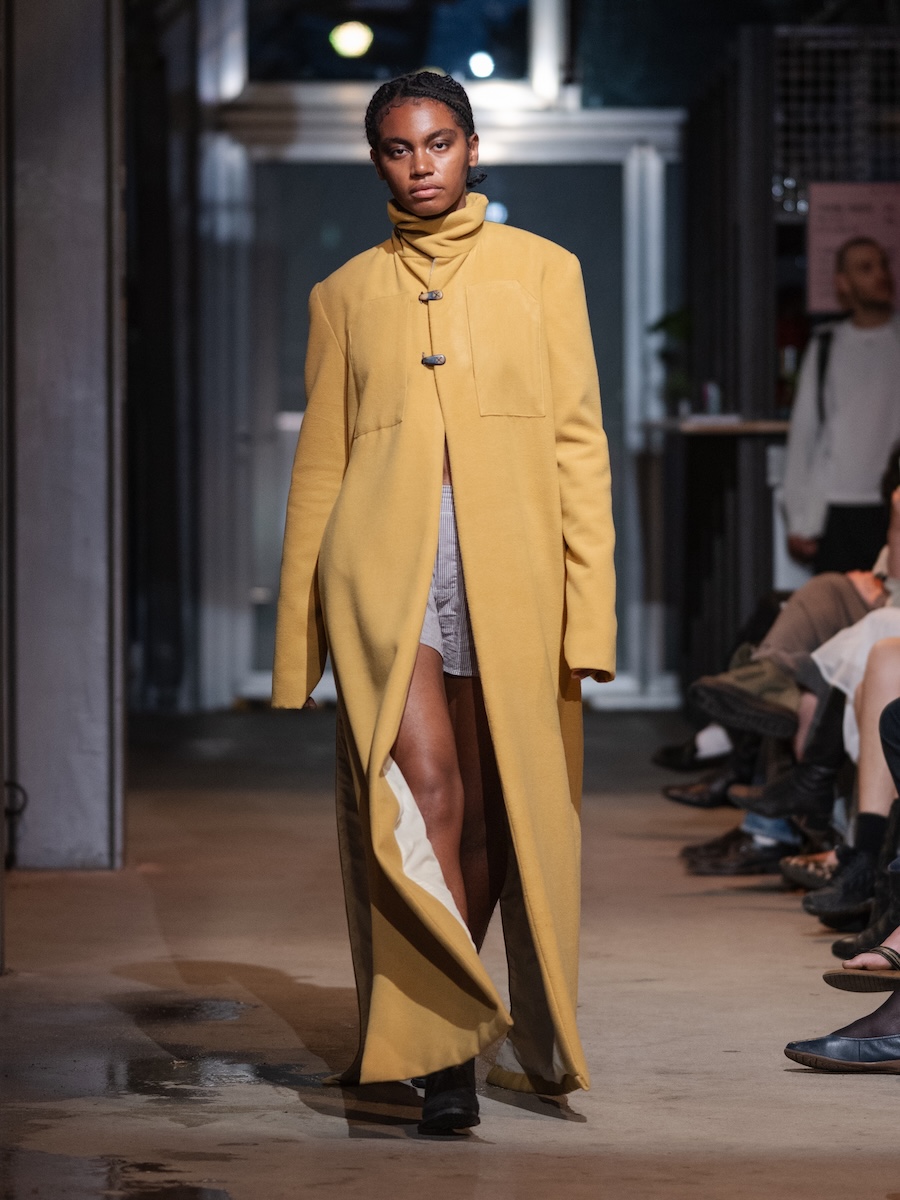
Conceptual thinking is essential throughout my process. I constantly analyse and reflect on how the concept translates into craftsmanship, ensuring that the technical decisions express the intended feeling. Trusting my instincts also plays a big role—often, the right choice comes from intuition.
Seeing your work transition from the studio into the specific architecture and energy of yesterday’s show at ZK/U, how did that moment feel, and did it change how you view your own pieces?
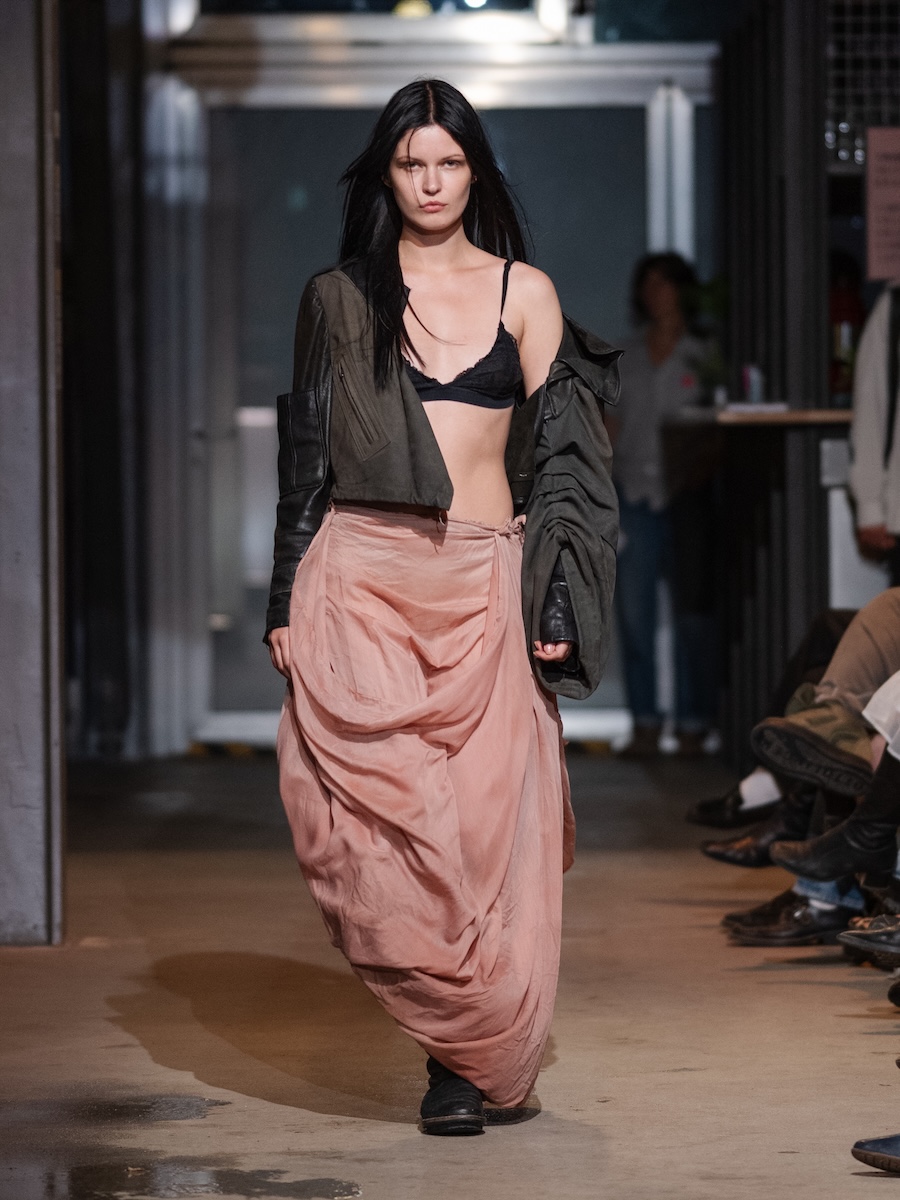
Honestly, I mostly observed the moment at the show when models came in and out of backstage and walked the runway. Seeing the garments personalised by the models made a strong impression and gave me a memorable perspective on how the pieces live beyond the studio.
What kind of dialogue or emotional reaction do you hope to trigger in the person viewing or wearing your garments?
I deeply value evoking nostalgia—a feeling that doesn’t need to be happy or sad but somewhere in between. That emotional space is often what I aim to express through my work.
Now that the graduate show is behind you, what aspects of your creative practice or design philosophy are you most excited to explore next?
I really enjoy the creative process involved in fashion, and the art of handwork continues to inspire me. I want to find clearer purpose in my work—fashion that is not just about profit or career, but about meaningful expression.
If your collection or creative identity could be translated into an ice cream flavour, what would it be and why?
Raspberry coconut—that’s my instinctive choice. It feels fresh, a little unexpected, and layered, much like my collection.
follow @sayo.mogi
Anita Schulte-Bunert – Runway Photography @nit.sb
Models @giovannibouzari @amea.magdalena @words.in.my.veins @nzisabirajoel @kalera300 @stibitzchen
Artist collaboration: @sophia_engel @zoelinea
CREATIVE & MOVEMENT DIRECTORS
Sarah Ama Duah @sarah_ama_duah
Madlen Schmid
PRODUCTION DIRECTORS
Doreen Schulz
Madeleine Madej
CASTING DIRECTOR
Madlen Schmid
STYLIST
Tabassom Charaf @tabicharaf
MAKE-UP ARTISTS
Head of Make-Up Artists: Feride Uslu @feride_uslu11 für airbeauty.com @ferideairbeauty
Dominika Obacz @dominica_obacz
Mert Kenger @mertkenger
Sarah Elisa Fischer
Sarah Ort
HAIR ARTISTS
Nicole Puzalowski
Béanne Da Costa @hairtouchedby
Jennifer Ohia @mmynd.irl @5.minah
Special thanks to our partners
Bezirksamt Mitte
ZK/U Zentrum für Kunst und Urbanistik @zku.berlin
Objets Trouvés Möbelmanufaktur @objets.trouves.berlin
uns* Model Agency @wirsinduns
VIVA Model Agency @vivamodelsberlin
The event is supported by the Economic Development Office of Berlin’s Mitte District Council in cooperation with PLATTE.Berlin, which is responsible for guest management and PR @platte.berlin
