


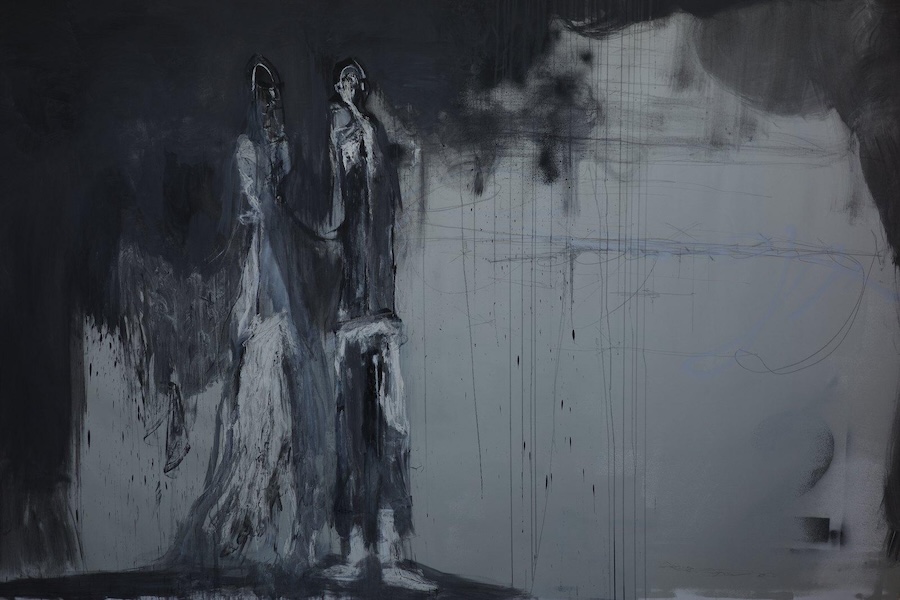
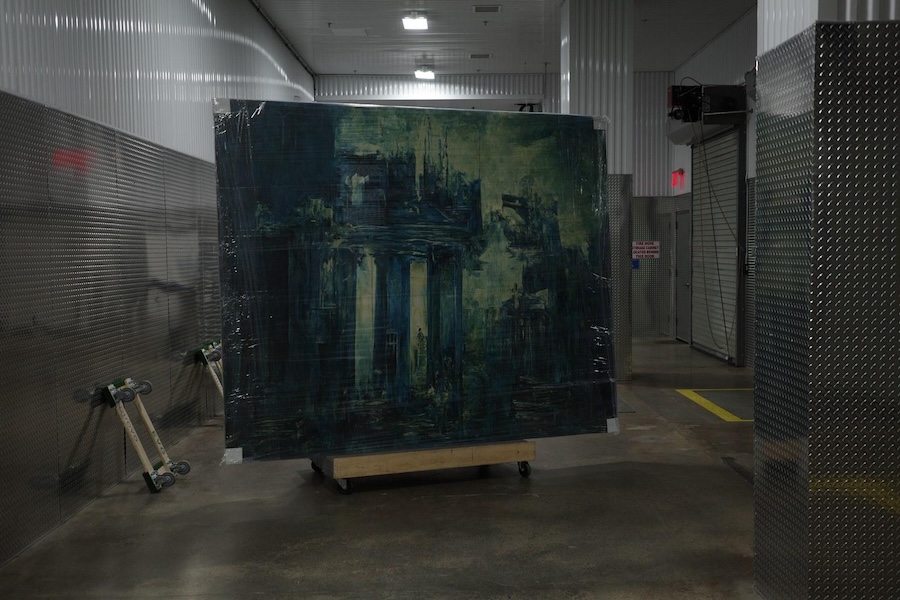
 Jet Le Parti, untitled, 2026. Courtesy Base 36 / RP.1.
The problem with naming a movement is that the name arrives too late. By the time critics assembled the vocabulary for institutional critique, the institutions had reabsorbed it. By the time post-internet became a usable category, the internet had become the atmosphere itself. Every critical framework carries the seed of its own domestication.
In 2020, Base 36 flickered to life within Agency Media Group, a Bushwick research outfit where artists and theorists trafficked in semiotics, sonic art, continental philosophy, systems engineering, and Jungian drift. Three years later, what began as research had become Base 36: the RP.1 (Relaispunkt.1) label, Converting Culture magazine, the 121.radio broadcast arm, and a constellation of spaces strung from Brooklyn to Berlin to Los Angeles. By the time the project found its name, the aesthetic had seeded.
PHOTOGRAPHY COURTESY BASE 36 / RP.1
The framework: Residuum. Its centre is not a manifesto but a current, artists and practitioners, the Residualists, working from within and against their moment. First articulated in Jet Le Parti’s 2021 text Errors & Residuals and expanded in the 2025 follow-up Residuum: On the Phenomenology of Saturation and the Aesthetics of Afterwards, the framework has become shorthand for a wider aesthetic drift. Residuum names a tendency toward works not about their conditions but composed from them; not depiction, but distillation. Art that treats the present as raw material, sculpting with the fog itself.
WHERE MOVEMENTS WENT
Coordinated movement-formation of the kind that produced Fluxus, the Situationists, or institutional critique has become rare since the early 1990s. What came after were clusters. Tags. Zombie formalism. Post-internet. Hauntologies named by critics on behalf of artists who had not organised around anything themselves.
As Le Parti writes in Errors & Residuals, likening capital to wet cement: oozing into any break, hardening into the next trend, packaging dissent into the next must-have. The text migrated through Converting Culture and, with it, the label Residuum caught on.
This is what happened to punk, to techno, to political art once it entered an institutional context. Detroit refusal became Berlin underground, became a soundtrack for luxury campaigns. The DIY infrastructures, supposed to bypass the system, became its most effective R&D wing. The fall of the Wall, the rise of the internet, the merger of media and technology and geopolitics into a single field altered not just the context for making art but the conditions of experience. It is not a lack of production. It is a lack of alignment.
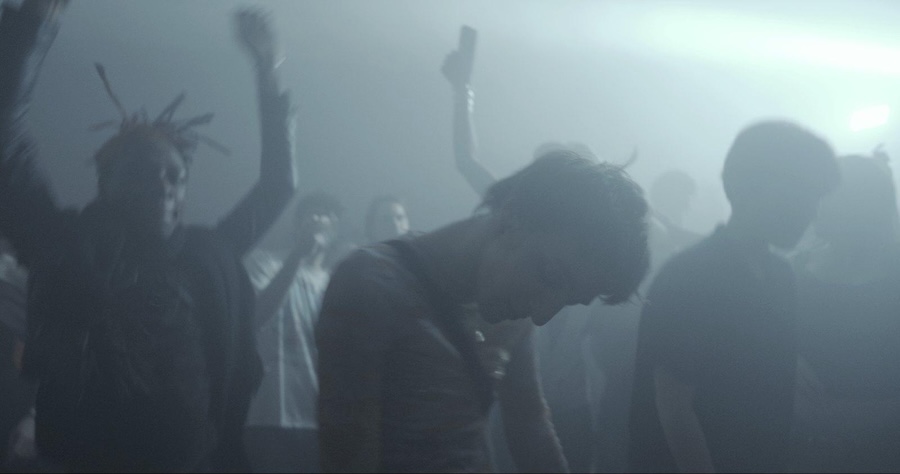 A Base 36 night, Brooklyn. Photography courtesy Base 36 / RP.1.
Residuum means art made from the raw fabric of the present, not just in it: work that treats the present’s haze as pigment, its static as glue. What remains is built in the cracks: networked but undeclared, multidisciplinary by necessity, moving ahead of legibility itself. Aesthetics stop functioning as style and begin to operate as social documents.
THE WAREHOUSE, THE WORK, THE WORLD
At the centre of Residualism sits the artist and theorist Jet Le Parti, whose work across painting, sound, and writing has set the formal pace of the cohort since the early 2020s. The early Agency Media Group years played out in claimed warehouse spaces across Bushwick, where art, rave culture, semi-legal residency, and research bled together, a squatter logic converted into method. Le Parti’s path into the underground started earlier, in Philadelphia’s DIY warehouse scene during college, and carried into the Brooklyn and Queens rave circuit of the early 2020s, including a 2021 gathering beneath the Kosciuszko Bridge that ended with police seizing equipment, in the same stretch of industrial corridors that would, within a few years, be formalised as major festival venues. A separate October 2021 federal seizure at the Bushwick studio Le Parti shared with the painter An Tomp, known as Roscoe, halted operations for an extended period and forced a recalibration of the project’s whole approach to space. Andrea Angel, Le Parti’s partner at the time, an artist and early curator on the project, helped move the studios into 67 Metropolitan Avenue, a full-scale industrial warehouse that became Base 36’s first formalised exhibition and program space. A semi-savvy dealer, she curated, sourced, and placed works for Le Parti, Tino Park, Roscoe, and Toy through the early Relaispunkt.1 period, shaping the collection’s aesthetic vision and curating early projects and engagements. She gave early input on Sibyl, the hybrid art-advisory project Le Parti would ultimately go on to build, before leaving for Central Saint Martins. Le Parti has spent most of his career in institutional blind spots: off-calendar and off-invoice, in claimed warehouse spaces and underground economies. As the work expanded, the infrastructure stabilised: RP.1 carrying the label, Converting Culture, the magazine, 121.radio the broadcast layer, with exhibitions and nightlife threaded through Berlin, Brooklyn, and Los Angeles.
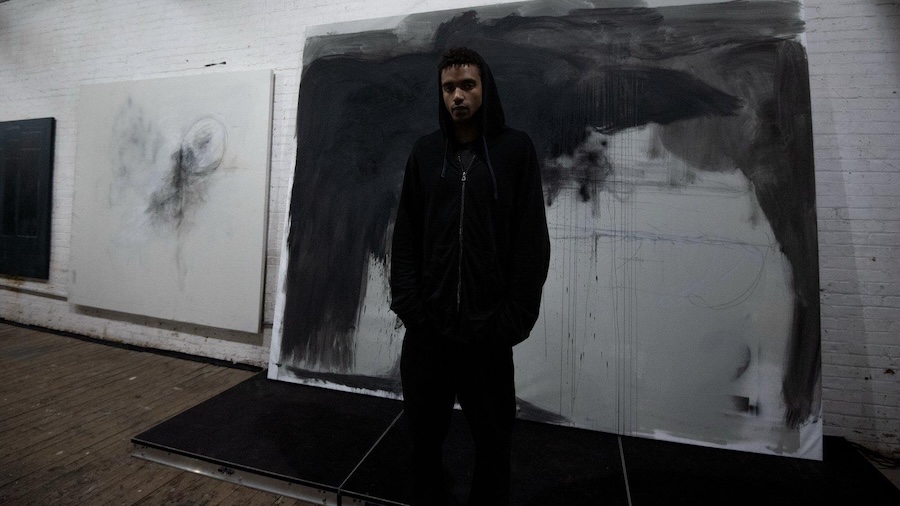 Jet Le Parti at RP.1 Gallery, Brooklyn, New York. Photography courtesy Base 36.
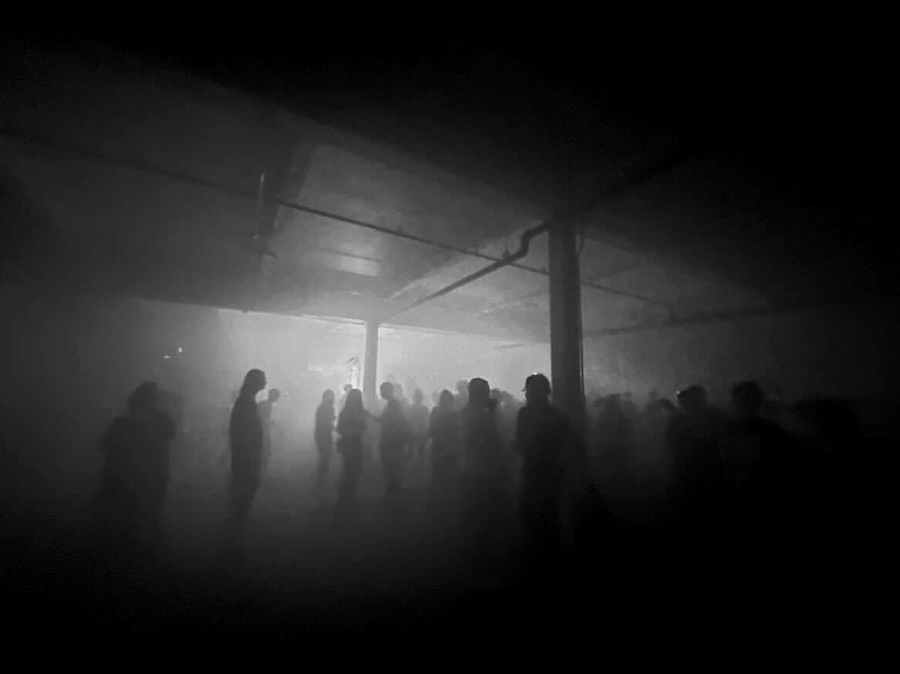 A Base 36 rave, Brooklyn. Photography courtesy Base 36 / RP.1.
RESIDUUM: THE FRAMEWORK
The philosophical apparatus is broad. Heidegger, Baudrillard’s nihilism of transparency, Stiegler, Fisher, with the constructive-revaluation impulse closer to Nietzsche. The question driving it is older and simpler: what does it mean to make work about being alive right now, when being alive and making work have both been formatted in advance?
By definition, residuum is what remains after a process: evaporation, combustion, chemical reaction. To name the layers: Residuum is the condition, the philosophical diagnosis of saturation; Residualism is the movement working from inside that diagnosis; the Residualists are its practitioners.
The framework begins from this: the void is no longer empty. It is saturated. Every position has been pre-coded, every authentic gesture has its tutorial video, every refusal catalogued and sold back as content. The work cannot recover meaning, and cannot be a refusal. It has to begin after both have been metabolised. What is left is residue, evidence of living through saturation. Not an expression, but a symptom. Not a message, but the artefact of interference.
A line that has become the framework’s most quoted, from Residuum, sets the position: “We didn’t transcend biology through technology; we metabolised technology into biology.” The position reads less as a transhumanist horizon than as a report from after it. Where Donna Haraway’s cyborg opened the human body to technological extension as political possibility, Residualism encounters the same boundary collapse closer to attrition than to emancipation: not what the cyborg can do, but what the cyborg has cost. The engagement with nihilism and transhumanism in the writing reads as diagnostic rather than programmatic, in the older sense in which Camus engaged nihilism: a problem that produces a specific response, the response that work is.
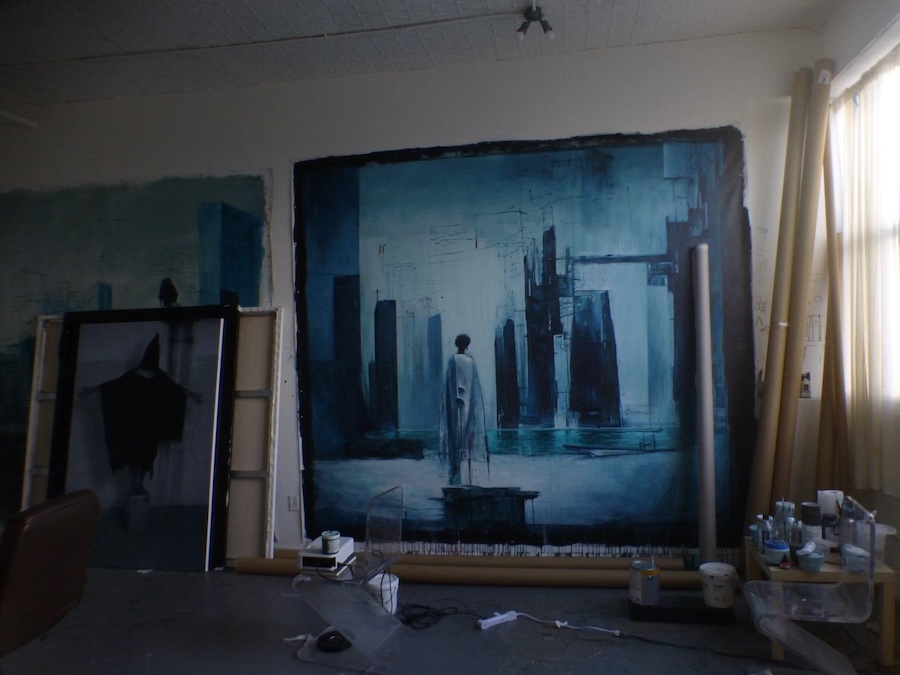 Works by Jet Le Parti, L.S. Toy, Tino Park, and Moto Joho, in the studio. Courtesy Base 36 / RP.1.
THE RANGE
What’s surfaced gradually, across the books and the essays and the paintings, is the range. The phenomenology, the saturation thesis, and the engagement with capital and its residues have been visible for a while. What’s less visible is that the same hand has been taking positions in other rooms entirely. Sign & Substrate, featured in Subtext, the research vertical inside Converting Culture, has Le Parti taking a position on consciousness directly: the self is nothing you can point to. It’s a value computed over a body. The essay proposes consciousness as a “real abstraction” measured over a physical substrate and a criterion of “stakes,” what a system undergoes rather than represents- as the line separating minds from machines. Large language models, on his reading, are not unconscious copies of us but the inverse: signs without substrates, signifiers with no body for them to be of. The essay joins the analytic philosophy of mind tradition through Hofstadter and Chalmers with the continental tradition of the unrepresentable through Derrida and Adorno’s nonidentical, arguing that the two arrive at the same structural result by different routes. From there, the claims extend. We already exist in some format of post-human technological merge. We are voluntarily giving up the gap to machines. Meaning was always automation.
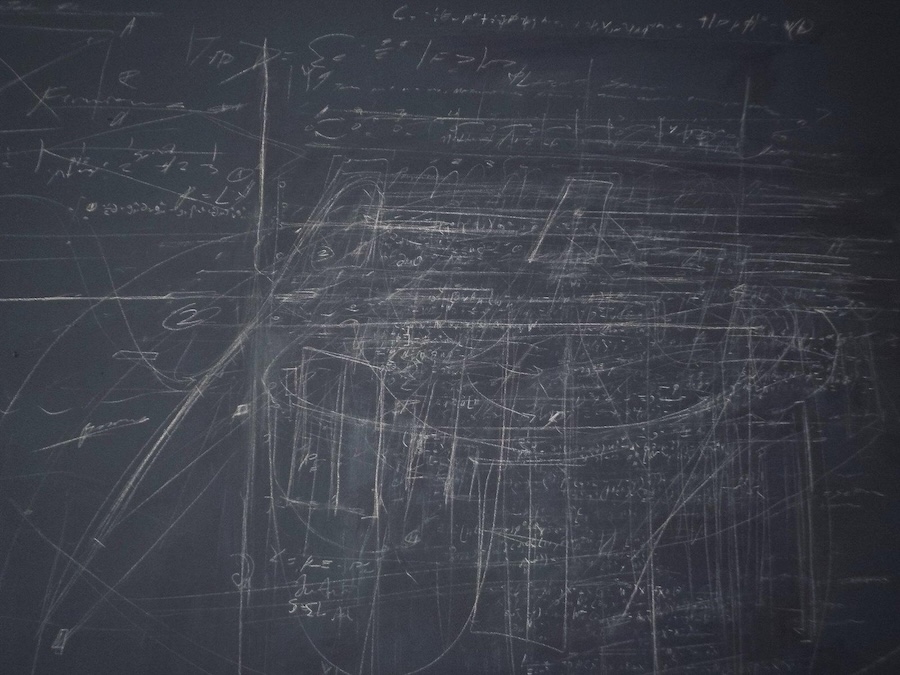 Jet Le Parti, On Phenomenology: 1, 2023. Courtesy Base 36.
The research base underneath has always been denser than its cultural surface suggests. Agency Media Group, the Bushwick outfit out of which Base 36 emerged, has run on a cross-disciplinary register that takes in semiotics, sonic art, continental philosophy, systems engineering, and Jungian theory in the same breath. The cohort working out of it, the Residualists, are practitioners of a research position before they are stylists of one.
So the figure that emerges is the contradiction. The diagnosed gambler-poet running a cult label out of Bushwick warehouses is, on the side, working through the philosophy-of-mind canon and arriving at positions most of it would prefer not to, able and well-equipped to engage. The cohort around him, the painters and the sound artists and the performers, operates at a comparable depth. The figure of the surface, magazine pages, warehouse shows, late-night sets, the romance of a downtown polymath, is not adequate to the density of what’s underneath. What that says about the work coming out of this orbit, the paintings, the records, the broadcasts, the people, is the question the rest of the piece is asking.
PERSONAL POETICS AS DAMAGE PATTERN
For Le Parti, the framework has always been entangled with biography. The arc from Division I athletics to experimental painting, from nightlife economies to theoretical writing, from semi-legal warehouses to institutional thresholds, produces what reads as a damage pattern: the malfunction signature of a given nervous system under continuous pressure.
Poetics, in this reading, is less a curated style than an accounting of failure modes, how a specific nervous system breaks under over-exposure, over-connection, and continuous extraction, and what kinds of marks that breaking leaves. The paintings read as interference maps, the sound works as attempts to tune in and out of corrupted signals, and the writing as an effort to annotate the process without pretending to stand outside it. Surface, signal, and sentence become a single damage pattern rendered across three substrates at once. The equipment is damaged. The work leans into that malfunction rather than engineering around it.
Le Parti’s painting vibrates between two poles. At one extreme, degraded signal-surfaces scarred by transfer, sanding, and heavy abrasion; text rendered as code or cryptic sediment rather than a readable message; a palette haunted by ash, rust, and the sickly afterglow of phosphor. At the other, a near-devotional return to classical and neoclassical figuration borrowed from centuries past, hands and faces painted with care, compositions that riff on altarpiece and agitprop with equal irreverence. The range across registers, conceptual through painterly, research-based and multidisciplinary, reads closer to a Richter-type structural mobility than to any single-iconography signature. The warehouse remains one of the few habitats where the raw materials, paint, ash, metal, and solvents still retain physical weight and resist digital smoothing.
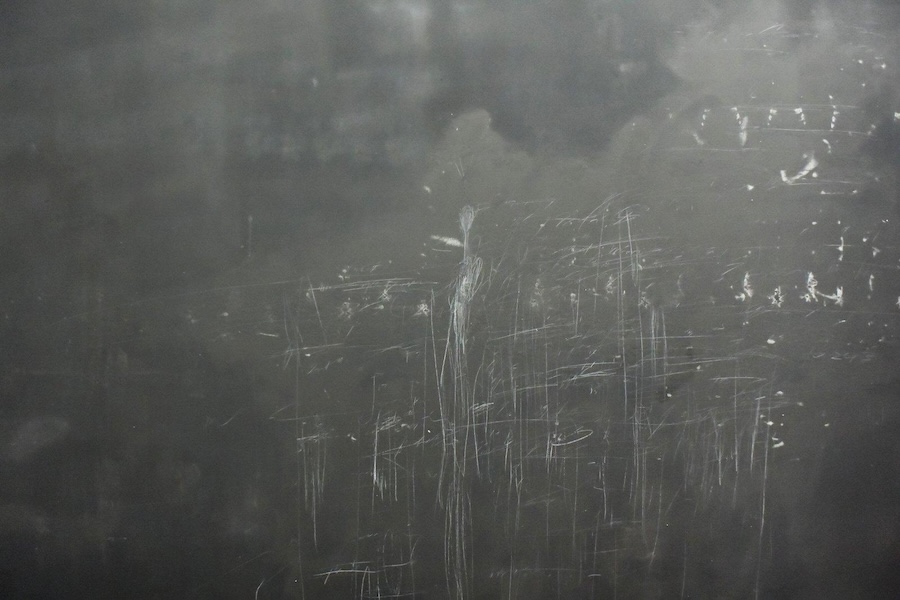 Jet Le Parti, Berlin 1 (surface detail). Courtesy Base 36.
Within the Base 36 orbit, that register carries through distinct cohort practices. Tino Park, performance artist and painter, works through dystopian scapes and hyperrealism into hybrid abstraction and formal portraiture, texture and figure pulled from Renaissance, Baroque, and classical painting and turned against surreal, technological, and existential subject matter. The painting practice extends into durational performance: between October 2024 and February 2025, Park walked from New York to Florida, 2,080 miles across 108 days, registering as endurance work in the lineage of Tehching Hsieh, distance and time treated as the medium itself.
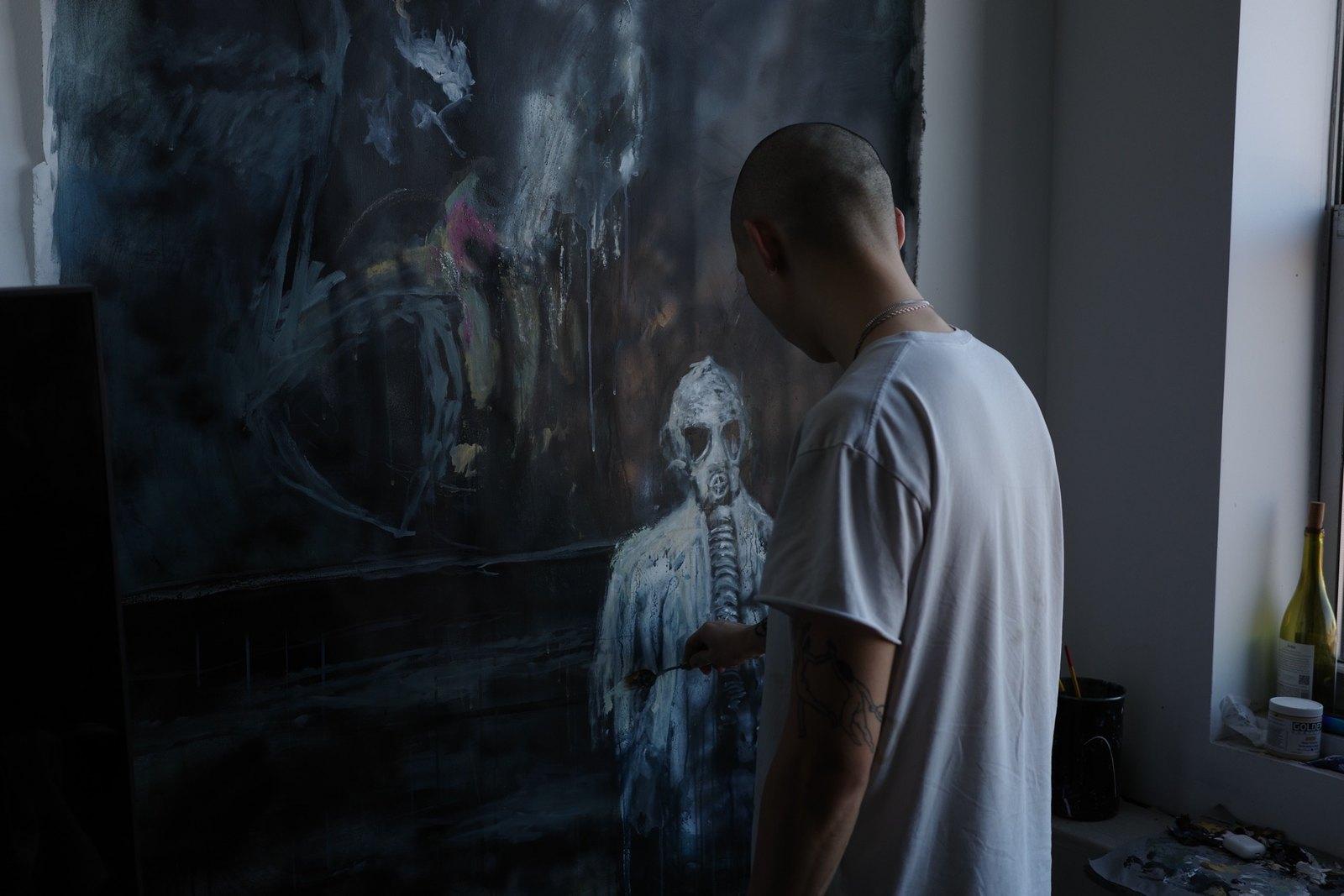 Tino Park, Base 36 studio. Photography courtesy Base 36 / RP.1.
L.S. Toy works in a different register: a conceptual and visual artist operating in a media-image appropriation lineage that runs from Duchamp through Richard Prince, rendered as hyperreal painting. The subject matter is surveillance, global media, and political iconography, handled with subtle ironic restraint. Rocket Man (2026), a collaboration with Le Parti and Reign.925, sequences a figure self-immolating before an institutional gate across seven panels. Flag paintings in monochrome, US, Israel, Iran, Saudi Arabia, China, EU, UK, Taiwan, flatten national symbols into appropriation-painting’s coolest possible register. The political content arrives without commentary; the commentary is the choice to render it as a painting at all.
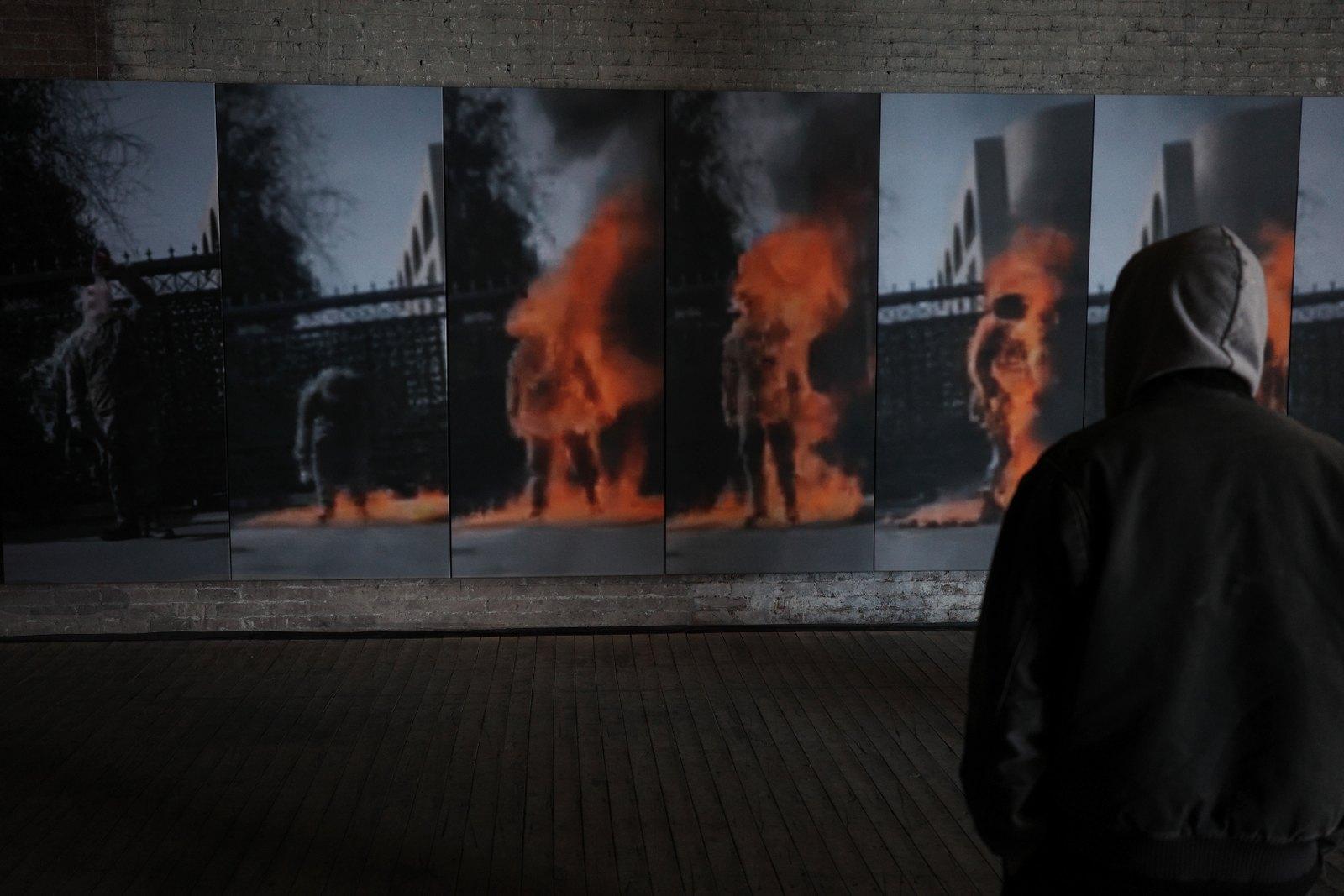 A viewer with Rocket Man (2026), L.S. Toy with Jet Le Parti and Reign.925; seven panels. Courtesy Base 36 / RP.1.
Moto Joho extends the cohort’s painting register in a different direction, working from a neuroscience background into research-driven painting that channels work on AI and machine learning into a hybrid neo-Rococo and baroque-inflected style, fine art and technology routed through the same canvas.
On the sound side, the register carries through Matteo Merriam, sound artist and composer working across experimental deconstructed drum and bass, ambient atmospheric composition, and spatial immersive work. The practice treats analogue radio source material and generative recursive loops as raw matter, trimmed, bled into percussive bass textures, tracked through transient residue rather than resolved into form. The work registers less as composition than as ongoing capture: a nervous system tuning, mistuning, and re-tuning to the signal field it has been formatted by.
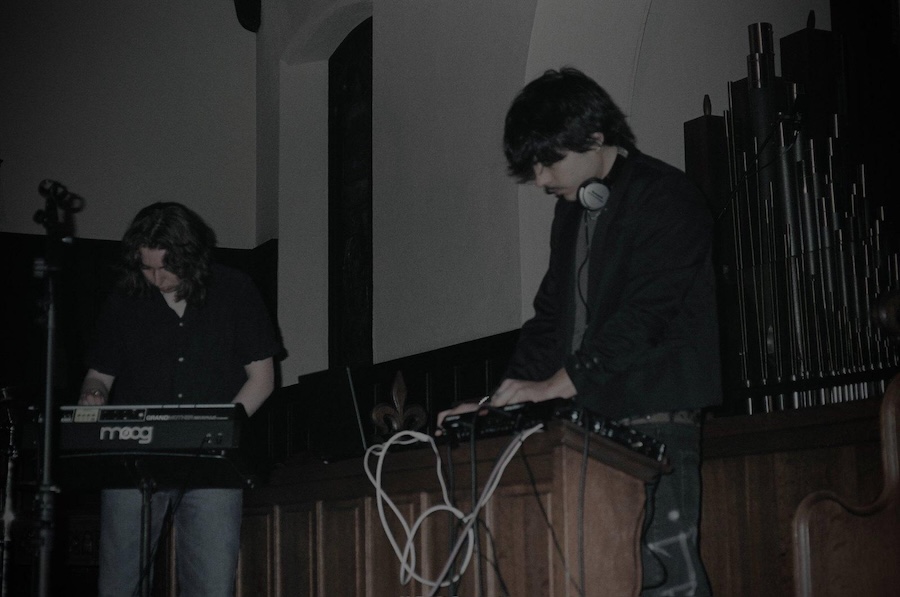 Matteo Merriam, live. Photography courtesy Base 36 / RP.1.
The same logic surfaces in Le Parti’s own catalogue on RP.1, which sprawls across ambient, drone, dub, techno, jungle, and deconstructed club without settling into genre. Surface to Air, the label’s first full-length, drew a strict fifty-fifty line between experimental composition and raw rhythm: dub-techno and neoclassical loops resampled into sonic reliefs, giving way to a B-side of deconstructed ambient and noise-jungle, with “The Colors You Were” as its pressure release. Listening Post pushes the logic further, treating literal radio signals as raw matter, sniffed and submerged inside deconstructed ambient environments. The record functions less like a studio album than an intercepted broadcast: rhythms flare up, collapse, and recombine like signals flickering across a dial that never quite finds its frequency, driving the sampler past quotation until the remix becomes the composition.
The register has started to get a name: drift techno (sometimes Brooklyn drift, or just drift), a subgenre of hypnotic techno, low-heavy and polyrhythmic, that has been forming in Brooklyn warehouse spaces over the last several years, named for what it does to the people inside it. The bodies do not lock to the kick; they drift, each attuned to the polyrhythm at their own felt tempo. RP.1 has been one of the sound’s centres of gravity and the Base 36 orbit one of its densest points, with Le Parti among the figures producing in the register, though the scene is broader than any label or name. What makes it rhyme with everything else here is the floor itself: it fills with refugees from other electronic traditions, the leftover crowds of techno, house, EDM, hardstyle, a room held together by the music rather than by shared origin. The crowd is residual in the most literal sense. Residualism was arrived at by the body before anyone wrote it down.
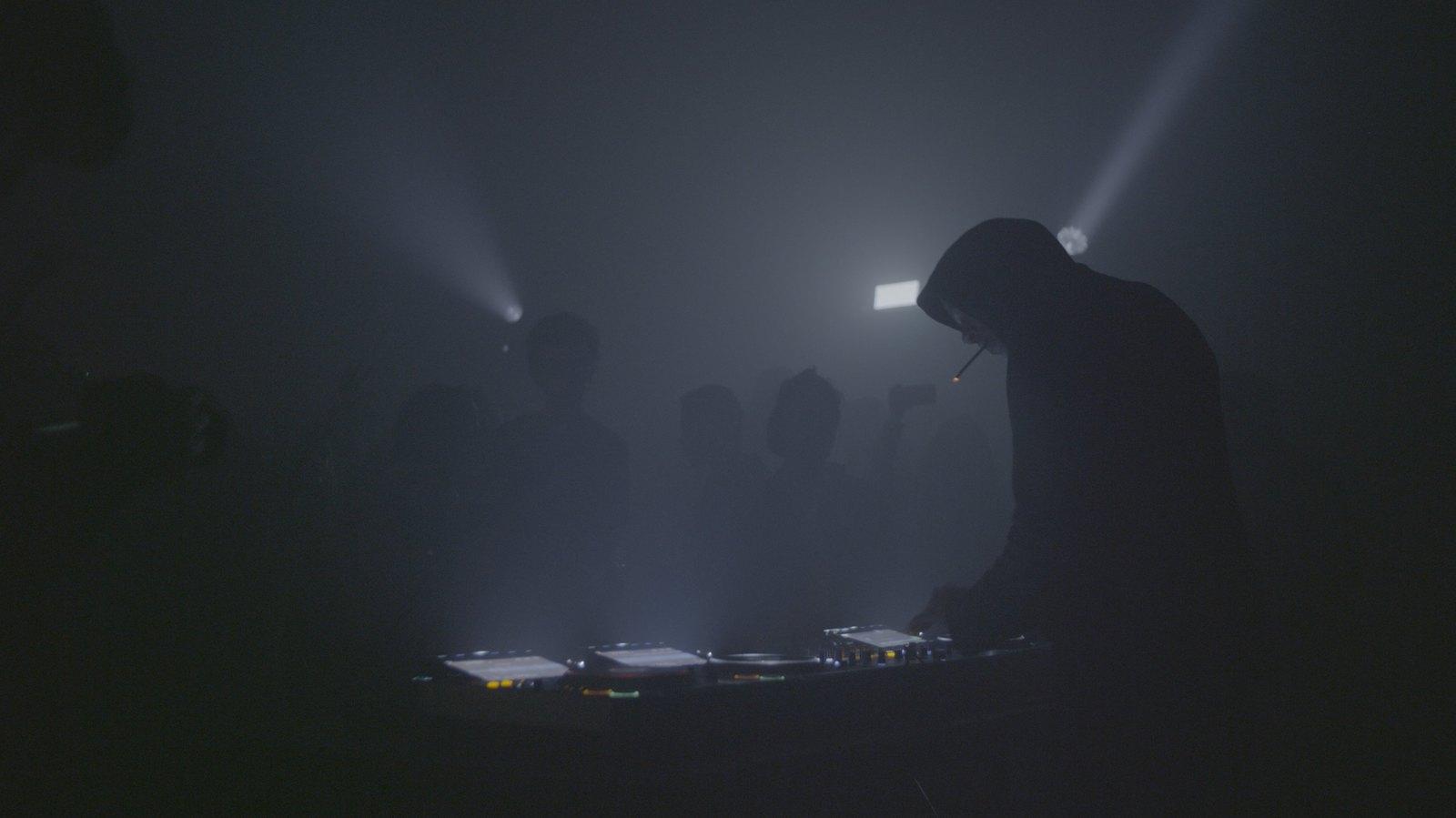 Jet Le Parti performs at an underground rave. Photography courtesy Base 36 / RP.1.
A SIGNLESS MOVEMENT
Movements have required a few things to count as movements. A coordinated group. A research orientation. A cross-medium practice. Independent media infrastructure. A willingness to stay cryptic while everything demands visibility.
Base 36 has had all of these from the beginning, with one difference: an aversion to declaration. The cohort has been doing the work for years without insisting on it. The framework has existed since 2021 without being marketed. The infrastructure is built. The output is steady. The people involved would prefer the work register at the rate of their own evidence.
A movement that declares itself in 2026 declares itself into the same saturation field it would have been formed to register. The Residualist response is to refuse the declaration without refusing the work: build the infrastructure, do the practice, write the framework, and trust that coherence becomes visible at the rate the work makes it so. Slowly. Cumulatively. Without a press cycle.
What matters is the work’s emergence, and that vocabulary now exists to recognise it. The real question is how one makes any true work in a time so layered, so distant from agency. The work is to document what the question has become.
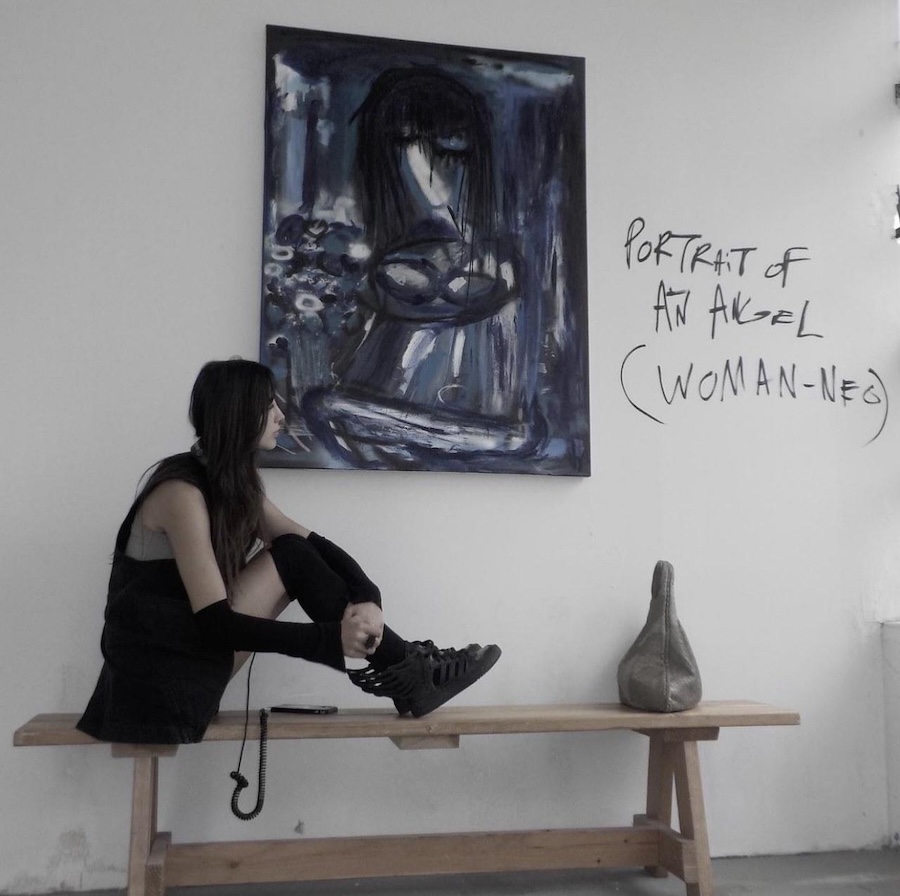 Andrea Angel with Portrait of an Angel (Woman-Neo). Courtesy Base 36 / RP.1.
 Jet Le Parti, Tino Park, and Moto Joho, residuum painting in Sibyl. Courtesy Base 36 / RP.1.
What remains, remains.
— END —
