

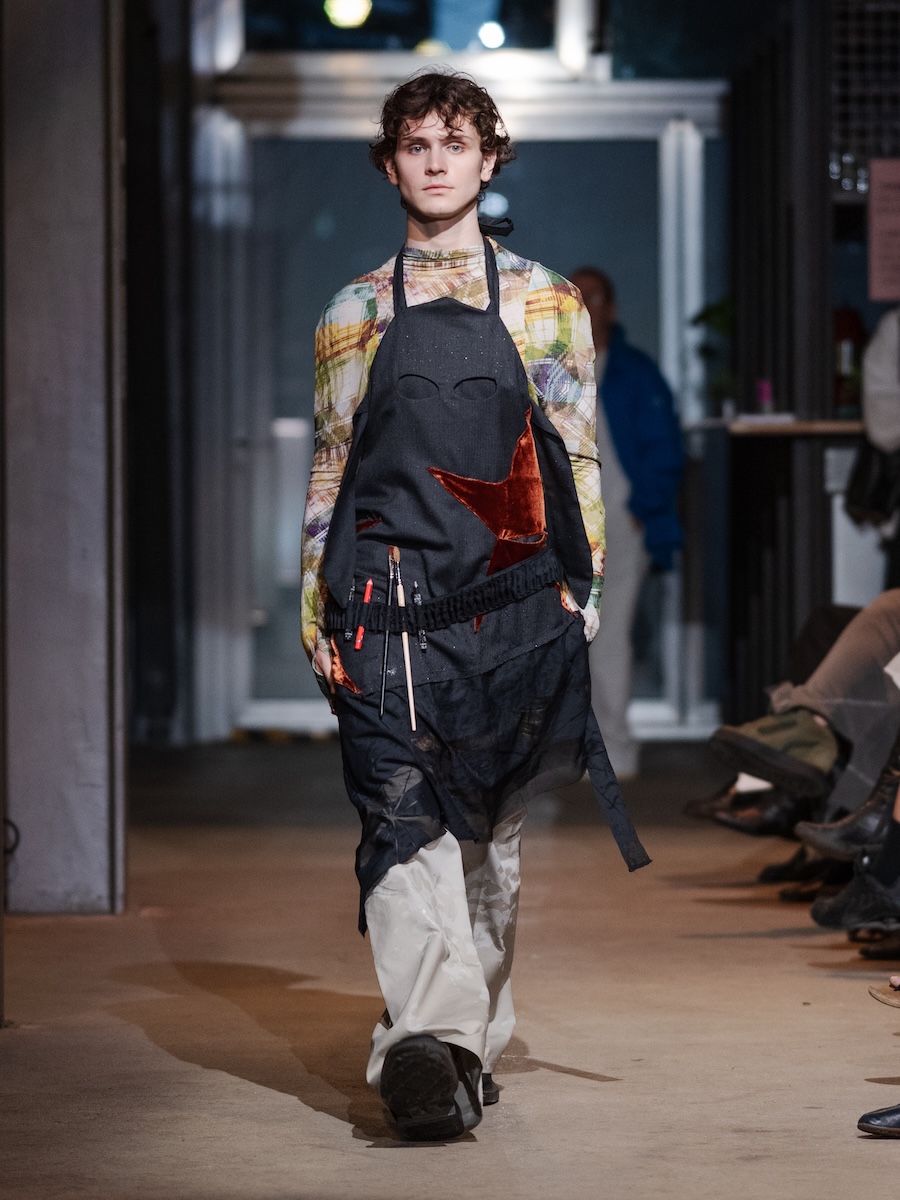
Fashion is rarely just about the fabric; in its most potent form, it is a battleground for ideas. For graduate Leonie Winkelmeier, the runway at ZK/U became a space for heavy, urgent interrogation. Her collection, titled ‘Frieden ist?’ (Peace is?), strips away the commercial armour of the industry and dives headfirst into the deeply polarising, contemporary debates surrounding rearmament, mandatory military service, and state recruitment.
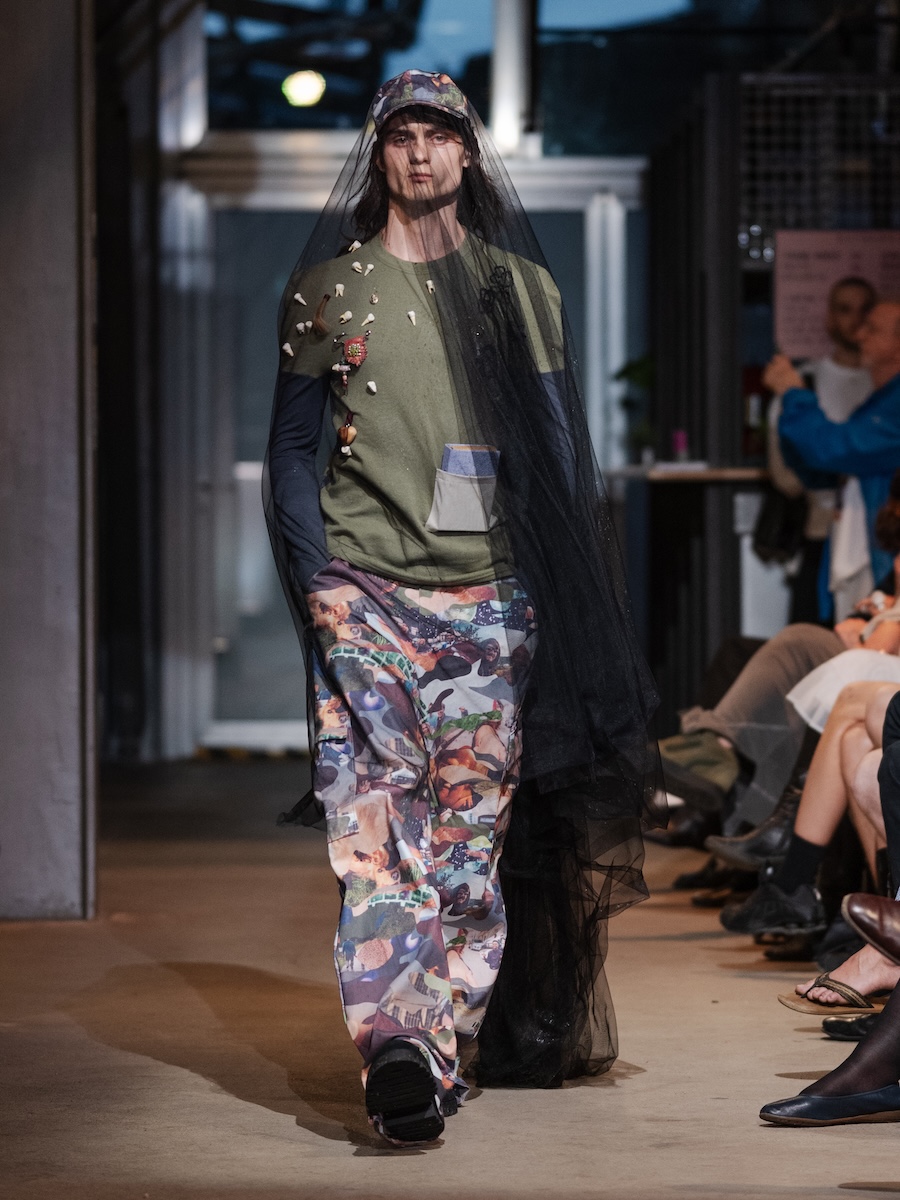
Conceived through the lens of costume design and heavily inspired by Marlene Streeruwitz’s “Handbuch gegen den Krieg,” Leonie created five distinct characters that clash and coexist on the runway. Each character carries a volatile duality—blending elements of aggressive wartime aesthetics with symbols of historical peace movements. This isn’t fashion that coddles you with easy answers; it’s an intellectual and tactile collision, born from Leonie’s own political activism and her hours spent observing Bundeswehr uniforms during Deutsche Bahn delays while commuting between Leipzig and Berlin.
When the rain slicked the concrete at Moabit’s open-air venue during the second show, it perfectly caught the wind-swept veils and outdoor-military textures of her garments, elevating the presentation into something cinematic. For Leonie, the ultimate destination for these pieces isn’t a showroom—it’s the stage of a theatre where dialogue can truly breathe.
Read on as we talk to Leonie about circular design, decoding military insignia at train stations, and why her creative identity tastes exactly like a contradictory scoop of pistachio-bubblegum ice cream.
Pistachio-Bubblegum & Political Protest: Step Into the Universe of Leonie Winkelmeier
What was your approach to choosing your materials, and how did working with those specific textiles or textures impact your design process?
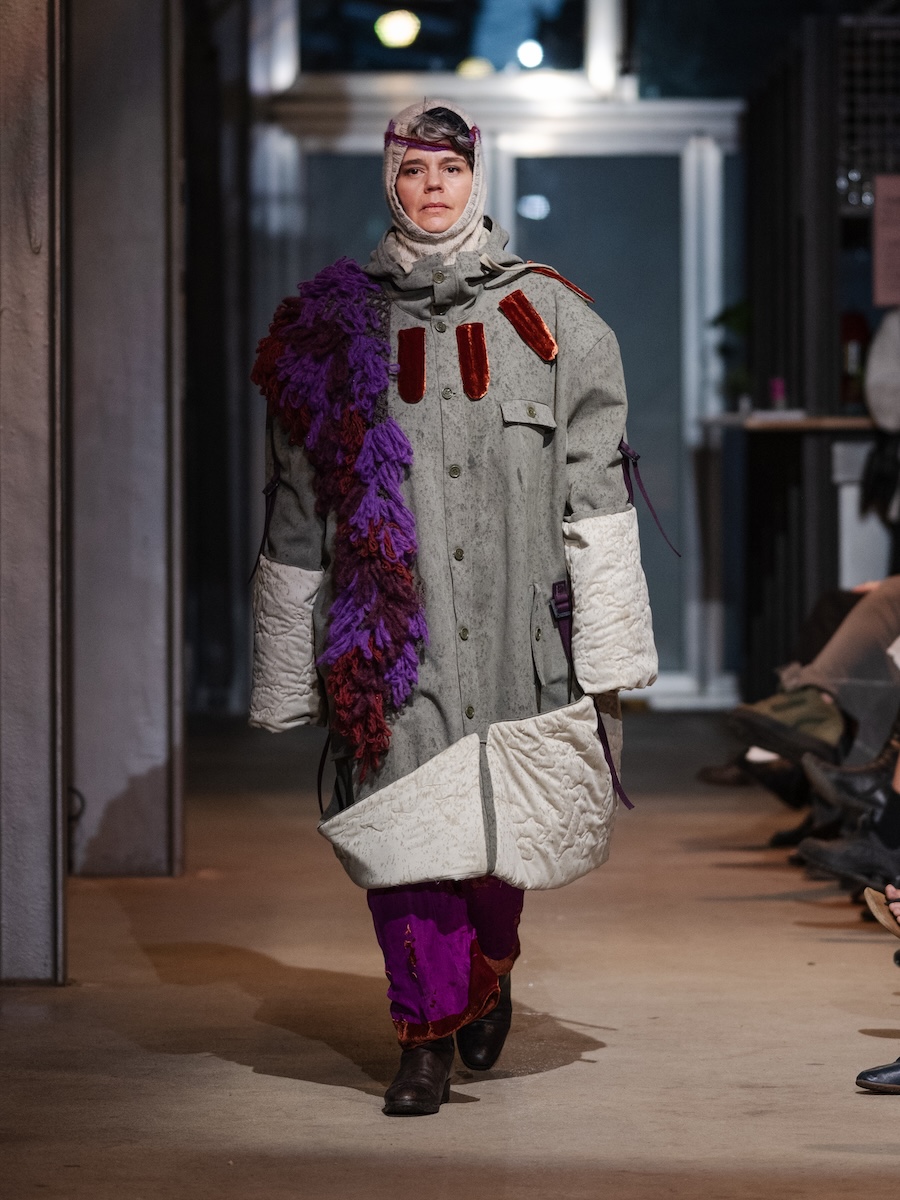
The concept of the costume design was central to my creative process. I based many of my design decisions on this concept, including my choice of materials. Each character embodies both a warlike and a peaceful side. A tension that is deliberately reflected in the materials used.
How do your personal background, heritage, or the environments you’ve lived in manifest in the details of your designs?
Both my own political activism and that of the people around me play a central role in this costume design. During my studies, I increasingly grappled with the question of how and whether I wanted to connect my political views with the clothing I design. When the debate over the reinstatement of mandatory military service was weighing heavily on my mind and that of many of my friends, it became clear to me that I wanted to use fashion to address both the fear of a possible war and the frustration over the ongoing wars in which Germany is involved through arms deliveries.
Looking back at your time as a fashion student at Weissensee, what was the most valuable lesson—or perhaps the most unexpected challenge—that shaped your identity as a designer?
I found the “Future Fashion Concepts” project with Daniela Felder particularly exciting. In this course, we had the opportunity to work with donated sustainable materials and, among other things, to learn about and experiment with vegan alternatives to leather. In addition to these innovative materials, we took an in-depth look at circular design and recycling options. This made me realise just how complex sustainable design really is and how many factors determine whether a garment can ultimately be recycled at all.
Berlin has a very distinct subcultural and creative energy. In what ways, if any, did the city’s landscape or community influence your graduate work?
In fact, I’ve been living in Leipzig since the beginning of the year and commute regularly to Berlin. That’s why I’d say that my work has been influenced less by Berlin’s subcultural and creative scenes and more by my encounters with a wide variety of people around Berlin’s main train station. That’s exactly where you can really see how the Bundeswehr tries to recruit young people. Not only through targeted advertising campaigns, but also through the large presence of soldiers in uniform, who are allowed to ride the trains for free. So I’ve spent the occasional Deutsche Bahn delay taking a close look at the Bundeswehr uniforms and Googling the meanings of their insignia and symbols.
Many collections today engage with contemporary cultural, political, or ecological themes. How do you view your role and responsibility as a designer entering the industry right now?
I believe that my generation bears a great responsibility, both politically and environmentally. Especially when it comes to the production of new clothing, the fashion industry must become fairer, more sustainable, and more transparent.
As I mentioned earlier, I’ve also spent a long time thinking about how to reconcile my fashion with my political activism and personal values. I’m now certain that I not only want to address issues like sustainability and production conditions in the fashion industry through my work, but also want to use fashion as a medium to artistically explore and bring to light political issues that are personally important to me.
Your collection showcases a balance between conceptual thinking and technical craftsmanship. How did you navigate the space between free experimentation and practical execution?
For me, concept and execution usually blend seamlessly. I often start with a topic that’s currently on my mind or interests me. From there, I develop the overall concept step by step and work my way down to the technical details. Throughout this process, new ideas keep emerging, causing the designs to gradually take shape. By the time I begin the actual execution, I usually already have a clear vision of the final product. Nevertheless, cuts, materials, or colours often change as I work, so the designs continue to evolve right up until the very end.
I find it particularly exciting to try out new techniques. Beautiful effects often arise by chance, or after a few tests, I realise that I had imagined it differently and look for another way to bring the design to life.
Seeing your work transition from the studio into the specific architecture and energy of yesterday’s show at ZK/U, how did that moment feel, and did it change how you view your own pieces?
Yes, definitely. At the end of a project, I often find myself thinking mostly about all the things I could have tried or developed further if I’d had more time. That’s why I sometimes find it hard to truly wrap up a project. That makes a final presentation all the more important to me. Ideally, with a successful show and beautiful runway photos.
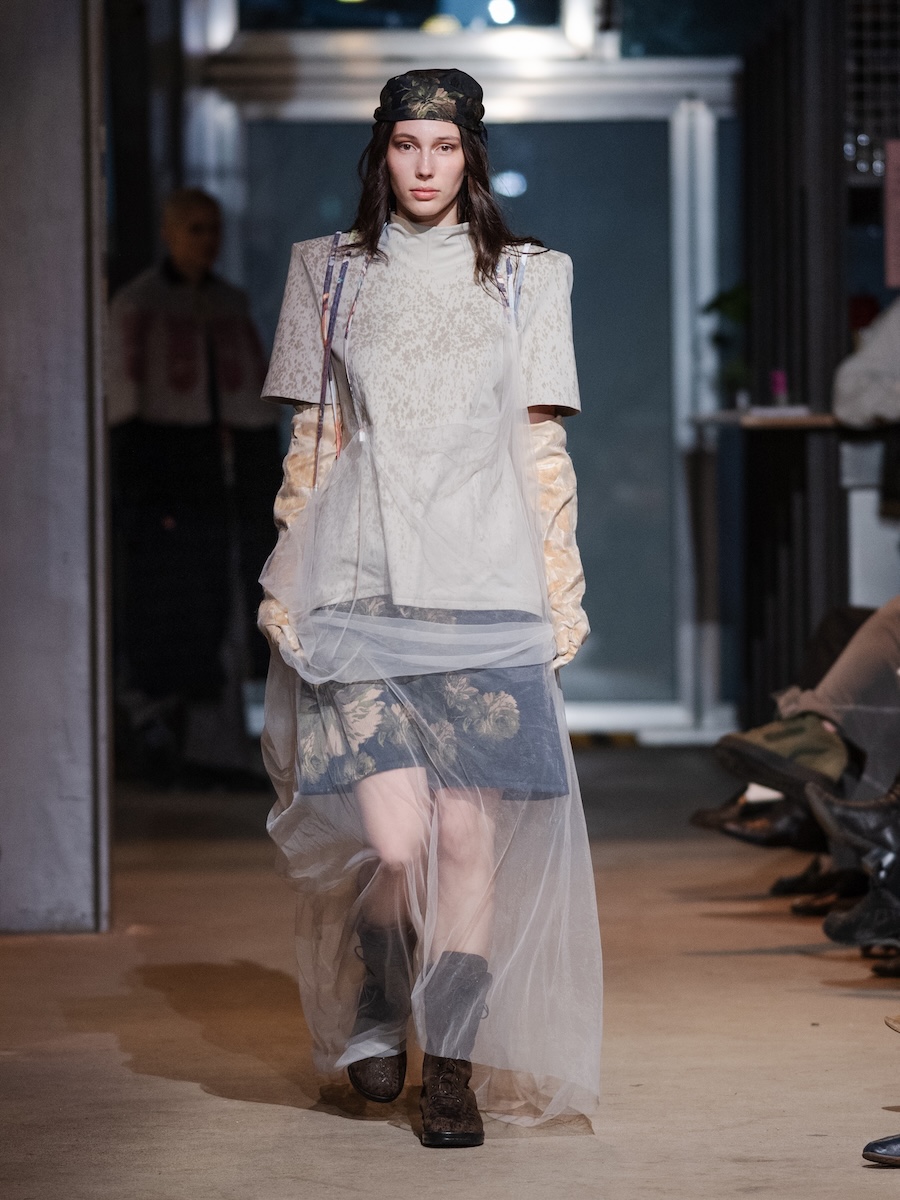
I found the atmosphere at ZK/U particularly well-suited for this. Above all, the weather, which played a major role thanks to the building’s open architecture, created exactly the mood I’d hoped for with my collection. While at the key visual shoot, I had to create wind myself using a large piece of cardboard; the weather at Thursday’s show played along perfectly with the two veils all on its own. And I also think the rain during the second show went very well with the garments, some of which are inspired by outdoor and military clothing.
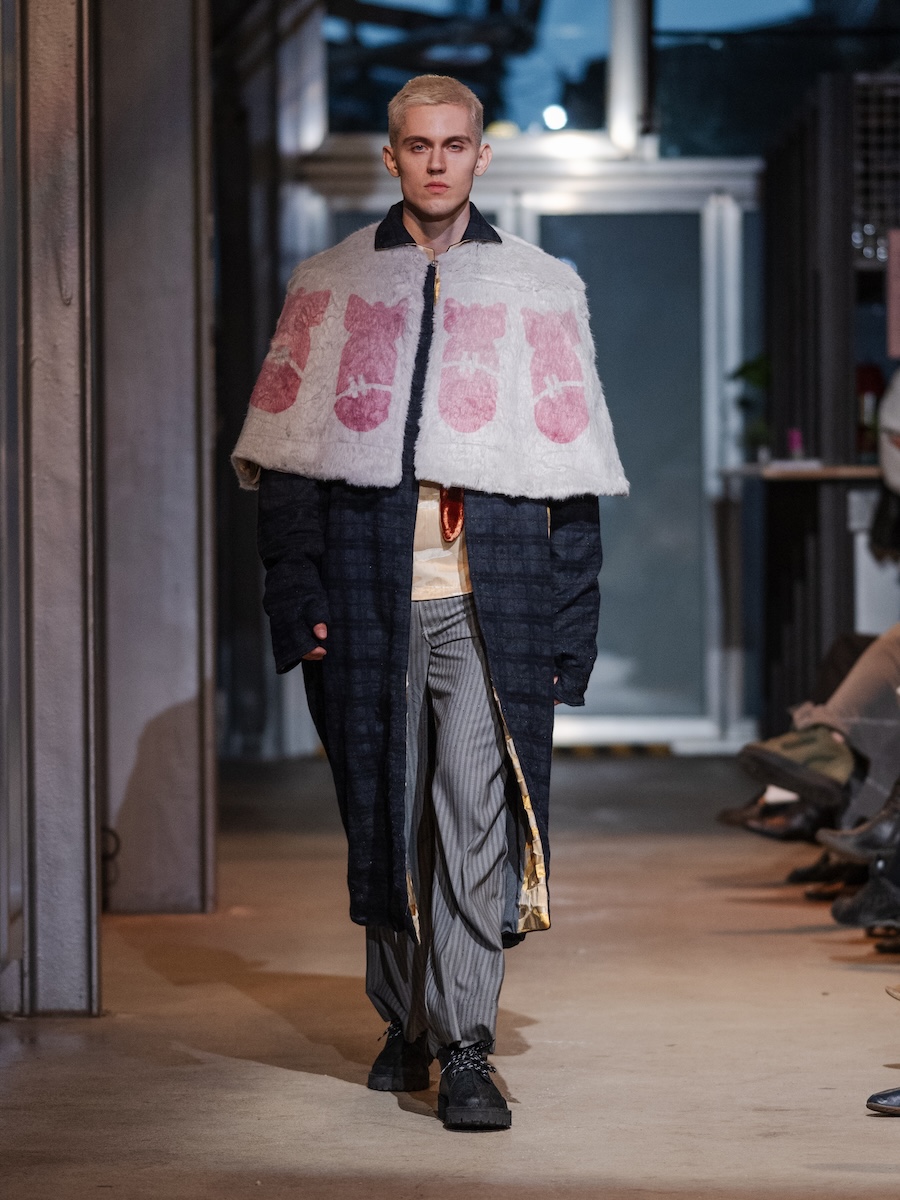
It was also a special moment to see the entire collection worn in its entirety side by side for the first time. During fittings in the creative process, it’s often hard to imagine the big picture. That made it all the more wonderful to finally see the finished looks in motion.
What kind of dialogue or emotional reaction do you hope to trigger in the person viewing or wearing your garments?
Through my costumes, I aim above all to highlight the complexity of the debate surrounding rearmament and military service and to create a space for dialogue and reflection. The focus is on the similarities, contrasts, and areas of tension among the individual characters. Inspired by Marlene Streeruwitz’s book “Handbuch gegen den Krieg” (Handbook Against War) and her thesis that we concern ourselves too much with war and too little with peace, each character is also inspired by a peace movement. I would therefore be delighted if this work encourages people to engage not only with the topics of war and rearmament, but also with the diverse ideas and movements for peace.
Ideally, however, the costume designs were not meant to be seen only on the runway. I would be very pleased if the costumes someday were also used in a theatrical production.
Now that the graduate show is behind you, what aspects of your creative practice or design philosophy are you most excited to explore next?
First, I would like to continue specialising in costume design. During my internship semester at the Leipzig Opera, I gained in-depth insight into this field and can easily imagine continuing my professional career in this direction.
On the other hand, I would like to delve even more deeply into various craft techniques. There was often limited time for this during the projects, so I’m looking forward to specifically deepening these skills and learning new ones in the future.
If your collection or creative identity could be translated into an ice cream flavour, what would it be and why?
Because of the many contradictions in my collection, it would probably taste different to everyone. It would be a mix of their favourite flavour and a flavour they don’t like at all. For me personally, that would be the pistachio-bubblegum flavour.
@inesleonie.winkelmeier
Photographer: Anita Schulte-Bunert @nit.sb
MODELS
Julia Rogge
Amea @amea.magdalena
Karl @karlklemens
Oleksii Bespavlov @oleksii.bespavlov
Andrei Oganov @_undrei
CREATIVE & MOVEMENT DIRECTORS
Sarah Ama Duah @sarah_ama_duah
Madlen Schmid
PRODUCTION DIRECTORS
Doreen Schulz
Madeleine Madej
CASTING DIRECTOR
Madlen Schmid
STYLIST
Tabassom Charaf @tabicharaf
MAKE-UP ARTISTS
Head of Make-Up Artists: Feride Uslu @feride_uslu11 für airbeauty.com @ferideairbeauty
Dominika Obacz @dominica_obacz
Mert Kenger @mertkenger
Sarah Elisa Fischer
Sarah Ort
HAIR ARTISTS
Nicole Puzalowski
Béanne Da Costa @hairtouchedby
Jennifer Ohia @mmynd.irl @5.minah
Special thanks to our partners
Bezirksamt Mitte
ZK/U Zentrum für Kunst und Urbanistik @zku.berlin
Objets Trouvés Möbelmanufaktur @objets.trouves.berlin
uns* Model Agency @wirsinduns
VIVA Model Agency @vivamodelsberlin
The event is supported by the Economic Development Office of Berlin’s Mitte District Council in cooperation with PLATTE.Berlin, which is responsible for guest management and PR @platte.berlin
