
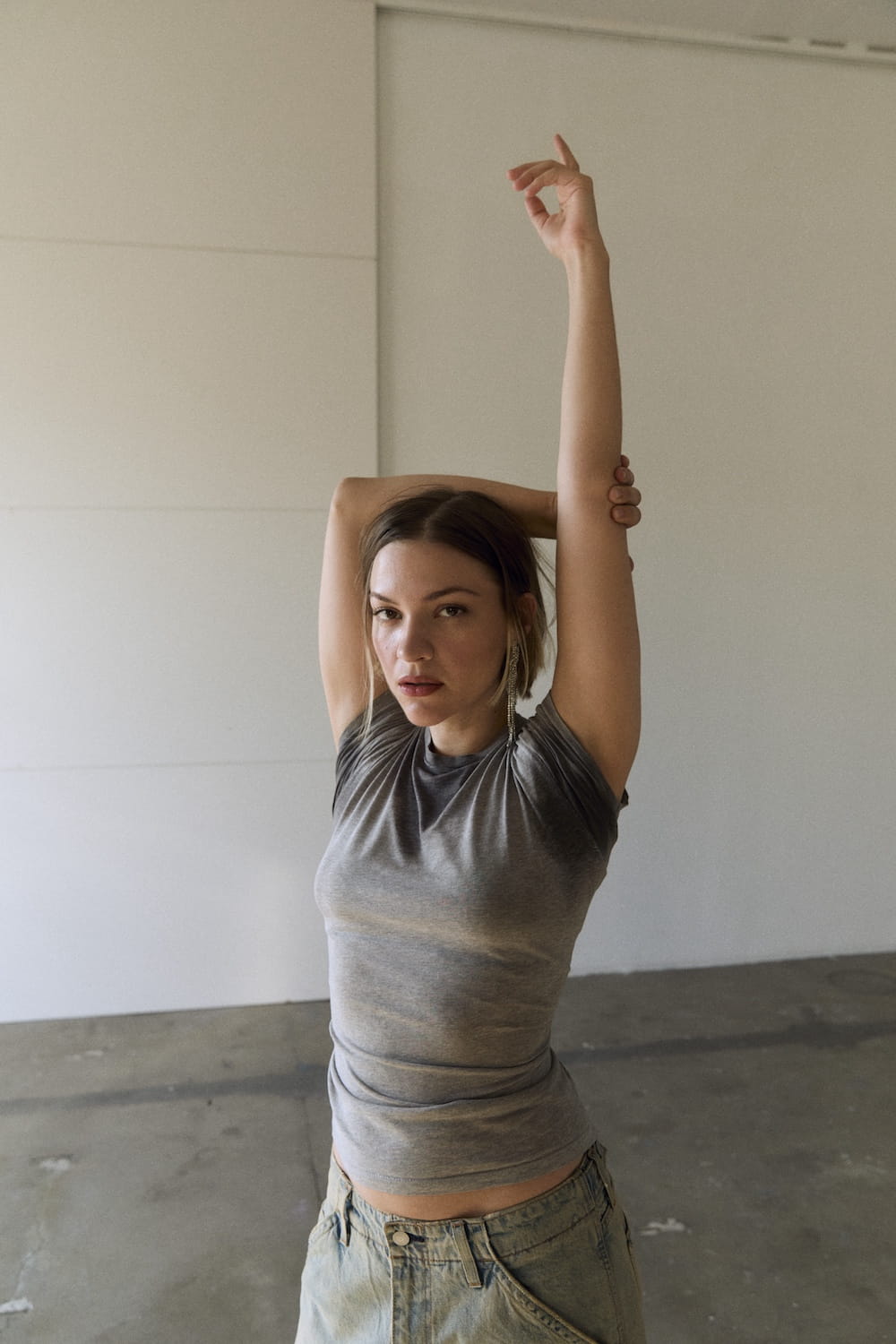
Swedish alt-pop visionary Tove Styrke returns with her fifth studio album, I thought this story wasn’t about me, released via Sony Music Sweden. Following a creative reset and a multi-year journey of self-reflection, the record captures a nocturnal narrative unfolding from dusk until dawn. Built entirely with 1970s and 1980s analogue synthesisers, live drums, and zero samples in collaboration with co-producer Magnus Larsson, the album weaves influences ranging from Kraftwerk and Laurie Anderson to Adrianne Lenker and Jon Hopkins. We spoke with Styrke to discuss the physical constraints that shaped her sound, the cinematic structure of her storytelling, and how studying biodynamic gardening fundamentally transformed her perspective on nature, existence, and artistic purpose.
I thought this story wasn’t about me unfolds over a single night from dusk until dawn. What inspired that cinematic, real-time narrative structure?
I think it was the state of the world. I feel like there’s this collective feeling that we’re all heading towards an inevitable end or rebirth. The night moving towards the inescapable threat of dawn was a good way for the story to sit within that feeling. I was on a mission to create a soundtrack for a movie inside my head, and I wanted it to be suggestive yet simple enough to trigger the listeners’ imaginations and allow them to create their own movie in their minds.
This album feels much more ambient and cinematic compared to your earlier releases. What shifted you into this new era?
It all started with an image that just appeared to me one day. There was a person alone in an apartment at night. Something about this image drew me in, and I had to keep going back there, exploring and finding out more about this scene. She was alone but surrounded by people. This seemed important. The feeling and mood of that image, and the themes that came with it, are what inspired the sound of the music. Compared to my previous projects, this album is different in so many ways. Intuition over logic, feeling over perfection, all heart, no fear. And that led me here.
The track “Sunflower” carries such an intimate, tender tone, written as a tribute to your daughter. How did writing from that perspective feel compared to your usual themes?
That song is actually really interesting because I didn’t know at the time I wrote it that it was for my daughter. The process was very easy. It came into being in just a few hours. I didn’t think about the words, I just wrote down what came naturally. Let the body and the room decide. It wasn’t until later, when I played the song to my partner and co-parent, that she said, “That’s beautiful. You wrote a song for our daughter.” And when I realised it, it was so obvious that that was the case.
You made this album entirely with 70s and 80s analogue synths, live drums, and zero samples. How did those strict physical constraints shape the overall sound?
My meditation teacher once said that “structure gives you freedom”, and I really find that to be true. When you make music today, the possibilities are endless, and every time you have to make a choice, it kind of halts the creative process. It’s better to prepare your palette with the colours you want to use and then just go and experiment to the max within that framework. I also just really loved the sound of those exact synths. They captured the right mood perfectly every time.
Influences on this record range from Kraftwerk and Suicide to Jon Hopkins and Adrianne Lenker. How did you balance those diverse electronic and indie worlds?
Yes, the list of things we drew inspiration from goes on and on. There were different things in each reference that were important: the texture of the synths on Cluster’s Sowiesoso, the presence and human-versus-machine dynamic in Laurie Anderson’s “O Superman”, the meditative quality of Jon Hopkins’s “Sit Around the Fire”, the way indie meets electronic in LCD Soundsystem, and the dank and very straightforward tone of Alex Cameron’s album Jumping the Shark. It was all important, especially when describing to each other what feeling or quality we wanted to aim for.
The focus track “Look At Me” wrestles with wanting to be seen while wanting to stay hidden. How do you personally navigate that tension online versus in real life?
I think many of us do. We’re living in a world where everything needs to be perceived online to feel really real. I hate that. As if our lives only have meaning if there’s a legacy with a certain kind of impact. But that’s not true. Everything has meaning in our original context, which is nature. Everything has a purpose. You don’t have to prove anything to live forever. We already do. It’s the fucking circle of life.
The video takes choreographic inspiration from classical statues. How did you translate those rigid forms into movement for the screen?
That was pretty easy. We chose poses that we’ve all seen hundreds of times and tweaked them a little bit to work in this setting. I think there’s beauty in the juxtaposition of a person, with all their humanness and imperfections, trying to imitate a hard, dead statue symbolising strength and man’s wish to live forever.
You’ve spoken about studying biodynamic gardening alongside making this record. How did working with nature influence your approach to music?
In so many ways, oh my gosh. I think we’ve done such tremendous harm to ourselves as a species by cutting our connection to nature. As I mentioned before, nature is our original context. That’s where we belong, but oftentimes we tend to look at it as if it’s humans versus nature. That’s a self-destructive way of looking at things. What do we as humans need to feel good about ourselves? We need a sense of purpose, of belonging, of context. Nature is that context, in which we don’t need to perform to be valuable. Your life has value just by existing in this ecosystem. Healing that connection to nature is the kindest thing you can do for yourself.
Co-producing with Magnus Larsson was central to this project. What did his background in electronic music bring to your songwriting process?
This album wouldn’t have been possible to make without Magnus. He’s like a walking, talking dictionary of electronic music, and he has great taste. He’s also incredibly good at creating sounds. Part of the reason why we could make the album completely without samples is that he made all the drum sounds we needed on his Korg MS-20. I also think it was vital for me to work with someone who’s used to building music dynamically over time, as you often do in electronic music, rather than the often quite block-based way of arranging a pop song, with big jumps between different parts instead of progressively building tension and release.
Between forming the band Året Var and starring in David Bowie’s musical Lazarus, you’ve explored several new creative outlets recently. How did those experiences bleed into this new solo chapter?
Creativity births creativity. The more I create, the more I create. I think it was Joni Mitchell who once likened the juggling of different art forms to crop rotation. In gardening, you never want to grow the same thing in the same place two years in a row, to promote soil health and get good results. The same goes for making art. You use different parts of your brain depending on what it is that you’re doing. When you’re painting, you use one part of your brain; when you play an instrument, you use another. After doing one thing for a while, that part of the brain gets tired and needs to rest. Then, instead of doing nothing, you move on to doing something else. And that other thing makes you practise other ways of thinking creatively, which will inspire you to make new things in other areas. So it’s a great ecosystem to be in as an artist.
Follow
@tovestyrke
I thought this story wasn’t about me is out now: tovestyrke.openlink.se/ittswam
