

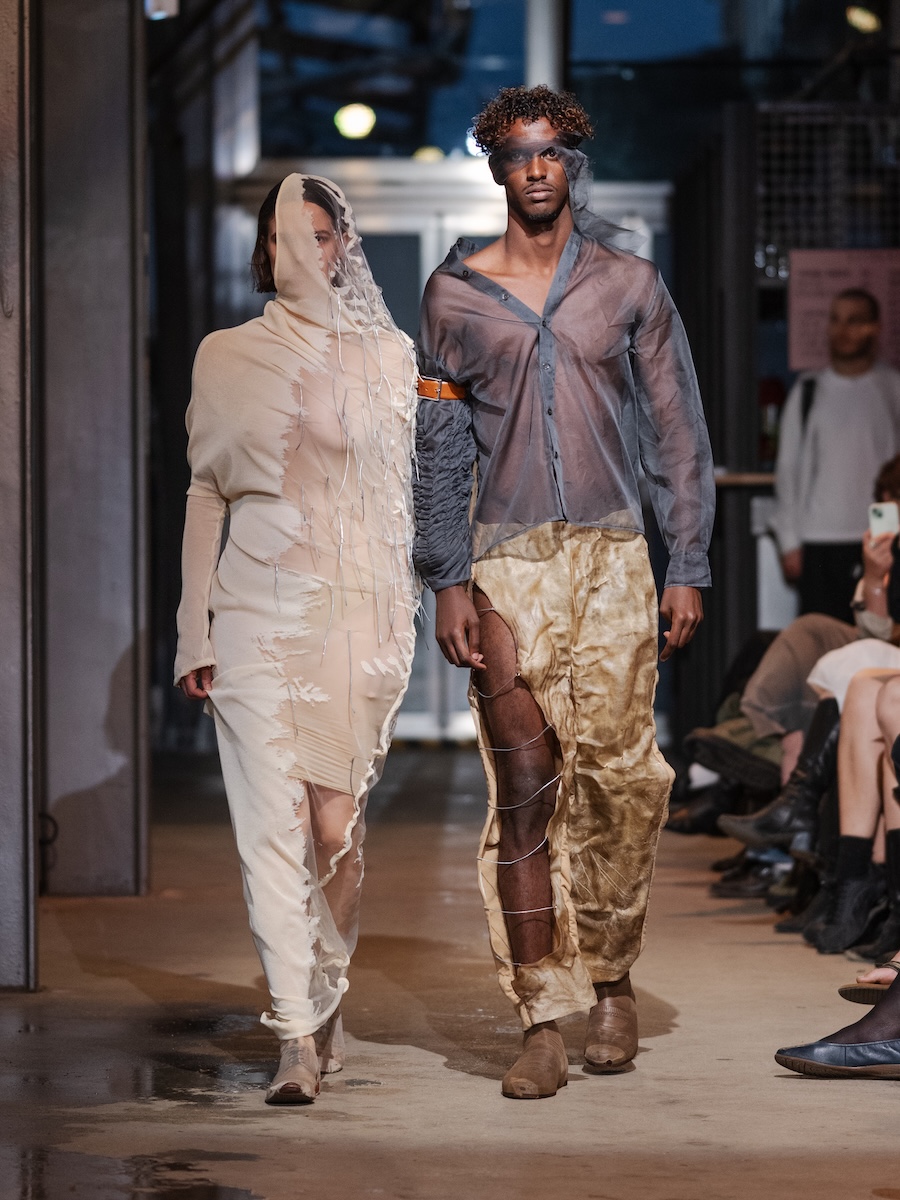
What does it mean to inhabit a body? For Berlin-born designer Anna Honegger, fashion is not a shield to hide behind, but a deeply personal, kinetic exploration of our most vulnerable selves. Her graduate collection, ‘Relations of the Human Form’—created in collaboration with knit designer @three_forms_of_the_light and artist Anna Stüdeli—is a masterclass in how garments negotiate space, movement, and the complex inner worlds we carry from youth into adulthood.
Having grown up with dance and music, Anna’s design process is inherently choreographic. She constantly questions how a textile dictates movement—whether it embraces the body’s natural flow or deliberately restricts it to provoke a new emotional state. Yet, beneath these abstract, poetic inquiries lies a razor-sharp technical foundation. Born to architect parents and possessing a background in product design, Anna fuses structured, rational execution with materials that defy easy categorisation.
Her work beautifully mirrors the very city she grew up in: a striking contrast between Berlin’s cold, industrial, and rational exterior and the immense warmth of the collective community holding it together. For Anna, fashion is a team sport, rejecting the outdated myth of the “lone genius” in favour of collaborative creation and shared voices. When her designs hit the runway at ZK/U, the meticulous planning faded into beautiful spontaneity as real, breathing bodies brought her sculptural silhouettes to life.
Read on as we talk to Anna about embracing her inner insecurities as a creative superpower, designing in codependency with movement.
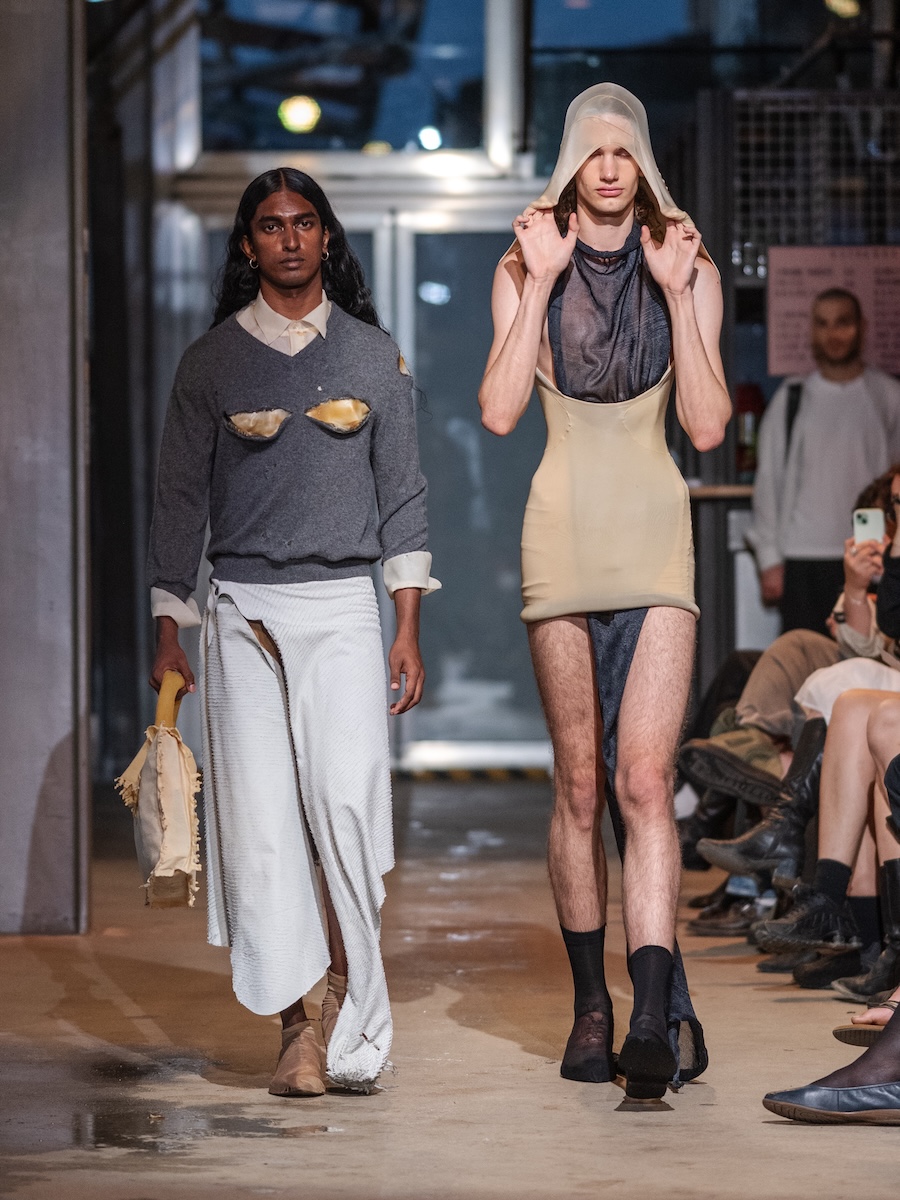
Mint-Chocolate & Kinetic Vulnerability: Step Into the Universe of Anna Honegger
What was your approach to choosing your materials, and how did working with those specific textiles or textures impact your design process?
Choosing the material is usually the first step in my process. Since a garment always interacts with the body, I think carefully about how I want it to behave. Do I want something soft, stretchy, and able to move with the body, or something that does the opposite—changing or even limiting the body’s natural movement? That first technical decision gives me the foundation for the piece, and everything that follows grows from there.
How do your personal background, heritage, or the environments you’ve lived in manifest in the details of your designs?
For me, the body is one of the most personal things that exists. It’s something that has been with me my whole life and will continue to be. Through my designs, I try to explore my own vulnerability, which is often difficult to define. How is the body perceived from the outside? What ideas or expectations are projected onto it? And what does it actually feel like from the inside?
My projects are an attempt to answer questions that built up inside me while growing up—as a young person and as a woman. They’re questions that never really had clear answers, so designing has become a way of working through them.
Because I grew up with dance and music, movement is an essential part of how I visualise these emotions and impulses. While I’m designing, I’m constantly asking myself: How does the body respond to this garment? Is it possible to walk in it? How does it feel to wear? Does it create a sense of comfort, or does it make the wearer feel uneasy? Seeing my designs in motion is my favourite part of the entire process, because that’s when I can really understand how the body and the garment interact.
To balance these more abstract ideas, I also rely on a technical and rational way of thinking. My background in product design, as well as growing up with two architect parents, has had a strong influence on the way I work. When I’m dealing with unusual materials or unconventional silhouettes, I often need that technical mindset to make my ideas work.
Looking back at your time as a fashion student at Weissensee, what was the most valuable lesson—or perhaps the most unexpected challenge—that shaped your identity as a designer?
At the beginning of my studies, I was always searching for my own voice. It almost felt like I had to justify myself: What do I actually have to say? Why am I here? Over time, I realised that my perspective didn’t come from trying to create a strong concept or message. At a certain point, it simply became impossible to ignore. In my case, the thing I was most insecure about—my own inner world—turned out to be the greatest strength of my work. It just took me a while to trust that and allow myself to see it.
Berlin has a very distinct subcultural and creative energy. In what ways, if any, did the city’s landscape or community influence your graduate work?
Because I grew up in Berlin, I often wish I could see the city through neutral eyes. I associate so many places with memories, while others still feel completely unfamiliar. Even after all these years, I’m always surprised by how a city can keep revealing itself in new ways.
What really fascinates me is Berlin’s mix of rationality, roughness, and a certain kind of coldness—which, at the same time, also feels like a strength. For me, the warmth of the city comes from the people who live in it. I think that the contrast between hardness and warmth is something that also carries through into the collection.
Many collections today engage with contemporary cultural, political, or ecological themes. How do you view your role and responsibility as a designer entering the industry right now?
One thing that’s very much on my mind right now is finding my place in the fashion industry. How do I build my own path in such a competitive field without losing my voice—or losing sight of myself and what I have to contribute?
I think there’s still this very stiff idea of what a career in fashion is supposed to look like: either you make it, or, as an individual, you’re simply not strong enough to succeed. I find that quite sad, because in reality, every collection is shaped by so many different people and ideas. Even something as simple as a conversation with a fellow student or a piece of advice from someone around you becomes part of the work in the end. That’s why I’d really like to continue exploring the idea of collective practice and collaborative creation—making projects together and recognising that great work rarely comes from just one person alone.
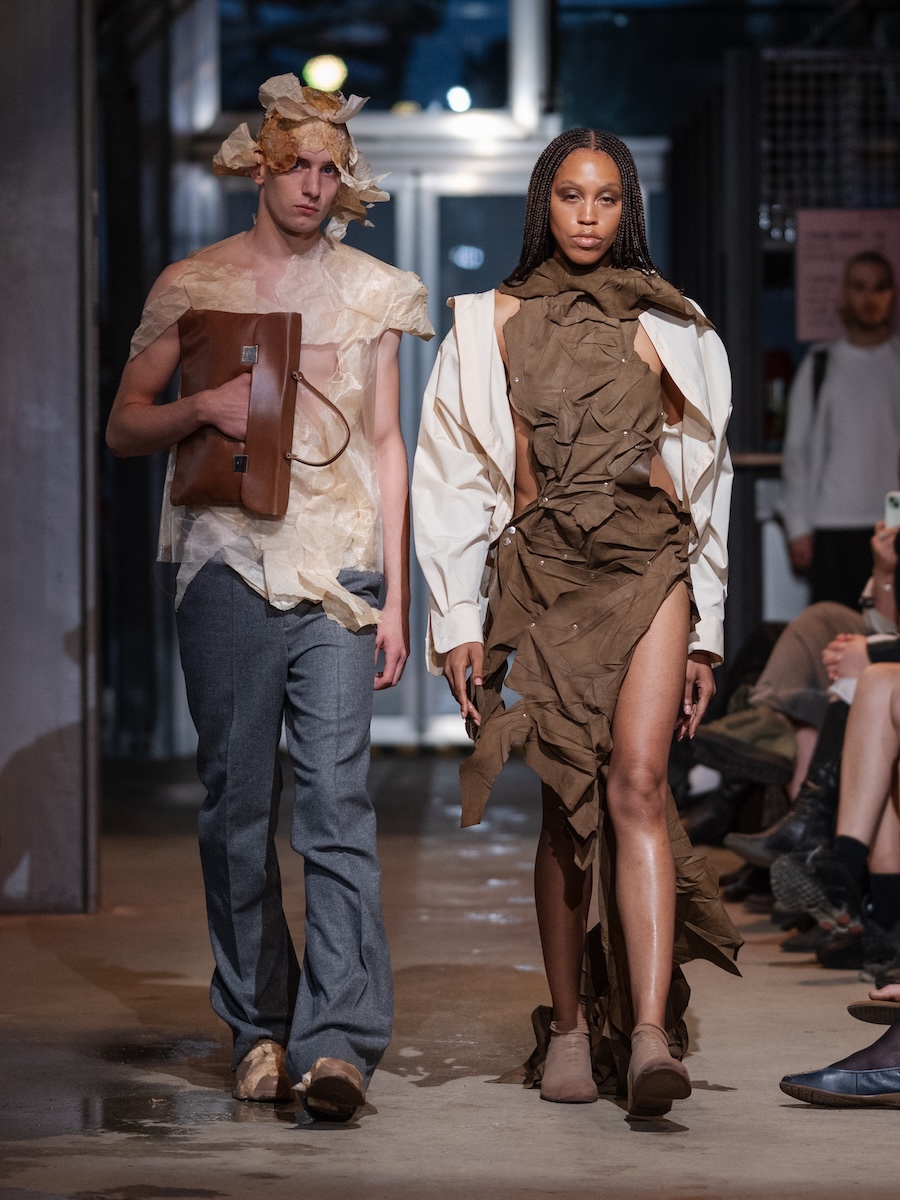
Your collection showcases a balance between conceptual thinking and technical craftsmanship. How did you navigate the space between free experimentation and practical execution?
At the beginning of my design process, I try not to limit myself too much. That’s often when the most unexpected ideas and silhouettes emerge, even if they seem almost impossible to realise at first. Step by step, I begin translating those ideas into sketches and material research, gradually breaking them down into something more tangible. I try to carefully plan the parts of the process that I can control—the technical and craft-based side of making—so that later I have enough time and space to respond to the things I can’t control, especially the material itself.
Seeing your work transition from the studio into the specific architecture and energy of yesterday’s show at ZK/U, how did that moment feel, and did it change how you view your own pieces?
One thing that never stops fascinating me is how much an object can change once it’s on a human body. When someone wears one of my pieces, it almost feels like a handover. I’ve created the foundation, but I’m letting go of the part that matters most—the part that’s no longer under my control. I love that idea of spontaneity after such a long and carefully considered process. The garment only really becomes complete when someone else brings it to life in their own way.
What kind of dialogue or emotional reaction do you hope to trigger in the person viewing or wearing your garments?
What I really enjoy is playing with contrasts. To create a reaction in the wearer or the person observing the piece, I believe there always needs to be an element that feels familiar—something they can personally connect with. That’s why I often try to include elements, or at least basic ideas, that are easy to understand and that can trigger memories or personal associations. I then combine these with a counterpart, such as a material that is difficult to categorise or a silhouette that distorts the shape of the body. This contrast creates a sense of curiosity and invites questions.
I like it when my designs don’t necessarily need to be understood completely, but instead create a feeling—something that, like the idea behind the work itself, might not be easy to define.
Now that the graduate show is behind you, what aspects of your creative practice or design philosophy are you most excited to explore next?
I’m very interested in expanding my knowledge in the fields of performance and scenography. Since movement is such an important part of my work, I would like to think beyond the body itself and explore its relationship with the surrounding space. I would find it very exciting to develop a project based on working closely with a performer, creating something in the form of codependency where the garment, the body, the movement, and the space influence and shape each other.
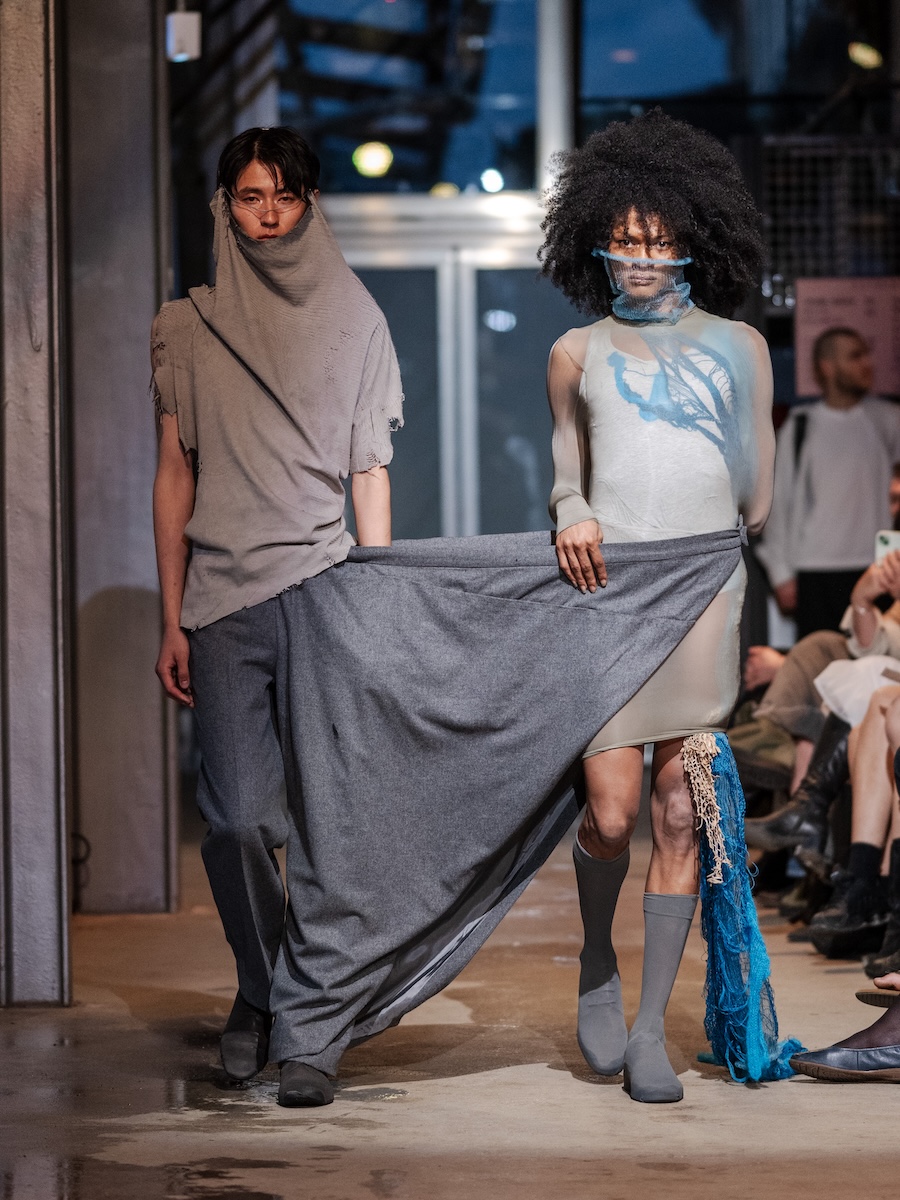
If your collection or creative identity could be translated into an ice cream flavour, what would it be and why?
I think it would be Mint – Chocolate. A kind of misunderstood flavour. Chocolate is a classic, kind of everyone likes it, but mint does not really speak to a lot of people. This idea of combining things that feel unfamiliar with warm associations is an idea that translates well into the concept of the collection.
Photographer: Anita Schulte-Bunert @nit.sb
Knit Design: @three_forms_of_the_light
Latex Bag: Anna Stüdeli, @Anna.stuedeli
With Help from Sayo Mogi & Fabienne Peranovic
CREATIVE & MOVEMENT DIRECTORS
Sarah Ama Duah @sarah_ama_duah
Madlen Schmid
PRODUCTION DIRECTORS
Doreen Schulz
Madeleine Madej
CASTING DIRECTOR
Madlen Schmid
STYLIST
Tabassom Charaf @tabicharaf
MAKE-UP ARTISTS
Head of Make-Up Artists: Feride Uslu @feride_uslu11 für airbeauty.com @ferideairbeauty
Dominika Obacz @dominica_obacz
Mert Kenger @mertkenger
Sarah Elisa Fischer
Sarah Ort
HAIR ARTISTS
Nicole Puzalowski
Béanne Da Costa @hairtouchedby
Jennifer Ohia @mmynd.irl @5.minah
Special thanks to our partners
Bezirksamt Mitte
ZK/U Zentrum für Kunst und Urbanistik @zku.berlin
Objets Trouvés Möbelmanufaktur @objets.trouves.berlin
uns* Model Agency @wirsinduns
VIVA Model Agency @vivamodelsberlin
The event is supported by the Economic Development Office of Berlin’s Mitte District Council in cooperation with PLATTE.Berlin, which is responsible for guest management and PR @platte.berlin
